

Best Eventbrite Alternative: Top Picks for 2026
 Written byAshish ChandraLast updatedJuly 1, 2026
Key Takeaways: An Eventbrite alternative is any ticketing platform that offers better pricing control, branding, or payout flexibility than Eventbrite. Eventbrite's fees are typically 3.7% + $1.79 per ticket, plus 2.9% payment processing, resulting in an effective fee rate of roughly 10–15% on many paid events. Some of the top alternatives in 2026 include Ticket Generator , Ticket Tailor, Cvent, and Humanitix, each designed for different event sizes and use cases. Ticket Generator uses a commission-free, credit-based pricing model, with payments sent directly to your own Stripe, PayPal, or Razorpay account. The best platform for you depends on your event size, fee tolerance, and the level of branding control you need.
Did you know that service fees can add 20% to 45% to the face value of an event ticket? Source: U.S. Government Accountability Office, Event Ticket Sales report.
That number is why "Eventbrite alternative" has become one of the most-searched ticketing queries on the web.
Eventbrite still hosts millions of events worldwide, but its 2026 fee structure, i.e., 3.7% + $1.79 per ticket plus 2.9% payment processing in the US, pushes effective fees well into double digits on most paid tickets.
I’ve talked to enough organizers who've moved off Eventbrite, and the same sentence shows up: "I was paying for something I didn't need."
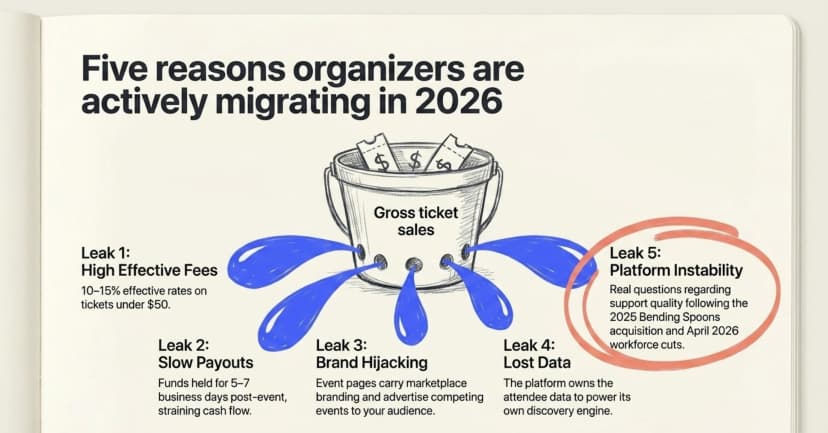
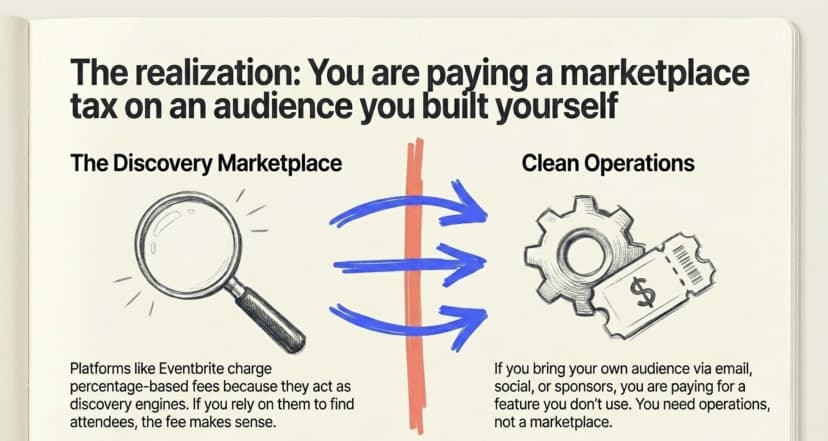
For most of them, the something is the discovery marketplace. They already had their audience through email lists, social media, sponsors, or a sales team.
What they actually needed was clean ticketing operations: predictable fees, payouts that didn't wait 5 days, branded pages that didn't carry someone else's logo, and a check-in app that worked on the first scan.
Eventbrite's percentage-based fees were a tax on a feature they weren't really using. Also, after Eventbrite's 2025 acquisition by Bending Spoons and the workforce cuts that followed in April 2026, more organizers are quietly evaluating backup options.
An Eventbrite alternative is any reliable ticketing or registration platform that gives organizers better pricing, faster payouts, more branding control, or stronger data ownership than Eventbrite.
Some win on cost. Others win on enterprise features. A very few, like Ticket Generator, replace Eventbrite's per-sale commission model with predictable per-ticket pricing and a payment gateway you actually own, all while offering all the features (no gatekeeping).
In this guide, I’ll explain why organizers are switching, what to look for in a replacement, and the top platforms competing with Eventbrite this year. I’ll also compare features side by side and show which platform fits each type of event.
Let’s begin!
Why are organizers leaving Eventbrite in 2026?
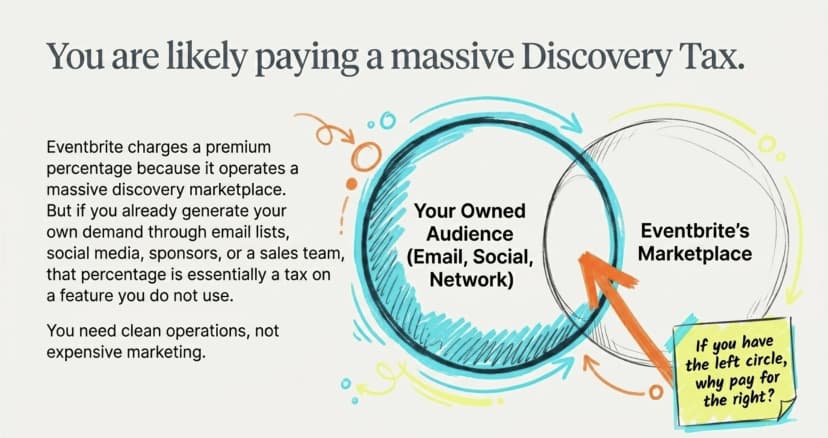
Organizers are leaving Eventbrite because of high cumulative fees, delayed payouts, limited branding, and uncertainty after the platform's acquisition.
The pain points are practical, not philosophical. They hit margins, cash flow, and brand experience directly.
Here are the most common reasons organizers seek a switch:
1. High effective fees. Eventbrite's US service fee of 3.7% + $1.79 per ticket, combined with 2.9% payment processing, lands around 10–15% on tickets under $50. On a $25 ticket, you keep roughly $21.55 after fees
2. Slow payouts. Funds are typically held for 5–7 business days after the event, which strains cash flow for back-to-back programming.
3. Limited branding control. Event pages carry Eventbrite branding, and the marketplace can surface competing events to your audience.
4. Data ownership concerns. Eventbrite uses attendee data to power its own discovery and marketing features. You don’t own the event attendee data; the platform does.
5. Platform instability. Eventbrite was acquired by Bending Spoons in 2025, and a wave of staff cuts in April 2026 raised real questions about support quality and product direction.
Did You Know? 39% of online shoppers abandon a purchase because of extra costs added at checkout. Hidden fees and surprise charges remain one of the biggest conversion killers in online transactions. Source: Baymard Institute .
That data point matters. When Eventbrite's service fee appears at checkout, buyers see sticker shock and a big portion of them walk away.
Switching to a platform with cleaner pricing isn't only about saving money; it's about not losing the sale in the first place. (I cover this in more depth in our guide to no-fee ticketing and selling tickets without a service charge.)
What should you look for in a new ticketing platform?
The best Eventbrite replacement is the one that matches your event type, fee tolerance, and brand requirements. A nonprofit charity gala needs something very different from a high-volume corporate conference series.
Evaluate any platform against these criteria:
1. Fee model. Some charge a percentage like Eventbrite. Others use a flat per-ticket fee. A few, like Ticket Generator, use credit-based pricing where you pay per ticket generated, regardless of ticket value. Plus, the credits you buy never expire. That predictable pricing goes a long way.
2. Payment processing. Does the platform use its own gateway, or does payment route through your Stripe, PayPal, or Razorpay account? Direct gateways mean instant settlement and no platform-controlled holds.
3. Branding control. Can you publish event pages without platform watermarks? Can you use your own domain? Do tickets carry your logo or theirs?
4. Data ownership. Who owns the attendee list? Can the platform use your data to promote other events to your audience?
5. Validation and check-in. Is there a free mobile scanner? Does it handle duplicates, multi-gate events, and re-entry?
6. Scale fit. Some platforms are built for under-100-person community events. Others are designed for 10,000-plus conferences. Ideally, the platform should fall somewhere in between.
7. Support and stability. Especially after the recent shake-ups in the ticketing space, look for platforms with stable ownership and responsive support.
Pro Tip: Run a quick "$50 ticket × 500 attendees" calculation against every platform you're considering. Multiply the total ticket revenue by the platform's effective fee percentage to see the real cost. The gap between a 3% fee and a 10% effective fee is often worth thousands of dollars per event. Ticket Generator's credit-based pricing removes percentage commissions entirely, so your costs stay predictable even as ticket prices increase.
What are the best Eventbrite alternatives in 2026?
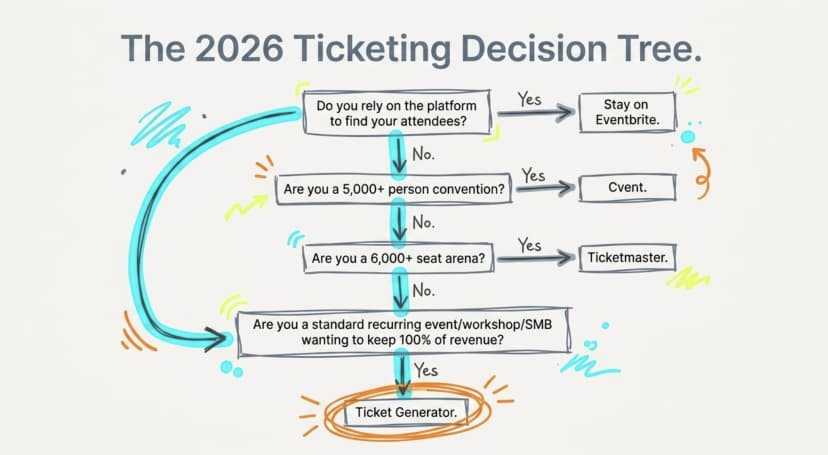
The top three Eventbrite alternatives in 2026 are Ticket Generator, Ticket Tailor, and Cvent. But at the same time, it's also important to note that each platform serves a different niche, so, there is no single "best" replacement.
Here is how the major options compare on the factors that matter most:
|
Platform |
Fee Model |
Payouts |
Best For |
|---|---|---|---|
|
Eventbrite |
3.7% + $1.79 + 2.9% processing |
5–7 days post-event |
Discovery-driven public events |
|
Ticket Generator |
Credit-based (as low as $0.06/ticket); zero commission |
Instant, your own gateway |
Branded, recurring, or secure events |
|
Ticket Tailor |
~$1 + 1.4% per ticket |
Direct via Stripe / PayPal |
UK community and small business events |
|
Ticketmaster |
Venue-set service + convenience fees (~19% to buyer) |
Per venue contract |
Large arenas and tour events |
|
TicketSpice |
$0.99 per ticket + 2.9% + $0.30 processing |
Weekly |
Attractions, venues, recurring events |
|
Cvent |
Enterprise contract pricing |
Direct |
Large corporate conferences |
|
RSVPify |
1.95% + $0.90 per ticket + Stripe processing |
Direct via Stripe |
RSVPs, weddings, corporate guest lists |
|
Humanitix |
~1.99% + $0.99 (100% of profit to charity) |
Direct |
Nonprofits and education |
Now let's look at each in more depth.
1. Ticket Generator

Best for: Organizers who want commission-free pricing, full branding control, and instant settlement to their own payment gateway.
Ticket Generator uses a credit-based pricing model which means you pay per ticket generated, not per sale. Credit packs start at 10 credits for $6 and scale down to as low as $0.06 per ticket at the 10,000-pack tier, with a 30% discount for verified nonprofits. There is zero commission on ticket sales, because payments route directly through your own Stripe, PayPal, or Razorpay account.
Beyond pricing, the platform is built for organizers who already have an audience and don't need a discovery marketplace. Tickets carry your branding (no watermarks). Event pages can run on your own custom domain. Guests can pick their preferred seating through the seat booking feature. Attendee data stays yours.
The platform has powered 30,000+ events and 1,000,000+ tickets across 100+ countries, with clients including Deloitte, Verizon, the Emmy Awards, UNHCR, and the University of Southampton. It is ISO 27001:2022 certified, GDPR-compliant, and SOC 2-aligned.
- Pros: Zero commission. Predictable per-ticket costs. Credits don’t expire. Own payment gateway. Full white-label branding. Free mobile QR ticket validation with duplicate detection. Interactive reserved seating plan feature.
- Cons: No public discovery marketplace (this is intentional, the platform works on a brand-first model).
2. Ticket Tailor

Best for: Small UK and European event organizers who want simple, flat-fee pricing.
Ticket Tailor charges roughly $1 + 1.4% per paid ticket on its standard plan, with cheaper prepaid booking-fee packs available. The platform integrates with Stripe and PayPal so payouts go directly to organizers, and it offers a free mobile check-in app.
Ticket Tailor has built a strong reputation for simplicity and customer support, particularly in the UK community-event space. It's a clear fit for organizers who want a leaner version of Eventbrite without rebuilding their entire workflow.
- Pros: Transparent flat-fee pricing. Strong UK support. Direct Stripe payouts.
- Cons: Limited advanced features for complex events.
3. TicketMaster
Best for: Arenas, stadiums, and large-scale concert or sports promoters operating under venue contracts.
Ticketmaster is the heavyweight in primary ticketing, but it's worth being clear about what kind of platform it actually is: a venue-contracted ticketing system, not a self-service product.
Organizer pricing isn't publicly disclosed which means fees are negotiated per venue, often as part of multi-year exclusivity deals.
Fan-facing service fees in 2026 typically run 12–15% of ticket face value plus per-ticket service charges, and the March 2026 DOJ settlement now caps service fees at 15% of face value alongside an all-in pricing requirement.
For a 200-person workshop, a 500-attendee conference, or a brand-led activation, Ticketmaster isn't really an option, it's not built for self-serve event creation in that segment. For 6,000-plus capacity venues running concerts, sports, or comedy tours, it's often the default and sometimes the only choice the venue offers.
- Pros: Industry standard for major venues. Strong fan trust. Advanced seat-mapping and dynamic pricing.
- Cons: Not self-service. Pricing is opaque and contract-negotiated. High buyer-facing fees. Limited organizer branding control.
Note: Live Nation Entertainment (and its subsidiary Ticketmaster) is currently facing an FTC antitrust lawsuit alleging monopolistic control over major concert venues and ticketing. The company has also faced legal setbacks in claims brought by dozens of U.S. states.
4. TicketSpice
Best for: Attractions, venues, and recurring events that want a flat, predictable per-ticket fee.
TicketSpice charges a flat $0.99 per paid ticket plus 2.9% + $0.30 credit card processing (with tickets under $5 dropping to $0.49).
There are no monthly fees, contracts, or setup costs, and payouts run weekly. The platform has been around for more than a decade and powers thousands of customers, including attractions, theaters, museums, and nonprofits.
Where TicketSpice stands out is feature depth at a flat-fee price. Branding control, timed ticketing, reserved seating, mobile scanning, merchandise sales, and a customizable page builder are all included.
For organizers running daily admissions or seasonal attractions, the flat $0.99 model gets significantly cheaper than Eventbrite's percentage as ticket prices rise.
- Pros: Flat $0.99 per ticket regardless of price. Strong page builder and branding controls. Reserved seating, timed entry, merchandise built in. US-based 7-day support.
- Cons: Weekly (not instant) payouts. Standard 2.9% + $0.30 processing still applies on top. AI features sit on more expensive tiers.
5. Cvent
Best for: Large enterprise conferences with complex registration, sourcing, and event marketing needs.
Cvent is the enterprise heavyweight in event management. It handles venue sourcing, abstract management, multi-track agendas, badge printing, and lead retrieval, well beyond what Eventbrite offers.
Pricing is custom and contract-based, typically starting in the tens of thousands of dollars annually.
If you're running a 5,000-person industry conference with sponsor booths and CME credits, Cvent is built for you. If you're running a 200-person workshop, it's overkill.
- Pros: Enterprise-grade feature depth. Strong analytics and reporting.
- Cons: Expensive. Long sales cycles. Steeper learning curve.
6. RSVPify
Best for: Weddings, galas, private parties, and corporate functions where guest-list management and RSVPs matter as much as ticket sales.
RSVPify started as an RSVP and guest-list tool, then grew into ticketed event support. The platform charges 1.95% + $0.90 per paid ticket with no subscription required (paid plans of $39–$409/month apply to non-ticketed events).
Stripe integration means payouts hit your bank account directly, typically every business day. The free tier covers events up to 100 guests, which makes it a popular pick for smaller, invite-driven gatherings.
Where RSVPify earns its place isn't ticketing depth, it's the registration side. Custom event websites, conditional logic for plus-ones and meal choices, document uploads, and well-designed invite flows are first-class features.
For a 200-person nonprofit gala with seated dinner and donor management, RSVPify is often a better fit than a pure ticketing platform.
- Pros: Strong RSVP and registration features. Direct Stripe payouts. Free for small events. Great for weddings, galas, and private events.
- Cons: Less suited to large public events. Some users report email deliverability and form-customization quirks.
7. Humanitix
Best for: Nonprofits, schools, and charity events.
Humanitix charges roughly 1.99% + $0.99 per ticket but donates 100% of its profits to children's education charities. That model has earned it a passionate nonprofit user base.
- Pros: Mission-aligned for nonprofits. Transparent pricing.
- Cons: Smaller feature set than enterprise alternatives.
Pro Tip: Why do most organizers end up choosing Ticket Generator ?
Each platform above is strong at one specific thing. Ticket Generator brings all of those capabilities together in one commission-free platform.
- Zero commission, credit-based pricing: As low as $0.06 per ticket. No subscription fees. Credits never expire. Includes a 30% nonprofit discount.
- Your own payment gateway: Connect Stripe, PayPal, or Razorpay. Funds settle instantly instead of waiting 5–7 days.
- Full event control: Interactive seat booking, multiple ticket categories, custom domains, white-label tickets, and multi-channel distribution via email, SMS, and WhatsApp.
- Secure QR validation: Free iOS and Android validator apps with duplicate detection and multi-gate scanning support.
- Enterprise-grade trust: ISO 27001:2022 certified, GDPR-compliant, and SOC 2 aligned. More than 1M+ tickets issued across 30,000+ events in 100+ countries, trusted by Deloitte, Verizon, the Emmy Awards, and UNHCR.
Get 10 free credits on signup with no credit card required → Try Ticket Generator free . Your event. Your revenue. Your rules.
How do Eventbrite and Ticket Generator compare directly?
Eventbrite and Ticket Generator solve different problems. Eventbrite is a discovery marketplace that takes a percentage of every sale.
Ticket Generator is an operational ticketing platform that charges per ticket generated and routes payments through your own gateway.
The clearest way to see the difference is side by side:
|
Factor |
Eventbrite |
Ticket Generator |
|---|---|---|
|
Pricing model |
3.7% + $1.79 per ticket + 2.9% processing |
Credit-based, as low as $0.06/ticket |
|
Commission on sales |
Yes |
None |
|
Payment gateway |
Eventbrite's |
Your own (Stripe, PayPal, Razorpay) |
|
Payout timing |
5–7 days post-event |
Instant — settled directly to your account |
|
Event page branding |
Eventbrite-branded |
Fully white-label, custom domain |
|
Data ownership |
Shared with Eventbrite |
100% organizer |
|
Discovery marketplace |
Yes (~30M users) |
No (by design) |
|
QR validation |
Paid scanner |
Free iOS + Android + web validator |
|
Compliance |
GDPR |
ISO 27001:2022, GDPR, SOC 2-aligned |
The simplest way to think about it: if your event depends on Eventbrite's marketplace to find attendees, stay there. If you already have your audience (through email, social, word of mouth, or sales) Eventbrite's fees are paying for a feature you're not really using.
Heartland Emmys, the regional chapter of the Television Academy, has used Ticket Generator across four consecutive years and 10+ events, generating 3,433+ tickets.
The team chose the platform specifically for the combination of branded ticket design, secure QR validation, and predictable per-ticket pricing; the exact gap a discovery-led platform like Eventbrite doesn't address.
Every Ticket Generator ticket carries both a unique QR Code and a unique Ticket ID to prevent duplication or fraud, and the platform is ISO 27001:2022 certified, GDPR-compliant, and SOC 2-aligned.
In short, Ticket Generator is the right replacement for organizers who don't need a marketplace, they need clean operations, full branding, and revenue that stays in their account.
Which platform is right for your event?
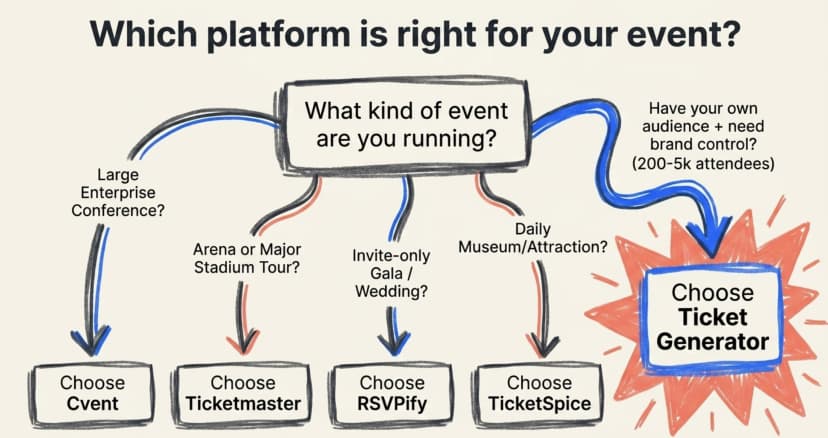
Choose based on the size, type, and brand sensitivity of your event. Here is a quick decision guide:
- Branded recurring events (workshops, training, member events, anything between 200-5,000 attendees) → Ticket Generator. Predictable pricing, your own gateway, no Eventbrite branding on tickets or pages.
- Small UK community events → Ticket Tailor. Simple, lean, well-supported.
- Theater, museum, or attraction with daily ticketing → TicketSpice. Flat $0.99 per ticket and venue-ready features built in.
- Wedding, gala, or invite-driven corporate function → RSVPify. Guest-list logic and RSVP flow beat pure ticketing here.
- Charity gala, school fundraiser, or nonprofit event → Humanitix. Mission-aligned, with 100% of profit going to children's education.
- 5,000+ person enterprise conference → Cvent. Feature depth matters more than fee percentage at this scale.
- Arena, stadium, or large concert/sports tour → Ticketmaster. The default for 6,000+ capacity venues, even with the buyer fees attached.
Conclusion
The ticketing landscape in 2026 is healthier than it has ever been. Organizers have real choices across pricing models, feature depth, and event types.
Fees, payout speed, branding, and data ownership are no longer trade-offs you have to accept; they're decisions you can make.
Eventbrite still has the discovery marketplace, and for some organizers, that's worth the fees. For everyone else (agencies, corporate teams, schools, nonprofits, and venues) there is now a better-fit option. Ticket Generator is one of them, especially for organizers who already have their audience and want to stop paying for a marketplace they don't really use.
Try Ticket Generator to keep 100% of your ticket revenue, brand every event page and ticket as your own, and validate entries from any smartphone. Your event. Your revenue. Your rules.
FAQs: Eventbrite Alternative
1. What is the best Eventbrite alternative in 2026?
The best alternative depends on your event type. Ticket Generator is the strongest fit for organizers who want commission-free pricing and full brand control. Ticket Tailor suits small UK community events, Cvent fits large enterprise conferences.
2. Is there a cheaper alternative to Eventbrite?
Yes. Several platforms charge less than Eventbrite's 3.7% + $1.79 per ticket plus 2.9% processing. Ticket Generator's credit-based pricing can drop to $0.06 per ticket at higher volumes. Ticket Tailor, and Humanitix also offer lower effective rates than Eventbrite on most ticket prices.
3. Why are people leaving Eventbrite?
Organizers are leaving Eventbrite mainly because of high cumulative fees (often 10–15% effective), payout delays of 5–7 days, limited branding control, and uncertainty after the platform's 2025 acquisition by Bending Spoons. The April 2026 staff cuts at Eventbrite added support-quality concerns to that list.
4. Can I switch from Eventbrite without losing my attendees?
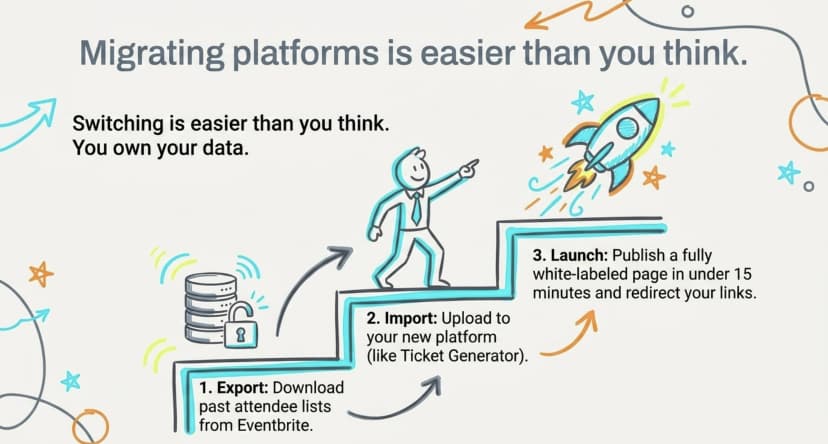
Yes. Your attendee data belongs to you, export your past lists from Eventbrite, import them into your new platform, and redirect your existing event links. Most modern alternatives, including Ticket Generator, let you publish a fully branded event page in under 15 minutes.
5. Does Ticket Generator charge commission on ticket sales?
No. Ticket Generator does not charge any commission on ticket sales. Payments route directly through your own Stripe, PayPal, or Razorpay account and settle instantly. You only pay per ticket generated, using credits purchased in advance.
About the author
Content Marketer at Ticket Generator
Ashish Chandra has spent 5+ years writing about event technology, covering topics such as ticket design, QR check-ins, attendee management, and event marketing strategy. As the Content Lead at Ticket Generator, Ashish has analyzed hundreds of real-world event workflows and ticketing setups, helping organizers across industries use QR-based tickets, event landing pages, and smarter ticketing systems to run smoother, better-attended events. His writing is shaped by real user needs and the questions organizers ask most often: How do I sell more tickets? How do I avoid chaos at the door? How do I make my next event better than my last? When he steps away from the screen, you'll likely find him hiking a quiet trail or tending his plants- his preferred way to reset.
Latest posts
Check out our latest articles on the blog
 12 min read
Email Marketing for Events and Webinars: What to Send, When to Send It, and How to Automate It
A step-by-step playbook for email marketing for events and webinars. Learn what to send, when to send it, and how to automate every email for in person and virtual events.
Ashish Chandra
18 Oct 2026
 10 min read
Halloween Masquerade Ball: How to Host a Night of Masks and Mystery
From Venetian-inspired masks to QR-coded entry, here is your complete guide to planning a Halloween masquerade ball your guests will talk about for years.
Ashish Chandra
18 Oct 2026
 9 min read
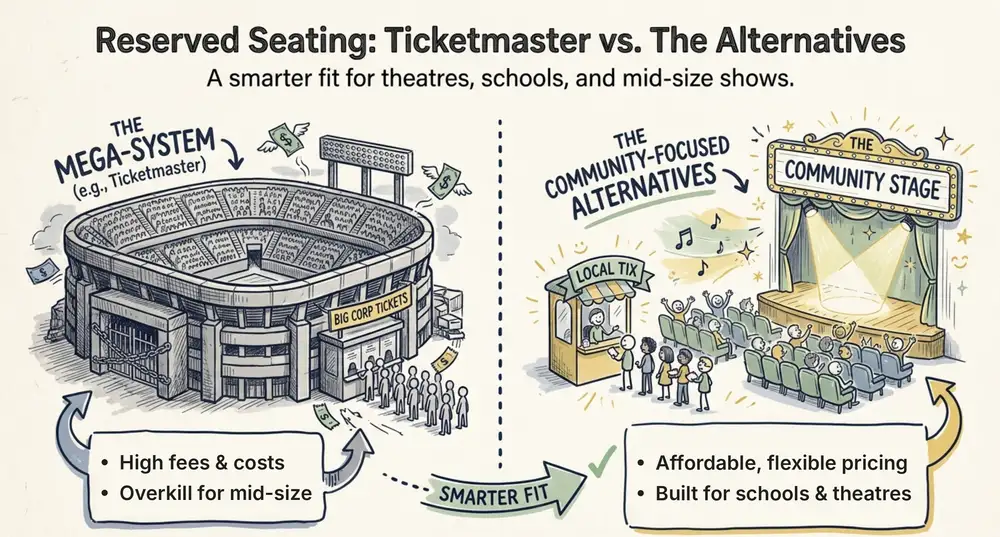
Ticketmaster Reserved Seating: How It Works and a Better Fit for Smaller Events
Ticketmaster reserved seating works well for arenas. If you run a theatre, gala, or mid-size show, see how it works, what it costs, and how to switch.
Ashish Chandra
16 Oct 2026