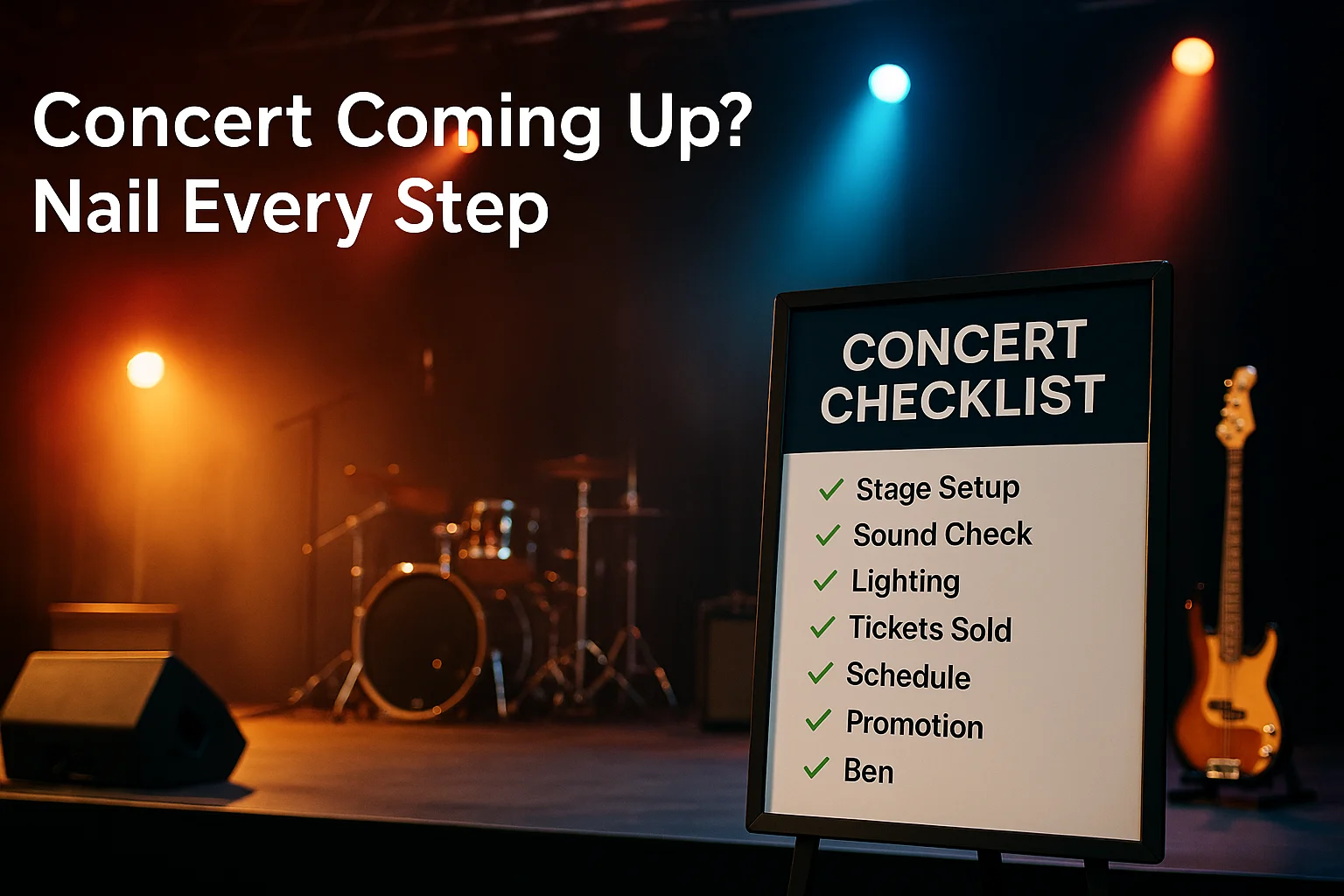
Learning how to plan a concert comes down to five fixed moves: define the goal, lock the venue, secure permits and artists, build a ticketing and security plan, and run a tightly managed production day.
The venue determines almost everything else. Sound restrictions, permit complexity, attendee capacity, and production costs vary dramatically between banquet halls, beaches, rooftops, and outdoor spaces.
Permits, processing fees, and security staffing destroy more concert budgets than artist fees in many cases.
Ticketing should be commission-free, QR-validated, and mobile-first.
Ticket Generator
handles all three without taking a cut of your revenue.
This guide includes 10+ venue-specific tutorials using one repeatable planning framework that works across indoor and outdoor concerts, formal venues, and casual event spaces.
If you are figuring out how to plan a concert, the hardest part is not the music. It is everything around it, the venue contract, the noise permit, the sound check that runs 40 minutes late, and the ticketing system that crashes when the headliner gets announced.
Did You Know? The global online event ticketing market is projected to reach $102.79 billion by 2030. Source:
Mordor Intelligence
(2024).
A concert is a live musical performance that brings a defined audience into one space at one time. To plan one well, you fix five things in order: the goal, the venue, the artists and permits, the ticketing and security plan, and the production day itself. Get those five right and the rest is execution.
In this guide, I'll walk you through the full planning process, breaks down venue-specific playbooks for 10 common concert spaces (banquet halls, community centers, conference centers, gardens, hotels, museums, parks, restaurants, rooftops, and beaches), and covers stage setup, permits, ticketing, and security.
Whether you are planning a 200-person acoustic night at a restaurant or a 5,000-person rooftop EDM show, the playbook below is the one to keep open in another tab.
Let's get right into it.
Who actually organizes a concert?
A concert is organized by a concert promoter (or the in-house events team of a venue, agency, or label) who owns the full P&L of the show. They are the person whose phone rings when anything goes wrong.
A promoter's day-to-day responsibilities typically include:
Booking artists: Negotiating fees, riders, and contracts, usually through the artist's agent or manager
Locking the venue: Comparing capacity, sound limits, dates, and rental costs
Managing the budget: Keeping a contingency reserve of at least 10-15% of total spend
Driving marketing and ticket sales: Paid social, email, partnerships, and PR
Running the show day: Coordinating load-in, sound check, doors, set times, load-out
On smaller shows, one or two people wear all of these hats. On larger productions, each function gets a dedicated owner. Either way, the role is operational, not creative, your job is to make sure the artist can do theirs.
What does the end-to-end concert planning process look like?
The end-to-end process for planning a concert runs across 11 steps, ideally started 3-6 months before the show date (6+ months for shows over 1,000 attendees).
1. Set the goal and define the format
Before anything else, write down what the event is actually for. Promote an album? Raise money for a cause? Fill a brand activation? The goal determines budget tolerance, artist selection, and venue type.
2. Choose a venue (the decision that shapes everything else)
Match the venue to your audience size, music genre, and noise tolerance of the surrounding area. See Section C and D for a full breakdown.
3. Lock the date
Pick a date that doesn't clash with major sports finals, religious holidays, or competing concerts in the same city. Friday and Saturday evenings draw the highest attendance for paid events; Sundays work for daytime family shows.
4. Build the budget
Use this rough split as a starting point for a paid concert:
Cost line
Typical share of budget
Artist fees + rider
30–45%
Venue rental + insurance
15–25%
Sound, lights, staging
15–20%
Marketing + ticketing tech
8–12%
Security, permits, staff
8–12%
Contingency
10–15%
Maintain the contingency fund untouched. Weather, equipment, and last-minute artist demands eat into it every single show.
5. Pull permits and licenses early
Standard permits include a noise permit, event permit, music/PRO license (BMI, ASCAP, PRS, or equivalent), liquor license if serving alcohol, fire-safety clearance, and a street-closure permit for outdoor city events. Start applications at least 60 days before show day. Pyrotechnic displays often need a separate clearance with a 90+ day window.
6. Book the talent
Sign artists in writing, never on a handshake. Spell out fee, payment schedule, set length, rider, soundcheck slot, and cancellation terms. For tours, Sam Cook-Parrott of the band Radiator Hospital has been honest about the financial reality: many bands skip meals on the road because eating out daily is unaffordable. Build the rider with that reality in mind.
7. Sort logistics and production
Sound system, lighting rig, stage, backline, generators (outdoors), barricades, comms radios for crew. Confirm everything two weeks before the show. Have a backup plan for every piece of critical equipment.
8. Build the marketing plan
Use a layered approach: tease three weeks out, paid social and influencer push two weeks out, retargeting and email reminders in the final 72 hours. The mobile segment held 55% revenue share in online event ticketing in 2023 (Global News Wire), so optimize landing pages for mobile first.
9. Open ticketing and set prices
Set up your registration page with clear pricing, early bird discounts, and grouped categories (General, VIP, Early Bird, Comp). Use commission-free ticketing so your face-value price stays clean, buyers abandon when fees jump at checkout.
Budget for 1 security staff per 75-100 attendees for standard concerts, and 1:50 for high-energy or alcohol-served events. Add ticketing crew, ushers, medical first-responders, and a designated incident lead.
11. Run the day
A typical concert run-of-show: crew call → load-in → stage build → sound check → doors open → opening act (30-45 min) → headliner → encore → load-out. Build a written schedule and stick to it. The fastest way to lose a venue's goodwill is to overrun load-out.
Set Up Event Ticketing and Distribution in Minutes!
First 10 tickets free | Free account | No credit card required
Below is the venue-specific playbook for the 10 most common concert spaces. Each section covers the use case, the constraints, and the production setup specific to that venue type.
1. How to plan a concert in a banquet hall: Seated concerts, 100-500 people
A banquet hall works best for seated concerts of 100-500 people, acoustic showcases, corporate music nights, fundraiser galas, classical and jazz performances.
Key considerations:
Acoustics first. Banquet halls are built for speech and dining, not music. Carpets and tablecloths absorb sound; bare drywall causes flutter echoes. Plan to bring in acoustic panels or hire a sound engineer who has worked the room before.
Stage placement. Place the stage on the long wall, not the short wall, for better sightlines. A 12-ft × 16-ft riser handles 4-6 musicians comfortably.
Catering and bar. Halls usually require in-house F&B. Negotiate the minimum spend up front and lock the bar package separately from food.
Power. Confirm at least 30 amps of dedicated circuit for backline. Old halls often share circuits with kitchen equipment, a coffee machine can drop your PA mid-show.
2. How to plan a concert in a community center: Low-cost, family-friendly shows
A community center works for family-friendly, neighborhood, and nonprofit concerts of 50-300 people, open mics, school music nights, charity shows, faith-community events.
Key considerations:
Low rental cost, high constraint trade-off. Community centers are cheap (often under $500 / local-currency equivalent for an evening) but come with stricter end-times, often a 10 PM curfew, and limited bar/alcohol options.
Bring everything in. Most community centers don't have a permanent stage, PA, or lighting rig. Budget for a full rental package, typically $1,500-$3,500 for a small concert setup.
Volunteer-led staffing. Many community centers expect you to provide your own volunteers for ticket-checking and ushering. A QR-based digital ticket simplifies this dramatically.
Accessibility check. Older community buildings sometimes lack wheelchair ramps or ADA-compliant restrooms. Inspect before booking.
Best fit: youth music programs, faith-community concerts, fundraiser shows, hyperlocal artist showcases.
3. How to plan a concert in a cvonference center: Mid-size ticketed concerts
A conference center handles mid-sized concerts of 300-2,000 people like corporate retreats, ticketed industry-event concerts, association galas with live music components.
Key considerations:
Built-in AV is your friend. Conference centers usually come with house audio, projectors, and a tech crew. Confirm what's included in the rental versus what's billed à la carte.
Watch the F&B minimum. Conference venues often require minimum food-and-beverage spend that can exceed the room rental itself. Negotiate package deals.
Configurable space. Most centers offer pipe-and-drape and modular staging, so you can size the room down for a 400-person show or scale up for 1,500.
Loading dock access. Conference centers handle truck load-in much better than hotels or banquet halls. Confirm dock hour, many don't allow load-in before 6 AM.
Best fit: corporate event concerts, ticketed industry galas, conference after-parties, ticketed keynote-plus-performance hybrids.
4. How to plan a concert in a garden: Boutique outdoor concerts
A garden (botanical, public, or private estate) works for boutique outdoor concerts of 100-500 people, especially acoustic, classical, folk, and jazz formats.
Key considerations:
Permits and protected-plant rules. Many botanical gardens have strict rules on stage anchoring, foot traffic flow, and amplification. Confirm in writing before signing.
Weather backup is mandatory. Have a tent option, a rescheduling clause in your ticketing terms, or a sister indoor venue on standby.
Sound engineering changes outdoors. No walls means no reflections, you need line array PAs angled at the seated audience, not standard PA stacks.
Pathway lighting. Most gardens close before sunset. If your show runs into the evening, budget for path lighting and emergency lighting.
Best fit: classical concerts in the round, jazz brunches, acoustic singer-songwriter sets, brand-experience concerts.
5. How to plan a concert in a Hotel: Ballrooms, rooftops, and AV packages
A hotel ballroom or rooftop bar handles concerts of 100-800 people with the advantage of on-site accommodation, catering, and parking (useful for corporate, destination, or weekend-anchored events).
Key considerations:
Negotiate the AV package. Hotel in-house AV teams charge a premium. Get quotes from outside vendors; many hotels will price-match or waive the "outside vendor" fee for paid concerts.
Room blocks unlock leverage. Booking a guest-room block alongside the venue typically gets you a discounted rental rate. Use this for destination events.
Noise curfews are non-negotiable. Most hotels enforce a hard 11 PM or midnight stop. Build the set list around it.
Branding restrictions. Hotels often limit signage and brand activations. Confirm before designing your stage backdrop.
Best fit: destination concerts, corporate music nights, wedding-week shows, brand-sponsored intimate performances.
6. How to plan a concert in a museums: Cultural and chamber concerts
A museum or gallery hosts boutique cultural concerts of 50-300 people, chamber music, jazz, contemporary classical, multi-disciplinary art-and-music shows.
Key considerations:
Collection protection is the headline constraint. Most museums limit dB levels to 85-90 dB and prohibit pyro, smoke machines, and unanchored staging anywhere near artworks.
Capacity is set by fire code, not floor space. Galleries often look bigger than their capacity allows. Ask for the official occupancy certificate.
Programming alignment. Concerts in museums work best when the music matches the exhibition. A chamber quartet under a Renaissance exhibit lands. A blues band in a contemporary minimalist space looks accidental.
Late-night options. Most museums offer "after-hours" rental slots from 6 PM to 10 PM. This is when the venue is yours.
Best fit: high-end private events, cultural fundraisers, classical/jazz programming, branded experiences targeting affluent audiences.
7. How to plan a concert in a park: Large-format and free community concerts
A public park accommodates concerts of 500-50,000+ people, free community shows, ticketed festival-style events, summer concert series.
Key considerations:
Permits are layered. You typically need a park use permit + noise permit + food vendor licenses + (often) a road closure or transport plan. Add a 90-day lead time.
Generator and power. Parks rarely have stage-grade power. Plan for dual diesel generators with phase-load balancing, plus a smaller backup for FOH (front-of-house mixing position).
Crowd management. Parks have multiple entry points. Use barricaded entry lanes with QR scanning at each gate to track capacity in real time.
Sanitation. One portable restroom per 75-100 attendees, refreshed every 3-4 hours for multi-day events.
Best fit: free community concerts, ticketed park festivals, summer concert series, brand-sponsored public events.
8. How to plan a concert in a restaurants: Dinner-and-show formats
A restaurant hosts intimate live-music concerts of 30-150 people, acoustic singer-songwriters, jazz trios, brunch sets, dinner-and-show formats.
Key considerations:
Revenue model is hybrid. Most restaurants run live music as a draw for F&B revenue, not as a paid ticketed event. Decide whether you're charging cover, ticketing the seats, or running a minimum-spend model.
PA size matters. A 30-seat room with a 4,000-watt PA is comically loud. Match speaker rating to room volume.
Service noise is the enemy. Coordinate with the kitchen to pause noisy prep during sets. Stagger food service around the performance arc.
Tip-jar etiquette. If the artist is performing for a smaller flat fee, set up a clearly-marked tip jar or digital tipping QR.
Best fit: dinner-and-show concept nights, brunch jazz residencies, singer-songwriter circuits, listening-room style shows.
9. How to plan a concert on rfooftops: DJ sets and lifestyle concerts
A rooftop venue suits boutique, energetic concerts of 100-800 people — DJ sets, indie band showcases, brand activations, summer cocktail-party concerts.
Key considerations:
Structural load limits. Confirm the rooftop's load rating. Staging, lighting truss, and a crowd of 500 add real weight. Get the structural engineer's sign-off in writing.
Wind affects everything. Banners, lightweight equipment, and even mic stands move on a rooftop. Use weighted bases everywhere.
Noise enforcement is aggressive in dense areas. Most cities now have smartphone-based noise complaint apps, a single neighbor can shut you down. Bring a dB meter and brief the FOH engineer on local limits.
Single-entry choke point. Most rooftops have one elevator or stairwell. Budget for slower load-in and stagger crowd entry to avoid a bottleneck.
Best fit: DJ nights, brand-sponsored summer parties, indie band launches, ticketed sunset shows.
10. How to plan a concert on a beach: fFestival-style and lifestyle events
A beach concert works for lifestyle, festival-style, and sunset events of 200-10,000+ people, DJ sets, summer music festivals, branded lifestyle events.
Key considerations:
Permits are the highest hurdle. Most coastlines require permits from a parks authority, the municipal body, and sometimes coast guard or environmental agencies. Start the permit process at least 4 months out.
Sand and equipment are enemies. Build raised flooring under stage, FOH, and high-traffic areas. Cover cabling with weatherproof matting.
Tides set your timeline. Confirm high tide and low tide times for your event date. Build the stage above the high-water mark with a meaningful safety margin.
Wind and salt corrosion. Tape every cable connection. Have backup mics, cables, and a covered FOH position.
Lifeguards and water safety. If swimming is even tangentially possible, hire certified lifeguards. Liability insurance for beach events is typically higher than for any other format.
Best fit: lifestyle and brand-activation concerts, summer DJ events, festival circuits, destination weddings with live music.
How long does a concert last for?
A concert's length can vary depending on the type of event and the artists performing in it.
Short sets can last for 20-30 minutes
Concerts by a well-known group can last a couple of hours
If multiple artists are performing, a concert can last an entire evening
However, there are no rules.
Billie Eilish's tour concerts are expected to last no more than 120 minutes
On dates where Taylor performs the full Eras Tour, the concert is 3 hours and 15 minutes long However, in some cases, the concerts have lasted as long as 3 hours and 45 minutes.
How do you set up the stage, sound, and lighting?
The production setup follows the same logic at any venue: build the stage so the artist can perform safely, set up sound so every seat hears clearly, and use lighting to shape attention.
1. Stage build
Use a modular riser system sized to the band — 4 ft × 8 ft sections, set at 24-32 inches high for visibility.
Allow at least 8 feet of upstage clearance for performers to move and switch instruments.
Mark dangerous edges with hazard tape and ensure stairs have handrails.
2. Sound system
Use a left-right PA configuration for rooms under 300 capacity. Above that, add front-fills and delay speakers.
Position monitor wedges so every performer can hear themselves without cranking the mains.
Run a full sound check 90 minutes before doors, not 30.
3. Lighting
Three lighting zones at minimum: stage wash, front spot, and back rim light. This is the difference between a venue that looks ready and one that looks rehearsed.
For outdoor events, add weather-rated moving heads and a programmable scene to follow the set.
Brief the lighting tech with a written cue sheet — verbal direction during the show fails.
4. Backstage
A dedicated, secured area with green room amenities: water, towels, snacks, mirrors, and a usable bathroom.
Power outlets for tuning, charging, and hair-and-makeup if applicable.
A clear path from backstage to the stage that doesn't cross the audience.
How do permits, security, and ticketing work?
These three are the operational backbone of every concert. Skip or under-staff any of them and the show suffers, usually publicly.
1. Permits
Required at most concerts (varies by jurisdiction):
Permit
Lead time
Event / assembly permit
30–60 days
Noise permit
30–60 days
Music / PRO license (ASCAP, BMI, PRS, etc.)
14–30 days
Liquor license (if alcohol served)
60–90 days
Health & safety / fire clearance
14–30 days
Street closure (outdoor in city)
60–90 days
Pyrotechnic / special effects
90+ days
2. Security
Hire licensed, insured security through a recognized agency. Brief them on:
Crowd density at peak — most modern guidance caps standing density at 2 people per square meter for general admission rock/EDM and 0.5 per square meter for seated shows.
Emergency evacuation routes and meeting points.
Re-entry policy (allowed? Wristbanded?).
Lost-child and lost-item protocol.
Stop conditions — what triggers a pause or cancellation (severe weather, medical emergency, threat).
3. Ticketing
Modern concert ticketing should be digital, QR-validated, commission-free, and mobile-first. The legacy model (aper tickets with fees that balloon at checkout) bleeds revenue and damages trust.
Did You Know?39% of online shoppers abandon a purchase because of extra costs added at checkout. Hidden fees and surprise charges remain one of the biggest conversion killers in online transactions. Source:
Baymard Institute.
How does Ticket Generator support concert organizers?
Ticket Generator is built for organizers who want predictable pricing, brand control, and fast operational ticketing, without paying a commission on every ticket sold.
For a concert organizer specifically, the relevant capabilities are:
Credit-based pricing, no commission — You pay per ticket generated, not per ticket sold. Payments flow directly to your Stripe, Razorpay, or PayPal account. There is no 5-10% bite out of your revenue the way Ticketmaster or Eventbrite charges.
Custom-branded tickets and event pages — Upload your own design or use a template. No platform watermarks. Your event page can sit on a custom domain.
QR validation across every gate — Validates instantly at the gate via the Ticket Validator app (iOS, Android, or web). The app requires an internet connection but supports multi-gate parallel scanning, so several gates can validate at once without conflicts. Duplicate tickets get flagged instantly.
Multi-channel distribution — Send tickets via email (batched up to 1,000 guests per send), SMS, or WhatsApp. Resend lost tickets without re-issuing.
Real-time attendance analytics — See live ticket sales, attendance rate, and unauthorized entry attempts across every gate in one dashboard.
Built for any concert size — Ticket Generator has powered over 1,000,000 tickets and 30,000+ events across 100+ countries, from 50-person community concerts to 10,000-person festivals.
Real example: Felipe Motta, a Panama-based F&B and lifestyle brand, used Ticket Generator to issue 638+ tickets for ticketed lifestyle events, with 96% maximum attendance and 95% of tickets generated via the API into their existing event workflow. That same setup works whether the venue is a beachfront restaurant or a hotel ballroom.
For organizers running multi-day or recurring concert series, the event cloning feature copies an entire event setup (ticket design, registration form, pricing) in seconds. Heartland Emmys used this approach for 10+ events across 4 consecutive years, issuing 3,433+ tickets without rebuilding their setup each time. You can browse event-specific ticket templates to see how a concert ticket design comes together.
The bottom line: Ticket Generator stays out of your way on pricing, branding, and data ownership, so the concert revenue stays yours.
Set Up Event Ticketing and Distribution in Minutes!
First 10 tickets free | Free account | No credit card required
A concert tour is when an artist or group of artists play a series of live shows across multiple cities or countries.
1. Plan the dates
Planning dates not only figures out if your tour clashes with any of your concerts.
It also makes sure that your dates don't and locations are separate from any other artists' events.
This ensures that you have the maximum attendance for your event.
2. Logistics
Figuring out the logistics when you plan a concert or tour should be one of the top priorities.
You would not want to risk any fault in equipment.
Nicki Minaj experienced several problems during her recent European tour due to equipment getting stranded or arriving too late. (Musicgateway)
3. Accommodation
Finding suitable accommodation when you are traveling to a concert is very important. It’s a good idea to ask the venue or the music promoter to arrange your stay.
Make sure to plan this far enough ahead of your music tour.
4. Food
Sam Cook-Parrott of the band Radiator Hospital puts it bluntly, “I think everyone in our band at some point skips a meal or two just because we couldn’t afford to be eating out every day”.
If you have a tour manager, they’ll most likely pre-organise this with the venue or promoter.
Usually, venues are more than happy to provide refreshments to the artists. This ensures your comfort and will keep you in good spirits, so you can give the show your best.
Conclusion
Planning a concert is fundamentally about sequencing, getting the goal, venue, talent, permits, and ticketing locked in the right order, with enough lead time for each to breathe. The venue shapes the rest. A banquet hall demands acoustic treatment and a tight F&B plan. A beach demands four-month permit lead times and salt-proofed gear. A rooftop demands wind contingency and structural sign-off.
Across every venue type, the same principle holds: keep production costs predictable, keep ticketing commission-free, and keep your revenue your own. The bigger the show, the more those three things compound.
Try Ticket Generator:Set up commission-free concert ticketing in minutes, issue branded tickets, validate by QR at every gate, and keep 100% of your ticket revenue. Your event. Your revenue. Your rules.
FAQs: How to plan a concert?
1. How long does it take to plan a concert?
A small concert (under 500 attendees) typically takes 2-3 months. A mid-size show (500-2,000) takes 4-6 months. Large concerts (2,000+) and outdoor events with heavy permit requirements need 6-9 months or more, mostly because permits and headline artist contracts have long lead times.
2. How much does it cost to plan a concert?
Costs vary widely. A community-center concert with a local act can be done for $3,000-$8,000. A mid-size ticketed concert in a hotel ballroom typically runs $25,000-$75,000. A multi-thousand-capacity outdoor concert with a touring headliner starts at $150,000 and climbs fast. Artist fees usually dominate the budget.
3. What is the best venue for a music concert?
The best venue is the one that matches your audience size, music style, and noise tolerance. For seated acoustic shows of 100-300, a banquet hall, restaurant, or museum works well. For energetic 500+ shows, a conference center, park, or rooftop fits. For lifestyle and DJ-led events, beaches and rooftops shine. There is no universal "best" the fit is everything.
4. Do I need a permit to host a music concert?
In most jurisdictions, yes. You typically need an event/assembly permit, a noise permit, a music licensing fee paid to a PRO (ASCAP, BMI, PRS, or equivalent), and additional permits for alcohol, food vendors, road closures, or pyrotechnics. Outdoor events generally need more permits than indoor ones. Start the application process at least 60-90 days before the show.
5. How do I sell tickets for a concert without paying commissions?
Use a commission-free ticketing platform like Ticket Generator. Unlike marketplace platforms that charge 5-10% on every sale plus processing fees, Ticket Generator uses a credit-based model, you pay per ticket generated and route payments through your own Stripe, PayPal, or Razorpay account. You keep 100% of ticket revenue minus your own gateway processing fees.
6. How long does a concert typically last?
A short acoustic set runs 20-45 minutes. A standard headliner concert runs 75-120 minutes including encore. Multi-act concerts and tour shows run 2.5-4 hours including transitions. Billie Eilish's recent tour stops are typically capped at 120 minutes, while Taylor Swift's full Eras Tour run reaches 3 hours 15 minutes — and sometimes longer.
7. How do I plan a concert tour across multiple cities?
A concert tour multiplies every planning step by the number of cities. Lock dates first, ensuring no overlap with other major artists in each market. Negotiate venue contracts, travel logistics, and accommodation as a package. Build a touring crew that travels with the show, plus local crew in each city for load-in/out.
Tour insurance is essential, Nicki Minaj's recent European tour faced equipment delivery issues that delayed multiple shows (Musicgateway), the kind of risk that insurance and contingency planning is designed for.
Ashish Chandra has spent 5+ years writing about event technology, covering topics such as ticket design, QR check-ins, attendee management, and event marketing strategy. As the Content Lead at Ticket Generator, Ashish has analyzed hundreds of real-world event workflows and ticketing setups, helping organizers across industries use QR-based tickets, event landing pages, and smarter ticketing systems to run smoother, better-attended events.
His writing is shaped by real user needs and the questions organizers ask most often: How do I sell more tickets? How do I avoid chaos at the door? How do I make my next event better than my last?
When he steps away from the screen, you'll likely find him hiking a quiet trail or tending his plants- his preferred way to reset.






.png)






.webp)

.svg)
.svg)