Key Takeaways: To sell tickets online, you set up an event page, take secure payments into your own account, and send QR-coded e-tickets, all with no code. Selling online means 24/7 sales, a wider audience, far less manual work, and live data you can act on. Smart pricing with tiers, early-bird deals, real scarcity, and bundles lifts revenue without scaring buyers off. Show the all-in price up front because surprise fees at checkout are the number one reason buyers abandon a purchase. Ticket Generator lets you sell tickets online with zero commission, with payments sent straight to your own gateway.
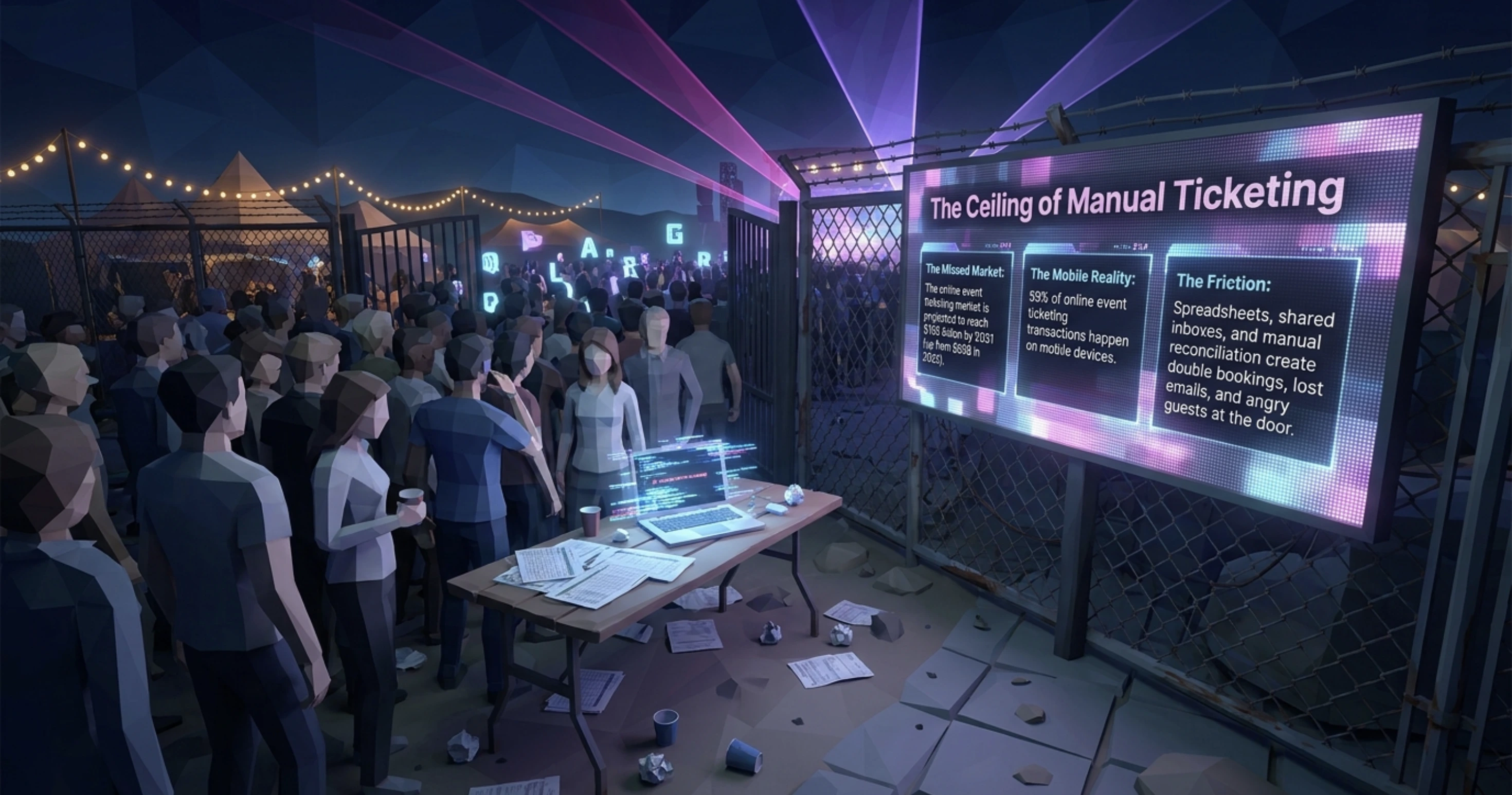
If you have ever tried to run ticket sales from a spreadsheet, a shared inbox, and a bit of hope, you already know how fast it falls apart. Over the years, I have watched organizers lose real money to double bookings, missed emails, and guests arguing at the door. The good news is that learning how to sell tickets online fixes almost all of it, and it takes far less setup than you would think.
Did You Know? In a 2025 study of more than 8,000 European event-goers, half of Gen Z respondents said they wait until friends confirm before buying a ticket, while 85% discover events on Instagram and 38% on TikTok. Buying is impulsive and group-driven, so a slow or clunky checkout can lose the whole crew. Source:
TicketSwap, Inside the Future of Live Events (2025).
Here is the short version. To sell tickets online, you use a platform that gives you an event page, takes secure payments into your own account, and sends each buyer a QR-coded e-ticket you scan at the door. Sales run around the clock, the numbers update live, and you never touch a spreadsheet again.
In this guide, I will cover why selling online is worth it, the exact step-by-step setup I use, how to price and promote so tickets actually move, real scenarios across different event types, and how to pick a ticket-selling platform that does not eat your margin. No coding required.
Why should you sell tickets online in the first place?
Because it removes the manual work and the ceiling on your reach at the same time. When you sell tickets online, anyone can buy from any city or time zone, at any hour, while the busywork runs itself.
Here is what changes the moment you move off spreadsheets:
Broader reach. Fans buy from any city or time zone, not just your local circle or office hours.
Round the clock revenue. A buyer can grab a seat at 2 a.m. as easily as at 2 p.m. You never miss a sale.
Less manual work. Orders flow in automatically, so there are no typos, no lost entries, and no late night data entry.
Live data. You see which tiers sell fastest and spot buying trends in seconds, then act on them.
Mobile first buyers. Most people now buy on their phones, so a smooth mobile checkout is not optional.
Did You Know? In a survey of 1,000 Gen Z consumers, 86% admitted they went over budget at a live event, while only 14% stuck to their original spending plan. The excitement is real, so clear ticket tiers, early-bird urgency, and simple upsells at checkout can convert better than you might expect. Source:
MERGE, The Event Effect (2024).
If you are still on the fence, the contrast with manual selling makes the case on its own:
What do you deal with
Spreadsheets, forms, and email
A ticket-selling platform
Setup time
Hours of manual building
Live in minutes, no code
Payments
Chase transfers and reconcile by hand
Secure checkout into your own account
Entry and validation
Printed name lists with no fraud protection
QR scanning with duplicate detection
Reach
Mostly your immediate circle
Anyone, anywhere, 24/7
Data
Manual counting after the event
Live sales and check-in dashboards
Errors
Typos, double bookings, and lost tickets
One clean, automatic record
Want the numbers behind this? It is worth taking a closer look at event ticket sales to see how top organizers turn these advantages into real revenue.
How to sell tickets online for an event (the right way)?
You can be selling in under ten minutes. Sign up, build your event, price your tickets, connect your payment account, and share the link. Here is the exact flow I use inside Ticket Generator every time.
Step 1: Create your free account
Go to Ticket Generator and sign up with your email or Google account. No credit card required. Your free account comes with 10 ticket credits (one credit generates one ticket), so you can build and test the whole thing before you spend anything. Once you are in, you land straight on the main dashboard where everything happens.
Step 2: Create your event
Click Create New Event and fill in the basics:
Event name
Date, time, and time zone
Venue or location
Whether tickets are free or paid
Single entry or multiple re-entry per ticket
Then pick how you want to sell:
Direct ticketing: you already have the guest list and send tickets straight to them
Free registrations: people sign up and get a free ticket automatically
Paid registrations: people pay on your event page and get their ticket the moment the payment clears
Your event is now live in the system and ready for tickets.
Step 3: Set your ticket types and pricing
Inside the event, add as many ticket tiers as you need: general admission, VIP, early bird, or group bundles. For each tier you can:
Set the price (anywhere from $0.60 up to $5,000 in your own currency)
Cap the quantity so a tier can genuinely sell out
Add scannable add-ons like parking, merch, or a meal, either baked into the price or offered as an upsell at checkout
This is where you turn a flat ticket into more revenue per buyer with no extra admin.
Step 4: Design your QR ticket
Head to the Ticket Design tab. You have three ways to go:
Use a ready-made template: pick from designs grouped by event type
Customize the standard design: drop in your logo, brand colors, background, and event details
Upload your own design: already made something in Canva or elsewhere? Upload it and Ticket Generator embeds the QR code and ticket ID automatically
Every ticket gets its own unique QR code and ticket ID, so no two are ever the same. That is what stops duplication, forgery, and gate crashing before it starts. In a hurry? The built-in AI designer turns your event details into four ready-to-use ticket designs in seconds.
Pro tip: If you are uploading a custom design, leave a clear space for the QR code. The system drops it in automatically, and you do not want it landing on top of your artwork.
Step 5: Connect your payment account
For paid events, link your own Stripe, PayPal, or Razorpay account. Buyer payments land directly with you, not in a middleman's account, and there is zero commission on ticket sales. You keep 100% of your ticket revenue and settle on your own schedule.
Step 6: Publish and share your event page
Turn on your Event Page, a mobile-optimized registration page you can share publicly or keep private. It takes about two minutes to set up. Customize the form to capture exactly what you need (name, email, phone, and payment for paid events), and host it on your own custom domain if you want it fully branded.
Then share the link everywhere your buyers already are: social posts, email, and your link in bio. People click through and buy in a couple of taps. If you would rather vet guests first, switch on manual approval so you confirm each registration before the ticket goes out.
Step 7: Deliver tickets automatically
The moment someone buys or is approved, their ticket goes out. You have four ways to get tickets into hands:
Generate and send: enter emails or phone numbers and deliver instantly by email, SMS, or WhatsApp (batches of up to 1,000 per send)
Generate and download: grab print-ready PDFs for the box office or physical handouts
Share a registration link: guests self-register and receive their ticket automatically
Generate via API: for developers wiring ticketing into an existing system at scale
Need to send later? Schedule the whole batch to go out at a set date and time. And if a guest loses their ticket, resend it in one click using their email, phone number, or ticket ID. No extra charge.
Step 8: Track sales, then scan at the door
Watch it all happen live from the dashboard: which tiers sell fastest, how many page visits convert, and where you can nudge with an early-bird deadline or a quick email Campaign while it still matters.
On event day, download the free Ticket Validator app (iOS or Android) or use the web validator at validate.ticket-generator.com. Point a phone at each QR code and get an instant result:
✅ Valid: first scan, entry approved
🔁 Duplicate: already scanned, entry blocked
❌ Invalid or Expired: not a real or active ticket for this event
Multiple team members can scan at once across every gate, all synced to the same dashboard, and no special hardware is needed. Just phones.
Pro tip: For multi-gate events, add your check-in staff as Coordinators. They get scanning access to their event only, without seeing your full dashboard, so entry stays fast and your account stays secure.
That is the whole loop, from empty dashboard to scanned-in crowd. If you want to go deeper on the promotion side and actually fill those seats, this guide on how to sell event tickets breaks down the tactics.
Set Up Event Ticketing and Distribution in Minutes!
First 10 tickets free | Free account | No credit card required
What is the smartest way to price and promote when you sell tickets online?
Use clear tiers, a little honest urgency, and an obvious price. The fastest way to lose a sale is a confusing checkout or a fee that shows up at the last second.
Build clear pricing tiers
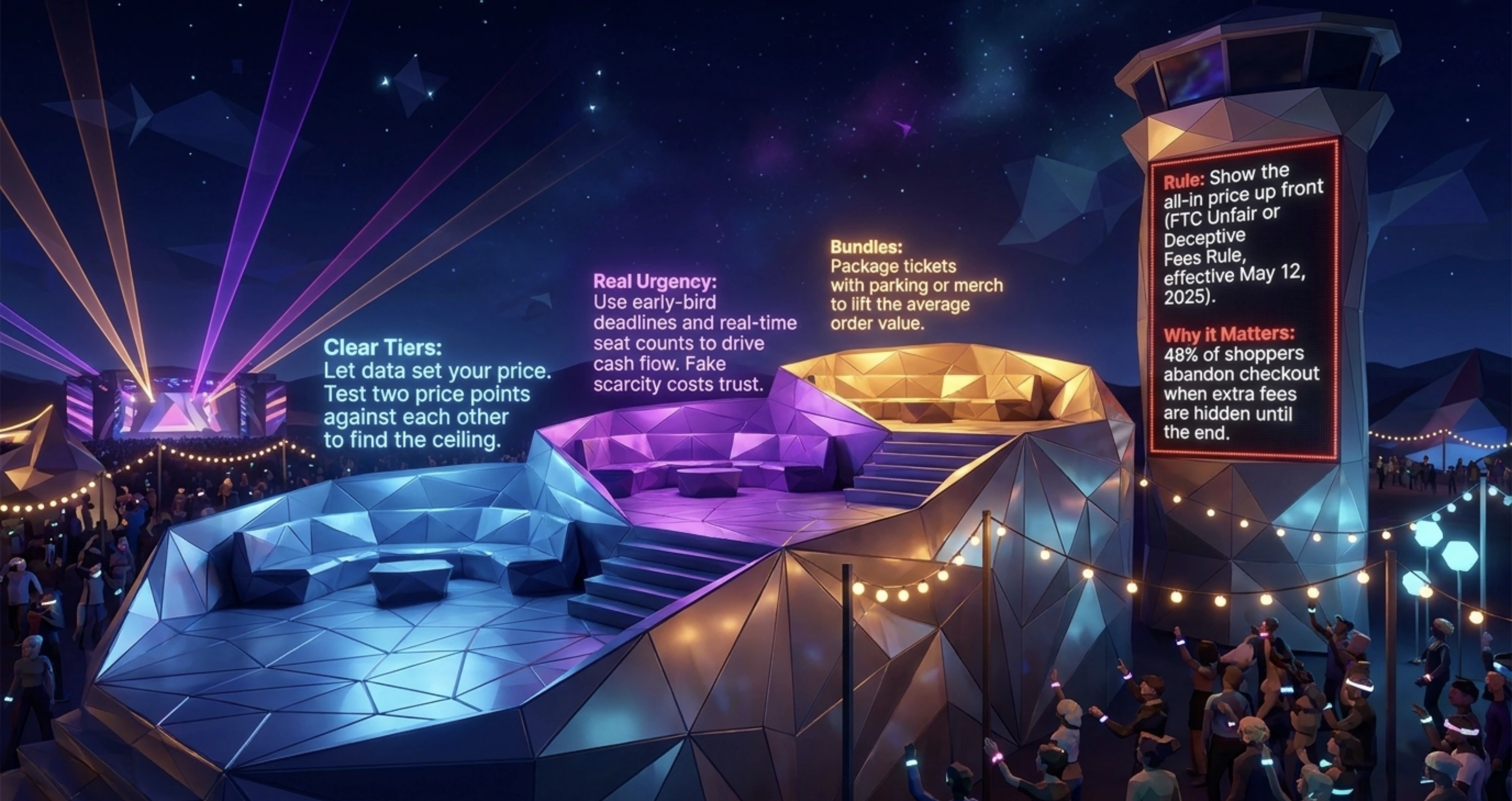
Start with three tiers: Standard gets people in the door, Premium adds better seats or perks, and VIP adds meet and greets or exclusive access. Test two price points against each other, watch which sells faster, and let the data set your price instead of guesswork.
Add real urgency, not fake urgency
Early bird pricing with a clear deadline gets people off the fence and brings in cash flow before the main push. Real-time seat counts ("only 23 left in Section A") work too, but only if the numbers are true. Buyers spot fake scarcity instantly, and it costs you trust.
Bundle to lift the average order
Package tickets with parking, merchandise, or food to raise revenue per buyer, and use group deals like "buy 4, get 10% off" so friends purchase together. Pricing strategy is a topic in itself, and it is worth reading up on tiered ticket pricing before you set your numbers.
Show the total price up front
This one is now the law in the United States, not just good manners. Since May 12, 2025, the FTC's Rule on Unfair or Deceptive Fees has required live event ticket sellers to show the all in total price up front, including mandatory fees, rather than revealing them at checkout.
Did You Know?48% of shoppers abandon checkout when extra costs like fees feel too high, making it the single biggest reason for cart abandonment. Source:
Baymard Institute (2024).
So transparent pricing is not only compliant, it converts better. If you want to remove the fee friction entirely, look at how no fee ticketing folds costs into one clean price your buyers actually trust.
Ready to sell tickets online with pricing you control and payouts that come straight to you?Start with Ticket Generator and keep 100% of your ticket revenue.
Set Up Event Ticketing and Distribution in Minutes!
First 10 tickets free | Free account | No credit card required
How do real organizers sell tickets online successfully?
The pattern is almost always the same. They swap manual chaos for one online flow, and reach, revenue, and calm all go up together. Here are three I have seen play out.
A local festival goes regional
A city jazz festival kept hitting a wall around 500 tickets because local record stores could not reach anyone outside town. Moving to online sales with geo-targeted ads and early bird tiers pushed them past 2,000, and the printing costs disappeared entirely.
A corporate conference doubles attendance
A tech conference capped itself at 200 because the spreadsheet buckled beyond that. Digital ticketing, automated registration and payments, and real-time dashboards showed which sessions filled fastest, and attendance jumped past 400 while the team reclaimed twenty hours of admin. If growth is your goal, these proven ways to increase event ticket sales work at any size.
A charity gala raises more
A hospital gala had plateaued at 150 guests for three years. An online page with VIP sponsorship tiers and personalized referral links for each board member widened the circle, attendance climbed, donations rose, and QR check-in cut the line from hours to minutes.
How do you choose a ticket-selling platform?
Pick the one that keeps your money and your data in your hands. The best ticket-selling platform for you is the one with transparent pricing, payouts to your own account, and solid QR validation, not the one with the flashiest marketplace.
Here is my checklist when I evaluate one:
Transparent, commission-free pricing. Know the full cost per ticket, and avoid platforms that skim a percentage of every sale.
Payouts to your own account. Money should settle in your Stripe, PayPal, or Razorpay, not sit with the platform until later.
QR validation with duplicate detection. Unique codes and one-time scans stop reuse, fraud, and gate arguments.
Branding control. Your logo and colors on the ticket and page, with no platform watermark.
Multi-channel delivery and analytics. Email, SMS, and WhatsApp delivery plus a live sales dashboard you can export.
If you want a side-by-side breakdown before you commit, I put the leading options head-to-head in my guide to the best ticket selling platform of 2026.
How Ticket Generator helps you sell tickets online?
Ticket Generator is built for organizers who want to sell tickets online on their own terms: branded tickets, secure entry, and no commission skimmed off a single sale. If you already have your audience and just need reliable selling and clean access control, it scales comfortably from a 10-person workshop to a 10,000-person festival.
Here is what you get, tied straight to everything above.
Keep your money and your data
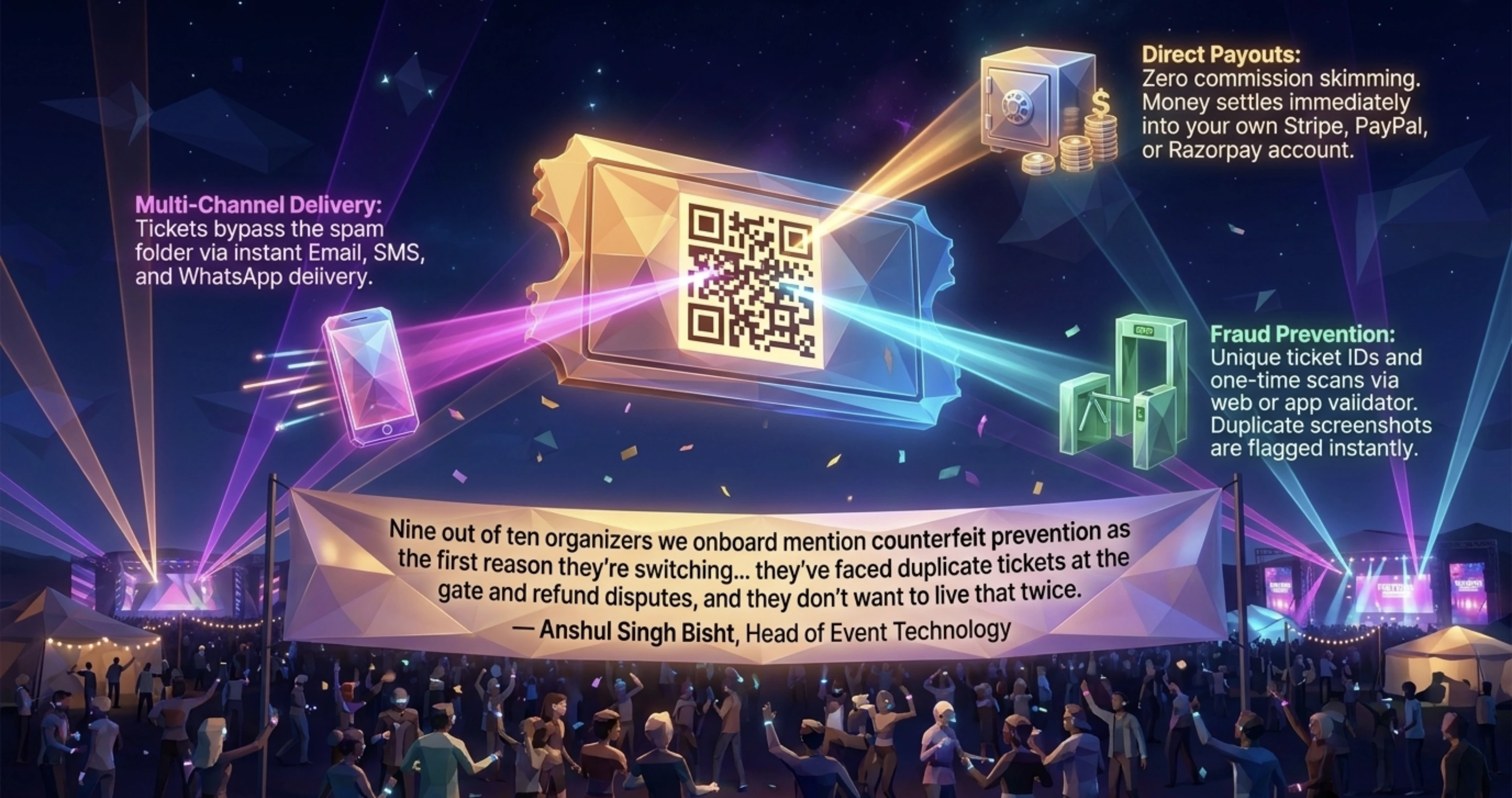
Zero commission, payouts to you. You buy prepaid credits and pay per ticket generated, not a percentage of sales. Payments go directly to your own Stripe, PayPal, or Razorpay, so you keep 100% of your ticket revenue and settle on your own schedule.
Predictable, usage-based pricing. Credits run about $0.25 to $0.60 per ticket depending on volume, they never expire, and nonprofits get 30% off. No subscription, no per-event fee, no surprises.
Full data ownership. Your attendee list stays yours. No marketplace sits between you and your buyers.
Sell the way your event actually works
Three ways to sell. Send tickets to a known guest list, collect free registrations, or take payments and issue tickets automatically, all from one dashboard.
Flexible ticket types and pricing. General admission, VIP, early bird, or group bundles, each with its own price (from $0.60 up to $5,000) and quantity cap so a tier can genuinely sell out.
Add-ons that lift revenue. Attach scannable extras like parking, meals, or merch, either baked into the price or offered as an upsell at checkout, so you earn more per buyer with no extra admin.
Registration controls. Custom form fields, document uploads, one-registration-per-person rules, and automatic or manual approval so you decide exactly who gets in.
Design and deliver without a separate toolkit
Branded ticket design. A drag-and-drop designer, ready-made templates, or upload your own artwork, with your logo and colors and no platform watermark anywhere.
AI ticket design and Canva. Turn event details into four ready-to-use designs in seconds, or edit any ticket in Canva and pull it straight back in.
Multi-channel delivery. Send by email, SMS, or WhatsApp in batches of up to 1,000, schedule whole batches in advance with Scheduled Send, and resend a lost ticket in one click at no extra charge.
Built-in Campaigns. Run email marketing, subscriber lists, and trigger-based sequences from inside the platform, so you can fill seats without paying for a separate email tool.
Secure entry and real-time control
Duplicate-proof QR validation. Every ticket carries a unique QR code and ticket ID, scanned through the free Ticket Validator app (iOS and Android) or the web validator, returning Valid, Invalid, Duplicate, or Expired instantly.
Multi-gate and re-entry support. Several coordinators can scan at once across different gates, all synced to one dashboard, with re-entry handling and flagged unauthorized attempts.
Coordinator roles. Give check-in staff scanning access to their event only, without exposing your full dashboard.
Live analytics and reporting. Track sales, page visits, conversion, and check-ins as they happen, review per-coordinator activity, and export everything to Excel or PDF.
Branding, hosting, and integrations
Custom domains and branded event pages. Host your registration page on your own domain for a fully white-labeled experience.
Developer-friendly API. A white-label REST API (120 requests per minute) lets you generate, send, and manage tickets from your own system at scale.
Connected stack. Native Zapier support plus Google Analytics, Facebook Pixel, Google Sheets, Mailchimp, and HubSpot integrations slot Ticket Generator into the tools you already use.
Recurring events made easy. Clone an event to relaunch in minutes, and run multi-day events with ticket status that resets at midnight.
On security, Ticket Generator is ISO/IEC 27001:2022 certified, GDPR compliant, and SOC 2 aligned, which matters when you are the one deciding who gets through the door. And the track record is real: more than 1,000,000 tickets generated across 30,000 plus events in over 100 countries. Felipe Motta, a retailer in Panama, ran its events with 96% peak attendance and issued 95% of tickets straight through the API, which is exactly the kind of scale online selling unlocks.
Anshul Singh Bisht, our Head of Event Technology, put it plainly:
"Nine out of ten organizers we onboard mention counterfeit prevention as the first reason they're switching; the cost and speed factors are added benefits. They've faced duplicate tickets at the gate, refund disputes, guests who claim they paid but aren't on the list, and they don't want to live that twice."
In short, if you want to sell online with predictable pricing, branded tickets, built-in promotion, and calm, secure entry, Ticket Generator fits the way real events actually run.
Conclusion
Learning how to sell tickets online is less about technology and more about getting out of your own way. Once the event page, payments, and QR tickets run themselves, you get your time back, and your reach goes up.
The roadmap is simple. Build an event page in minutes, set pricing that is clear and honest, deliver QR tickets your buyers can trust, and let the live data guide your next move. Do that, and the spreadsheets, missed sales, and printing headaches are gone for good.
Whatever platform you land on, choose one with transparent pricing and payouts that come straight to you. If you want all of that in a setup you can finish this afternoon, Ticket Generator is a strong place to start.
Try Ticket Generator to sell tickets online with secure payments, branded QR tickets, and zero commission. Your event. Your revenue. Your rules.
FAQs: How to Sell Tickets Online
1. Can I sell tickets online without a website?
Yes, you do not need your own website to sell tickets online. A ticketing platform gives you a ready made event page with a unique link you can share on social media, email, or text. It handles payments and delivers the tickets automatically.
2. How much does it cost to sell event tickets online?
Most platforms charge a small per ticket fee or a percentage of each sale, plus payment processing. Ticket Generator keeps it predictable at about $0.25 to $0.60 per ticket based on credits, with no commission and no monthly fee. Compared with printing, staff hours, and lost sales, selling online usually saves money overall.
3. What is the best way to sell tickets for a small event?
Keep it simple and pick a platform with no minimum fees. Create a couple of clear ticket tiers, share your event link in local groups and your own channels, and let people buy on their phones. For a small event every sale counts, including the midnight ones you would otherwise miss.
4. How do I prevent ticket fraud and scalping when selling online?
Use QR coded tickets that scan once and then expire, so a screenshot cannot get two people in. Set purchase limits and require attendee names for high demand events. Selling through a secure platform with duplicate detection means you control access at the door completely.
5. Can I sell tickets at the door and online at the same time?
Yes, and real time inventory keeps you from overselling across both. You can hold back a batch of tickets for door sales if you want, while online sales run in parallel. For most events, online becomes the main channel and door sales are a bonus.
Ashish Chandra has spent 5+ years writing about event technology, covering topics such as ticket design, QR check-ins, attendee management, and event marketing strategy. As the Content Lead at Ticket Generator, Ashish has analyzed hundreds of real-world event workflows and ticketing setups, helping organizers across industries use QR-based tickets, event landing pages, and smarter ticketing systems to run smoother, better-attended events.
His writing is shaped by real user needs and the questions organizers ask most often: How do I sell more tickets? How do I avoid chaos at the door? How do I make my next event better than my last?
When he steps away from the screen, you'll likely find him hiking a quiet trail or tending his plants- his preferred way to reset.







.png)





.webp)

.svg)
.svg)