

Event Ticket Barcode Generator: Make Every Ticket Unique and Safe
 Written byAshish ChandraLast updatedSeptember 24, 2026
Key Takeaways:
- An event ticket barcode generator makes a separate, single-use code for every ticket and checks each one at the door.
- Free barcode tools give every ticket the same code, so the gate cannot spot a duplicate.
- "Barcode" covers 1D stripes and 2D squares. Event tickets now mostly use a 2D barcode, which is a QR code.
- Ticket Generator issues a unique QR code and ticket ID per ticket, with duplicate detection and no commission.
- Scanning is a live lookup, so gate connectivity is a planning task.
Doors open at 7pm. One volunteer, one phone, four hundred people in a line around the building. Somewhere in that line are two friends holding the same ticket, because one forwarded the PDF. The barcode is almost never what fails at a gate. What fails is that every ticket carried the same one.
An event ticket barcode generator is software that creates a separate, single-use barcode for every ticket, links it to a named attendee, and checks it at the door. A free barcode image tool makes one code you paste onto four hundred tickets. A real ticket barcode generator makes four hundred codes, and flags the second scan of any.
In this guide I cover what barcode tickets are, how 1D and 2D codes differ, the features worth paying for, how gate validation works, where the technology falls short, and how Ticket Generator compares with the alternatives.
Did you know that mobile devices account for roughly 58% of online event ticketing transactions? Source: Mordor Intelligence, 2025
Most tickets are shown on a phone, at arm's length, in bad light. That is the design brief for the code.
What are barcode tickets, and what does an event ticket barcode generator do?
Barcode tickets are event tickets carrying a machine readable code, so entry is decided by a scan instead of a glance. The generator produces those codes, one per ticket, and keeps the record of which ones have been used.
"Barcode" is an umbrella term, used loosely. It covers two families:
- 1D barcodes are the familiar stripes, in formats like Code 128 and EAN-13. They hold a short string, usually a number, and scan quickly at close range on a clean, flat surface.
- 2D barcodes are square patterns: QR codes, PDF417, Aztec. They hold far more data, read at an angle, and survive partial damage because error correction is built in.
A QR code is a 2D barcode, not a separate technology. Calling a ticket "QR" or "barcode" is often one statement made two ways.
Ticket Generator issues a unique 2D barcode on every ticket it creates, in the form of a QR code, alongside a unique ticket ID. No two tickets in an event share a code, whether it shows as black and white lines or as a square pattern.
Event ticketing has settled on 2D, part of the wider move to QR code tickets. Phones display them well, scanners read them at awkward angles, and they hold a ticket reference rather than a bare number. For the mechanics of getting a code onto the artwork itself, see our guide to creating event tickets with a barcode. This page is about choosing and running the generator.
Static or unique? The question that decides everything else
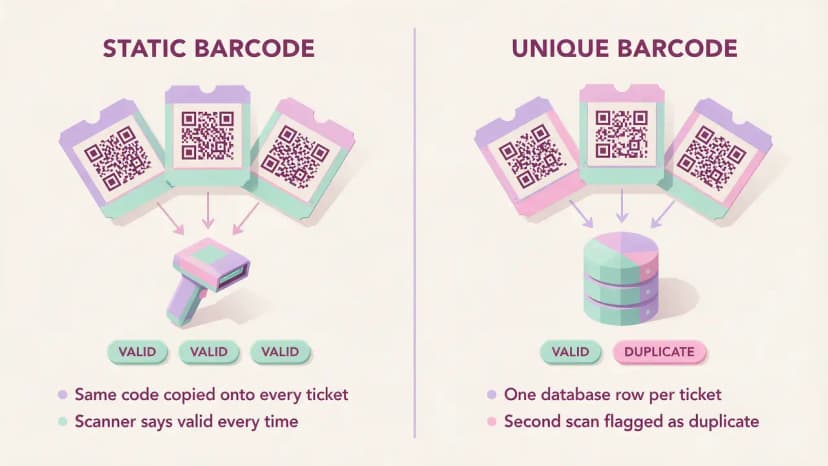
A static barcode is the same code on every ticket. A unique barcode is a different code on each one. Only the second tells you whether the person at the gate has already walked in.
This is the most expensive mistake I see. An organizer opens a free barcode generator, downloads one image, and drops it into the ticket template. Four hundred tickets, one code. The scanner reads it four hundred times and says the same thing every time: valid. It is worth being precise here: a genuine free ticket maker that issues a real per-ticket code is a different thing entirely from a free barcode image generator, and the difference is exactly the uniqueness this section is about.
"The most common mistake we see is organizers using a generic QR generator and realizing that this way every attendee will have the same code. Also, those generators can't help you stop duplicates."
Anshul Singh Bisht, Head of Event Technology, Ticket Generator
A static code is a picture. A unique code is a record. The difference is not the image, it is the database behind it. Issuing a unique code writes a row for that ticket: who holds it, whether it has been scanned, when, and at which gate. That row turns a scan into a decision.
It also changes what a forwarded ticket costs you. With static codes, one screenshot in a group chat admits everybody in it. With unique codes, the first person through is let in and everyone after is flagged as a duplicate. It is the practical defence against counterfeit tickets too.
Pro Tip: Before you commit to any tool, generate two test tickets and compare the codes. If they are identical, you are holding a barcode image maker, not a ticket generator. Ticket Generator issues a unique QR code and ticket ID on every ticket, including custom artwork you upload.
What features should a ticket barcode generator have?
The features that matter are the ones that show up on event day: unique code generation, bulk creation, attendee data bound to the ticket, duplicate detection, and reporting you can export. Here is the checklist I work through with organizers.
|
Capability |
Why it matters on event day |
What good looks like |
|---|---|---|
|
Unique code per ticket |
Without it, nothing else on this list can work |
Its own code plus a separate readable ticket ID |
|
Bulk generation |
Nobody makes 800 tickets one at a time the night before |
Upload a guest list or generate through an API |
|
Attendee data on the ticket |
Staff can confirm the holder, not just the code |
Name, seat, row, section, and category as variable fields |
|
Duplicate detection |
The forwarded PDF is the most common gate problem |
Second scan of the same code is flagged instantly |
|
Design control |
A ticket is a brand asset, not a receipt |
Templates or your own upload, with no platform watermark |
|
Reporting and export |
You need the attendance number before the debrief |
Live attendance, flagged entry attempts, and Excel or PDF export |
A tool that covers the first four rows is a ticket maker. One that covers all six is a barcode ticket system you can run a gate on. See the full set on the Ticket Generator features page. Design control matters here too: if you want full say over layout and branding rather than a fixed template, our guide to a custom ticket maker covers that ground, and every design still gets the unique barcode automatically.
How do you choose the right ticket barcode generator?
Judge a ticket barcode generator on six things: whether codes are genuinely unique, how validation works on the ground, what the pricing model costs across a year, how far it scales, how much design control you keep, and how fast a volunteer can learn it.
- Security. Unique codes, one-time validation, duplicate flagging. Ask what happens on the second scan.
- Validation model. Does scanning need a connection, can several gates scan at once, is re-entry supported? Tools differ most here and market most vaguely.
- Pricing model. Commission, flat per ticket, desktop licence, or credits. Model each against your real annual volume, not one event.
- Scale. Bulk upload, an API if registrations live elsewhere, sensible rate limits. Ticket Generator's API allows 120 requests per minute.
- Customization. Your own artwork, your own domain, no platform logo on the ticket.
- Ease of use. The person scanning at gate 2 is often a volunteer who arrived forty minutes ago.
How does a ticket barcode scanner validate a ticket at the gate?
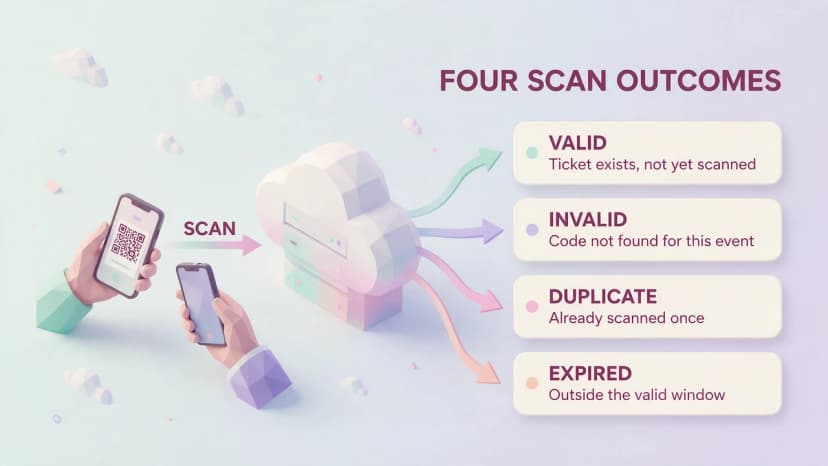
A ticket barcode scanner reads the code, sends it to the ticketing system, and gets back one of four answers: valid, invalid, duplicate, or expired. The exchange takes about a second, and it is a live lookup, not a check against something on the device.
- The attendee shows the code, on a phone screen or paper.
- A staff phone running a validator app reads it.
- The app sends the ticket reference to the system.
- The system checks the ticket exists, belongs to this event, and has not been scanned.
- The app returns the result and the attendee's name, and the record updates.
Two things separate a gate that works from a gate that queues. The first is multi-gate scanning: several devices validating at once against one shared record, so gate 3 knows about the ticket gate 1 admitted eight seconds ago. The second is re-entry, which needs the system to permit a deliberate second scan rather than flag a duplicate.
You do not need special hardware. Ticket Generator's Ticket Validator app runs on ordinary iOS and Android phones, with a web validator at validate.ticket-generator.com. Attendance updates live, so you know the room count without counting the room. We go deeper in how to use a QR code scanner for event entry and event ticket validation with QR codes.
Want to see what a real scan looks like before your next event? Set up a test event and validate tickets with Ticket Generator on any phone you already own.
Where does barcode ticketing hit its limits?
Barcode ticketing has three real weaknesses: it depends on gate connectivity, the code has to be physically readable, and a barcode alone does nothing to stop sharing before the event.
Connectivity is the honest one, and it applies to Ticket Generator directly. The Ticket Validator app needs an internet connection and cannot validate offline. Every scan is a live lookup, which is what makes duplicate detection reliable across four gates and what makes it dependent on a signal. Two competitors below publish an offline claim. We do not, and I would rather you read it here than find out in a field.
If coverage is weak, plan for it before doors open:
- Test the signal at every gate position, at the hour the event runs.
- Put a hotspot at each scan point, on a different carrier from your staff phones.
- Keep scanning devices on power. A phone at 8% battery fails like no signal.
- Print a per-gate attendee list as the fallback. Slower, but the line keeps moving.
Physical readability is where the 1D and 2D difference stops being academic. A 1D barcode fails hard: a crease through the bars, a cracked screen, a low contrast print, and the scanner sees nothing. 2D codes tolerate real damage.
Sharing before the event is not a barcode problem. Nothing in the code stops someone screenshotting a ticket and posting it. Only one-time validation at the gate stops the second person walking in.
Pro Tip: Run a dry run the day before with five real tickets, and make one a deliberate duplicate. You will learn more in ten minutes than from any feature list. Ticket Generator returns Valid, Invalid, Duplicate, or Expired, so a duplicate is unmistakable.
How do you create barcode tickets with Ticket Generator?
Ticket Generator is built for organizers who want unique, scannable tickets without handing a percentage of every sale to a platform. Three steps.
- Create the event and design the ticket. Start from a template, use the drag and drop designer, or upload your own artwork. Variable fields cover guest name, seat, row, section, ticket ID, and the QR code, and custom uploads still get the unique QR automatically.
- Generate and distribute. Issue tickets singly, in bulk from a guest list, or automatically after registration. Delivery runs over email in batches of up to 1,000 guests per send, plus SMS and WhatsApp.
- Validate at the gate. Staff scan with the Ticket Validator app on their own phones. Results come back as Valid, Invalid, Duplicate, or Expired, across several gates at once.
Two examples from our own customers. DART, the Dallas Area Rapid Transit authority, runs multi-location access control with real-time tracking, the multi-gate case at a size most organizers never reach. Felipe Motta, a food and beverage business in Panama, has issued 638+ tickets with up to 96% attendance, 95% of them generated through the Ticket Generator API. The same unique-barcode engine sits behind smaller, one-off events too. If you are running something more informal, our party ticket maker guide walks through the same generator on a much smaller guest list.
Pricing is credits, not commission. One credit generates one ticket. Packs run from 10 credits at $6 up to 10,000 at $2,500, credits do not expire, new accounts start with 10 free credits, and nonprofits get 30% off. Payments go straight to your own Stripe, PayPal, or Razorpay account. The platform is ISO 27001:2022 certified, GDPR compliant, and SOC 2 aligned, with more than 1,000,000 tickets issued across 30,000+ events in 100+ countries.
How does Ticket Generator compare with other barcode ticket generators?
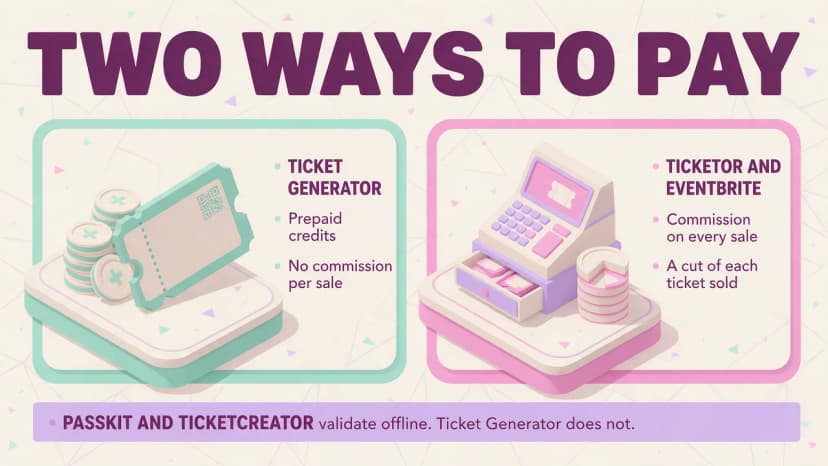
Ticket Generator, Ticketor, PassKit, and TicketCreator all issue unique barcodes. They differ on how you pay, where the ticket lives, and whether validation works offline.
|
Tool |
What it costs |
Unique code per ticket |
Offline validation |
Best for |
|---|---|---|---|---|
|
Ticket Generator |
Prepaid credits, no commission. $6 for 10, down to $0.25 each at volume. 10 free on signup |
Yes, a unique QR code plus a ticket ID on every ticket |
No. The Ticket Validator app needs an internet connection |
Organizers of 10 to 10,000 who want commission-free pricing and their own gateway |
|
Ticketor |
Standard: no monthly fee, 2.90% plus $0.69 per item. Premium discounted to $37.95 per month, from a $54.95 standing rate |
Yes. Ticketor states all e-tickets and physical tickets carry a barcode and QR code |
Not claimed on its published pages |
Sellers who accept a cut of every sale |
|
PassKit |
No pricing published on its barcode ticket system page. Promotes a 45-day free trial |
Yes. PassKit states each barcode is unique and can only be used once |
Yes. PassKit states wallet tickets work without an internet connection |
Teams delivering tickets into Apple Wallet and Google Wallet |
|
TicketCreator |
Windows desktop licence. No price published on its barcode page; the Barcode edition needs an upgrade |
Yes. Random 10-digit numbers as copy protection, in Code 2 of 5 interleaved, Code 39, or QR |
Yes. States tickets can be checked at several entrances, with or without a network |
Organizers who print their own tickets from a Windows PC |
|
Eventbrite |
Commission of roughly 3% to 8% plus payment processing on paid tickets |
Yes |
Not the deciding factor here |
Organizers who want marketplace discovery and will pay for it |
Competitor details read from each vendor's own published pages in September 2026: ticketor.com/Account/Prices, passkit.com/blog/barcode-ticket-system, ticketcreator.com/secure_tickets_with_copyprotection.htm. Vendor pricing changes often; confirm before you commit.
Read the offline row as written. PassKit and TicketCreator publish an offline claim and Ticket Generator does not. If your gate has no signal, they solve a problem we do not.
Where Ticket Generator wins is the money. Ticketor's Standard tier costs 2.90% plus $0.69 on every item sold: on 500 tickets at $40 that is about $925 gone, before card processing, a separate cost under every model at around 2.9% plus $0.30 per transaction on Stripe's published rates. Eventbrite's 3% to 8% commission works the same way. Ticket Generator charges nothing per sale, so the same 500 tickets simply consume 500 credits: $250 bought as five 100-credit packs, or $400 if you buy the 1,000-credit pack outright and bank the 500 credits left over for your next event. Either way the ticket revenue lands in your own account, not a platform's.
Did you know that 40% of shoppers abandon a checkout when extra costs such as fees are too high, the second most common reason for abandonment after simply browsing? Source: Baymard Institute, cart abandonment rate statistics
Per-item fees usually land on the buyer's screen, which makes the pricing model a conversion question as well as an accounting one. Our Eventbrite alternatives rundown runs the same arithmetic across more platforms.
Final thoughts
Every tool in this guide can put a barcode on a ticket. What separates them is the second scan. A static code says valid forever. A unique code, tied to a record, says valid once and then tells you the truth.
Costs are real under every model, credits included. What you are buying is predictability: a per-ticket cost that does not grow with your ticket price, tickets that cannot be quietly duplicated, and attendance data you own. For most organizers running 10 to 10,000 attendees, an event ticket generator with commission-free pricing beats a marketplace.
Try Ticket Generator to give every attendee a unique, scannable barcode ticket, with duplicate detection at the gate and zero commission on your sales.
FAQs: Barcode ticket generators
1. What is an event ticket barcode generator?
A ticket barcode generator creates a unique, single-use barcode for every ticket and records which codes have been scanned. That record is what lets a scanner tell a first entry from a duplicate. Ticket Generator issues a unique QR code and ticket ID per ticket.
2. Can I use a free barcode generator to make event tickets?
You can make an image, but you cannot run a gate with it. Free tools produce one code you copy onto every ticket, so the scanner says valid for the first person and the twentieth. Duplicates need a different code per ticket.
3. What is the difference between a 1D barcode and a QR code on a ticket?
A 1D barcode is a row of stripes holding a short number. A QR code is a 2D barcode that holds more data and includes error correction, so it reads at an angle and survives creases. Most event tickets now use 2D.
4. Do I need an internet connection to scan tickets at the gate?
With Ticket Generator, yes. A ticket barcode scanner is only as good as the record behind it, and the Ticket Validator app checks every scan against the live ticket record, so it cannot validate offline. Test the signal at every gate beforehand and keep a printed attendee list as a fallback.
5. What is a barcode ticket system?
A barcode ticket system is the full loop rather than just the code: generating unique tickets, distributing them, scanning at entry, and reporting on who turned up. A generator handles the first part only.
6. How much does an event ticket generator cost?
It depends on the pricing model. Commission platforms take a percentage of every sale, desktop software charges a licence, and credit systems charge per ticket generated. Ticket Generator uses prepaid credits from $6 for 10, down to $0.25 each at volume.
About the author
Content Marketer at Ticket Generator
Ashish Chandra has spent 5+ years writing about event technology, covering topics such as ticket design, QR check-ins, attendee management, and event marketing strategy. As the Content Lead at Ticket Generator, Ashish has analyzed hundreds of real-world event workflows and ticketing setups, helping organizers across industries use QR-based tickets, event landing pages, and smarter ticketing systems to run smoother, better-attended events. His writing is shaped by real user needs and the questions organizers ask most often: How do I sell more tickets? How do I avoid chaos at the door? How do I make my next event better than my last? When he steps away from the screen, you'll likely find him hiking a quiet trail or tending his plants- his preferred way to reset.
Latest posts
Check out our latest articles on the blog
 12 min read
Email Marketing for Events and Webinars: What to Send, When to Send It, and How to Automate It
A step-by-step playbook for email marketing for events and webinars. Learn what to send, when to send it, and how to automate every email for in person and virtual events.
Ashish Chandra
18 Oct 2026
 10 min read
Halloween Masquerade Ball: How to Host a Night of Masks and Mystery
From Venetian-inspired masks to QR-coded entry, here is your complete guide to planning a Halloween masquerade ball your guests will talk about for years.
Ashish Chandra
18 Oct 2026
 9 min read
Ticketmaster Reserved Seating: How It Works and a Better Fit for Smaller Events
Ticketmaster reserved seating works well for arenas. If you run a theatre, gala, or mid-size show, see how it works, what it costs, and how to switch.
Ashish Chandra
16 Oct 2026