

Best Ticketmaster Alternatives in 2026: Fees, Control, and What the Monopoly Verdict Changed
 Written byAshish ChandraLast updatedSeptember 8, 2026
Key Takeaways:
- The best Ticketmaster alternatives charge a predictable per-ticket cost instead of a percentage of every sale.
- A federal jury found Live Nation and Ticketmaster liable on all antitrust claims in April 2026, and the remedies are still undecided.
- Primary market ticket fees average 27% of face value, according to the U.S. GAO.
- Ticket Generator uses prepaid credits with zero commission, paid straight into your own gateway.
- You keep the branding, the attendee data, and every dollar of ticket revenue.
On April 15, 2026, a federal jury in Manhattan decided that Live Nation and Ticketmaster had operated an illegal monopoly over live event ticketing. The jury put a number on the damage: an average overcharge of $1.72 per ticket.
If you have ever organized an event through Ticketmaster, that verdict probably did not surprise you. Steep fees, rigid structures, and limited control over branding are not accidents of the system. A jury has now found they were the system.
So here is the practical answer. The best Ticketmaster alternatives for organizers are the event ticketing platforms that remove the percentage cut entirely and charge you a flat, predictable cost per ticket instead. Ticket Generator is built on exactly that model: you pay only for the tickets you generate, never a commission on what you sell.
In this guide I will cover what the antitrust ruling actually changes, what Ticketmaster fees cost line by line, how the leading alternatives compare, and how to move your ticketing across in an afternoon.
What did the 2026 Ticketmaster antitrust verdict change for event organizers?
The verdict established that Ticketmaster illegally maintained monopoly power in primary ticketing, but it has not yet changed what you pay. Remedies are still being decided, and the case is likely to run into 2027.
Here is the sequence, and it matters because the two halves of the case ended very differently.
- May 2024: The U.S. Department of Justice and 40 state attorneys general sued Live Nation and Ticketmaster for monopolizing live event ticketing.
- March 2026: Days into trial, the DOJ settled. Live Nation kept Ticketmaster. It agreed to cap service fees at 15% at its amphitheaters, open its platform to rival sellers, give up exclusive booking at 13 amphitheaters, and fund roughly $280 million for state claims.
- April 15, 2026: 33 states and the District of Columbia rejected that settlement and took the case to verdict. A jury found Live Nation and Ticketmaster liable on every antitrust claim submitted, and set the consumer overcharge at $1.72 per ticket.
- Now: Live Nation has asked the court to overturn the verdict or order a new trial. Discovery on a possible breakup is paused until that is resolved. The states want Ticketmaster separated from Live Nation outright.
Did you know that the jury found for the states on all federal and state claims after a five week trial and four days of deliberation? The DOJ settlement that preceded it did not require Live Nation to sell Ticketmaster at all, which is precisely why two thirds of the states walked away from it. Source: Paul, Weiss
What this means for you as an organizer?
Very little, in the short term. That is the honest read.
The 15% fee cap in the DOJ settlement applies to service fees at Live Nation controlled amphitheaters. It does not cover arenas, theaters, clubs, festivals, or the conference and community events most organizers actually run. No court has ordered Ticketmaster to lower what it charges you or your attendees.
What the verdict does give you is leverage and cover. The argument that fees are simply the cost of doing business no longer holds when a jury has found the fee structure was maintained illegally. If you have been putting off a move to lower fee ticketing, this is the year that decision defends itself.
What do Ticketmaster fees actually cost (complete breakdown of fees involved)?
Fees on a primary market ticket average 27% of face value, according to the U.S. Government Accountability Office. They are not one charge. They are a stack of four, set by different parties, and only disclosed together at checkout.
This is the part almost every comparison article skips, so here is the full anatomy on a single $60 ticket.
|
Line item |
Who sets it |
Typical range |
On a $60 ticket |
|---|---|---|---|
|
Face value |
Artist, promoter, or venue |
The advertised price |
$60.00 |
|
Service fee |
Ticketing platform, on the venue rate card |
15% to 25% of face value |
$10.80 |
|
Facility fee |
The venue, kept in full by the venue |
$2 to $6 flat per ticket |
$3.00 |
|
Order processing fee |
Ticketing platform, charged per order |
$3 to $6 per order |
$3.00 |
|
Delivery fee |
Platform, varies by delivery method |
$0 to $5 |
$0.00 |
|
Total fees |
|
About 27% on average |
$16.80 |
|
Total paid at checkout |
|
|
$76.80 |
Who actually keeps the fee money?
This is the detail that reframes the whole conversation, and it cuts against the usual assumption.
Ticketmaster told Marketplace in May 2026 that its own share of service fees is typically around 5% to 7% of the total ticket price, and that it receives no portion of a ticket's face value. The venue keeps the entire facility fee. The rest of the service fee is split under negotiated contracts, and ticketing companies commonly rebate a share back to venues as part of exclusive deals.
That structure explains why fees have been so resistant to pressure. The venue has little incentive to push them down, because a share of them comes back. The artist does not see the fee revenue. The buyer has no competing checkout to switch to. Everyone in the chain is paid except the person paying.
For you as an organizer, the cost is real but it is indirect. You do not pay Ticketmaster a simple commission invoice. You pay in a harder currency: fee inflation on your own event that suppresses conversion, a checkout that is not yours, and an attendee list you do not own.
Did you know that the National Independent Talent Organization found in an October 2025 New York study that primary market fees averaged 28.65% of face value, and that New York ticket fees had risen 36% since 2016? Fees have been climbing, not settling. Source: Pollstar
Since the FTC's Junk Fees Rule (16 C.F.R. Part 464) took effect on May 12, 2025, live event ticket sellers must show the total price including all mandatory fees up front. That rule governs disclosure, not the level of the fee. Buyers now see the full number sooner, which is exactly why tickets without a service charge convert better than they used to.
Why do organizers look for a Ticketmaster alternative?
Cost is the headline reason, but it is rarely the only one. Ticketmaster is built for large arenas and touring promoters, which leaves smaller and mid sized organizers with a platform that does not fit the way they work.
1. Fees you do not control and cannot explain
The fee stack above is set by the venue rate card and the platform contract, not by you. When an attendee complains that a $60 ticket costs $77, the complaint lands on your brand. Ticket Generator uses a pay-per-ticket model instead: you pay for the tickets you generate, and payments go directly to your own Stripe, PayPal, or Razorpay account with no commission on sales.
2. Limited branding and customization
On Ticketmaster, your event page looks like every other listing. You cannot fully control design, layout, or domain.
Ticket Generator gives you complete freedom. You can:
- Add your logo, brand colors, and event theme
- Use your own custom domain, for example, events.yourbrand.com
- Personalize tickets with attendee names, seat numbers, and QR Codes
- Generate a full branded ticket design with AI, or edit it in Canva and import it straight back
Your brand stays front and center, not the platform's watermarks and logos.
3. Lack of control over attendee data
Ticketmaster owns the attendee database, not you. That means you do not always get full contact details for follow-ups or marketing after the event.
With Ticket Generator, the data belongs to you. Every registration captures attendee details that you can export, analyze, and use for future promotions. You can also run email campaigns to that list from inside the platform, without a separate marketing tool.
4. Complicated setup and delayed payouts
Ticketmaster's setup can be complex for smaller events. It often requires approval processes and integrations, and payouts can take days or weeks to process after your event ends.
Ticket Generator is self serve. Sign up, create an event, set up your registration page, connect your payment gateway, and start selling in minutes. Because the gateway is yours, settlement is yours too.
5. Not built for every type of event
Ticketmaster focuses on large entertainment events. Many organizers today run something else entirely:
- Private shows and community fundraisers
- College fests and workshops
- Conferences, expos, and brand activations
- Corporate training sessions and seminars
Ticket Generator handles all of these, whether your event has 50 guests or 50,000.
Set up event ticketing and distribution in minutes. First 10 tickets free. Free account. No credit card required. Start now for free at ticket-generator.com.
How do the main Ticketmaster alternatives compare?
The right alternative depends on one question: do you already have your audience, or do you need a marketplace to find one for you? If you have the audience, every percentage point you hand to a marketplace is pure loss.
|
Platform |
Fee model |
Who pays the fee |
Best for |
|---|---|---|---|
|
Ticket Generator |
Prepaid credits per ticket generated, zero commission on sales |
Organizer, as a flat cost |
Organizers with their own audience who want full branding and 100% of revenue |
|
Eventbrite |
Roughly 3% to 8% plus payment processing per paid ticket |
Buyer or organizer, configurable |
Public events that genuinely need marketplace discovery |
|
Ticket Tailor |
Flat fee per ticket sold, no commission, own payment processor |
Organizer |
Simple, low cost setups with straightforward needs |
|
TicketSpice |
99 cents per ticket plus card processing at 2.9% and 30 cents |
Either, configurable |
Flat per ticket pricing at moderate volume |
|
Humanitix |
About 5% plus $1.29 per paid USD ticket, profits go to charity |
Buyer by default |
Nonprofit and mission aligned organizers |
|
Cvent |
Quote based, commonly around $19,550 per year plus $7 to $12 per registrant |
Organizer |
Enterprise conferences and complex meetings programs |
|
Ticketmaster |
Buyer side service, facility, and processing fees averaging 27% of face value |
Buyer, at checkout |
Major arena and stadium tours with venue contracts already in place |
A note on the arena tier. If you are ticketing a venue that genuinely needs primary arena distribution, AXS and SeatGeek are the realistic like-for-like replacements, and both are contracted at the venue level rather than chosen by an individual organizer. Under the DOJ settlement, rival sellers like these gain access to Ticketmaster-controlled inventory for the first time, so that tier should get more competitive over the next few years.
For everyone below the arena tier, which is the overwhelming majority of events, the comparison is simpler. See our full breakdown of ticketing platforms with the lowest ticket fees, or if you are weighing the other big marketplace, the Eventbrite alternatives comparison covers the same ground for a lower-priced competitor.
Pro Tip: Before you compare platforms on headline price, run your real numbers. Take last year's ticket volume and average price, then calculate the total cost on each model. A 5% commission and a flat 50 cent credit look similar on a $10 ticket and look nothing alike on a $200 one. Percentage models punish you precisely when your event succeeds.
How does Ticket Generator compare to Ticketmaster feature by feature?
Ticket Generator is built for organizer control, and Ticketmaster is built for marketplace distribution. That single difference explains almost every row below.
|
Feature |
Ticket Generator |
Ticketmaster |
|---|---|---|
|
Pricing model |
Pay per ticket generated; zero commission on sales |
Buyer side service, facility, and processing fees averaging 27% of face value |
|
Revenue ownership |
100% of ticket revenue goes to the organizer |
Fee revenue split between platform and venue under contract |
|
Setup time |
Self serve; create an event and start selling in minutes |
Lengthy setup; typically requires a venue or promoter contract |
|
Brand customization |
Full control; add logo, colors, and custom domain |
Limited; most event pages share the same look and URL |
|
Ticket design |
Fully customizable, with templates, AI generated designs, and Canva editing |
Standardized design; minimal customization |
|
Ticket delivery |
Instant delivery via email, SMS, or WhatsApp, with scheduled send |
Email and app delivery on the platform's terms |
|
Validation system |
Built in Ticket Validator app with QR scanning and duplicate detection |
Dependent on venue hardware or integrations |
|
Event types supported |
Concerts, fundraisers, corporate events, conferences, workshops, private events |
Primarily large concerts and sports events |
|
Analytics and reporting |
Real time dashboard for attendance, scans, and engagement |
Limited insight for small scale organizers |
|
Payment gateway |
Connect your own: Stripe, Razorpay, or PayPal |
Payouts handled by Ticketmaster, and may be delayed |
|
Brand visibility |
100% white label; no platform watermark |
Ticketmaster branding appears on all listings |
|
Security and compliance |
ISO 27001:2022 certified, GDPR compliant, SOC 2 aligned |
Enterprise grade, but controlled by the platform |
|
Ease of use |
Simple, no coding required |
Complex dashboard for new organizers |
Why organizers actually make the switch
The cost saving is what gets people to look. It is usually not what makes them move.
"Nine out of ten organizers we onboard mention counterfeit prevention as the first reason they're switching; the cost and speed factors are added benefits. They've faced duplicate tickets at the gate, refund disputes, guests who claim they paid but aren't on the list, and they don't want to live that twice."
- Anshul Singh Bisht, Head of Event Technology, Ticket Generator
That tracks with what the platform is built around. Every ticket carries a unique QR Code and a unique Ticket ID, duplicate scans are flagged instantly, and validation runs on any smartphone through the free Ticket Validator app. No turnstile hardware required.
How do you switch from Ticketmaster to Ticket Generator?
You can create and launch your first event in a few minutes. There is no coding, no contract, and no waiting for platform approval.
Step 1: Log in or sign up
Visit Ticket Generator and sign up for free. Once you are in, click "Create New Event." You will land on a simple dashboard where you manage everything from event setup to ticket validation.
Step 2: Add your event details
Enter your event name, date, time, and venue. You can also upload a banner image and a short description. You will typically fill out:
- Event name
- Date and time
- Timezone
- Venue
- Ticket activation time
These details appear automatically on your tickets and landing page.
Step 3: Choose registration or ticketing type
Decide whether your event will use free registration or paid ticketing.
- For free events, attendees sign up and receive digital tickets instantly
- For paid events, connect Stripe, Razorpay, or PayPal and collect payments directly with zero commission
Step 4: Design your tickets
You can:
- Upload your own ticket design to maintain brand consistency
- Edit within the built-in designer by adding logos, colors, and backgrounds
- Choose from ready-made templates for concerts, fundraisers, workshops, and conferences
- Generate a design with AI, or open an uploaded design in Canva and import the edit back
Each ticket automatically includes a unique QR Code for secure entry validation.
Step 5: Create your registration page
Go to Delivery Methods, then Generate Form Link. Alternatively, click the event you just created and open the Event Page tab. Here you can:
- Customize your event page title, banner, and description
- Add or remove form fields
- Set a registration cap or manual approval
- Change button text, for example, "Register Now" or "Get Tickets"
Your page becomes your event landing page, shareable by URL, email, or QR Code.
Step 6: Preview and publish
Before going live, use the Test Registration Link to check your page and form flow. No ticket credits are deducted during testing. Once everything looks right, copy the live URL and share it across your website, social channels, and email campaigns.
Step 7: Manage attendees in real time
Every registration appears in your dashboard with the attendee's name and email, ticket status, and delivery confirmation. You can approve entries manually if enabled, or let the system auto-approve and send tickets instantly by email, SMS, or WhatsApp.
Step 8: Validate and track
On event day, use the free Ticket Validator app on iOS or Android to scan QR Codes at entry. Each scan returns valid, duplicate, or invalid, which stops fake and reused tickets at the door. Afterward, your analytics dashboard shows total registrations, attendance rate, and engagement, all exportable as Excel or PDF.
That is the whole migration. You now own your event, your audience data, and your revenue.
What results do organizers see after switching?
Across industries, organizers who move off high-fee platforms report the same four outcomes: lower cost, shorter queues, higher attendance, and full control of their brand. Here is what that looked like for four of them.
1. Antioch University: replacing paper tickets with sustainable digital entry
Higher Education | Ohio, USA | 1,700+ tickets across 3 events
Antioch University Santa Barbara wanted to move away from printed passes for campus events. Their goals were to cut paper waste, make check-ins easier, and avoid high platform fees. With Ticket Generator, they digitized ticketing across three events, validated entries by scanning QR Codes on ordinary phones with no added hardware, and cut the staffing needed at check-in.
"The ability to check in using a QR Code made guest entry smoother and faster." - Elida Martinez, Antioch University Santa Barbara
2. Heartland Emmys: improving security and access control at scale
Television and Broadcasting | USA | 3,433+ tickets across 10+ events, 4 consecutive years
The Heartland Chapter of the Emmy Awards needed a system that could handle multiple venues, stop unauthorized entry, and stay inside a nonprofit budget. Manual guest verification and high platform fees had made logistics painful. After switching, they generated over 3,433 scannable QR tickets, eliminated gate crashing with instant mobile validation, cut guest wait times, and reported saving thousands of dollars compared with legacy platforms.
3. Felipe Motta: scaling high attendance events with automation
Food and Beverage | Panama | 638 tickets generated, 96% maximum attendance
For its annual Wine Fair, the Panamanian wine retailer Felipe Motta needed to modernize ticket sales that had previously happened only in stores, creating queues and limiting reach. With Ticket Generator, 95% of ticket creation was automated through the API, both digital and physical formats stayed available, and real time QR validation managed entry.
"The platform is intuitive, and setting up our first event was quick and hassle free." - Felipe Motta team
4. KHreative Works: streamlining conferences with paperless check ins
Design and Branding | Trinidad and Tobago | 680+ tickets, 98% maximum attendance
When KHreative Works moved the National Health Research Conference from virtual back to in person, the team needed something affordable, fast, paperless, and usable by several coordinators at once. They issued 680+ digital tickets, hit 98% attendance, ran simultaneous QR scanning across multiple coordinators, and tracked scan timestamps for post event reporting.
"It has certainly helped make the registration process quicker, smoother, and better for the planet. No paper tickets, yay!" - Kershelle Barker, KHreative Works
The pattern holds whether it is a university, a global brand, or a creative agency. You do not need complex tools or high commissions to run professional grade events. Ticket Generator has powered more than 1,000,000 tickets across 30,000+ events in 100+ countries.
The bottom line on Ticketmaster alternatives
For years the answer to high ticketing fees was that there was no realistic alternative. In April 2026 a jury found that this was not a market outcome but a maintained monopoly, and the remedies fight over whether Ticketmaster gets separated from Live Nation is still live.
You do not have to wait for that ruling. For any event below the arena tier, the alternative already exists and has for years.
Ticket Generator gives you zero commission pricing, branded event pages, real time QR validation, and full ownership of your attendee data. It works for 50 guests or 50,000. If you are ready to take back control of your ticketing and keep every dollar you earn, start your free event on Ticket Generator today.
Your event. Your revenue. Your rules. Set up event ticketing and distribution in minutes. First 10 tickets free. Free account. No credit card required.
FAQs: Ticketmaster alternatives
1. What is the best Ticketmaster alternative for event organizers?
For organizers who already have their own audience, the best Ticketmaster alternative is a commission-free platform like Ticket Generator, which charges a flat prepaid credit per ticket generated instead of a percentage of every sale. If you need marketplace discovery to find attendees, Eventbrite is the closest substitute, though it charges roughly 3% to 8% plus processing.
2. Did Ticketmaster lose its antitrust case in 2026?
Yes. On April 15, 2026, a federal jury in the Southern District of New York found Live Nation and Ticketmaster liable on all antitrust claims brought by 33 states and the District of Columbia, including illegally maintaining monopoly power in primary ticketing. The jury set the consumer overcharge at $1.72 per ticket. Live Nation has asked the court to overturn the verdict, and the remedies phase is expected to continue into 2027.
3. How much does Ticketmaster charge in fees?
Fees on primary market tickets average 27% of face value, according to a U.S. GAO study, and the National Independent Talent Organization measured 28.65% in an October 2025 New York study. That total is a stack of separate charges: a percentage service fee, a flat facility fee kept by the venue, an order processing fee, and sometimes a delivery fee. Ticketmaster says its own share is roughly 5% to 7% of the total ticket price.
4. Will the antitrust verdict make my event tickets cheaper?
Not directly, and not yet. The DOJ settlement caps service fees at 15%, but only at amphitheaters Live Nation owns or operates, which does not cover most conferences, campus events, festivals, or community events. No court has ordered a broader fee reduction, and the remedies phase is still open.
5. Is Ticket Generator really commission-free?
Yes. Ticket Generator uses a credit-based model where you pay only for the tickets you generate, not for each sale or registration. Credits are bought in packs, do not expire, and payments from attendees go directly to your own Stripe, PayPal, or Razorpay account. Nonprofits receive a 30% discount, and every new account gets 10 free credits.
6. Can Ticket Generator handle large-scale events?
Yes. Ticket Generator is used worldwide for corporate conferences, film festivals, award ceremonies, and university galas, with a sweet spot between 10 and 10,000 attendees. QR-based validation supports multiple gates scanning simultaneously, so check-in stays fast even at multi-thousand-attendee events. Note that the validator app requires an internet connection and cannot validate offline.
7. Does Ticket Generator support both free and paid events?
Yes, and both work the same way from your side. Free events issue digital tickets instantly on registration, while paid events route payments through your own connected gateway with no commission taken. You can also run mixed pricing on a single event, including VIP, general admission, and early bird tiers.
8. Can I use my own branding and domain?
Yes. Ticket Generator is fully white label. You can use your own domain for event pages, apply your logo, brand colors, and ticket design, and remove all third party branding. Attendees see your brand throughout, from the registration page to the ticket in their inbox.
9. How secure is the platform?
Ticket Generator is ISO 27001:2022 certified, GDPR compliant, and SOC 2 aligned. Every ticket carries a unique encrypted QR Code and a unique Ticket ID, and duplicate detection flags any ticket scanned twice. Custom uploaded designs still receive an auto embedded unique QR Code.
About the author
Content Marketer at Ticket Generator
Ashish Chandra has spent 5+ years writing about event technology, covering topics such as ticket design, QR check-ins, attendee management, and event marketing strategy. As the Content Lead at Ticket Generator, Ashish has analyzed hundreds of real-world event workflows and ticketing setups, helping organizers across industries use QR-based tickets, event landing pages, and smarter ticketing systems to run smoother, better-attended events. His writing is shaped by real user needs and the questions organizers ask most often: How do I sell more tickets? How do I avoid chaos at the door? How do I make my next event better than my last? When he steps away from the screen, you'll likely find him hiking a quiet trail or tending his plants- his preferred way to reset.
Latest posts
Check out our latest articles on the blog
 12 min read
Email Marketing for Events and Webinars: What to Send, When to Send It, and How to Automate It
A step-by-step playbook for email marketing for events and webinars. Learn what to send, when to send it, and how to automate every email for in person and virtual events.
Ashish Chandra
18 Oct 2026
 10 min read
Halloween Masquerade Ball: How to Host a Night of Masks and Mystery
From Venetian-inspired masks to QR-coded entry, here is your complete guide to planning a Halloween masquerade ball your guests will talk about for years.
Ashish Chandra
18 Oct 2026
 9 min read
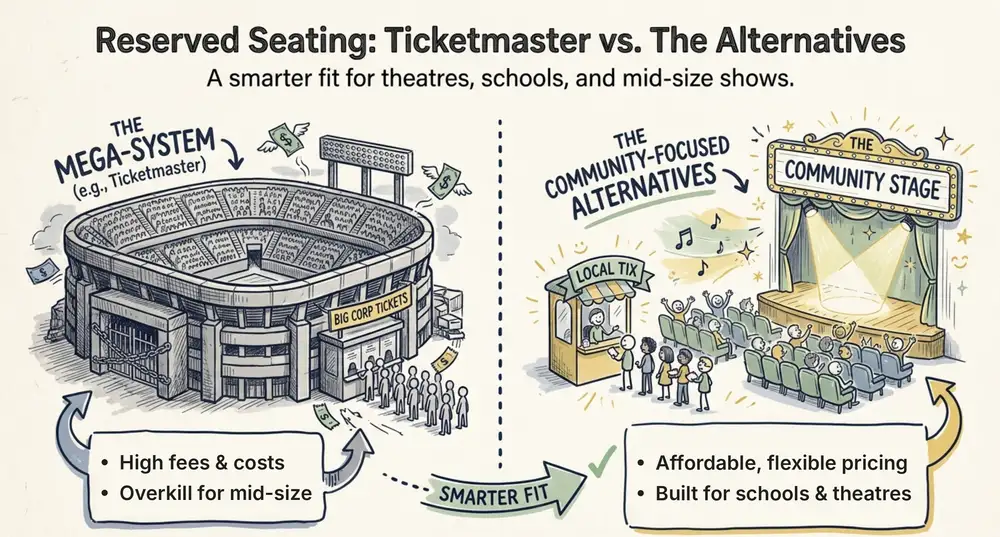
Ticketmaster Reserved Seating: How It Works and a Better Fit for Smaller Events
Ticketmaster reserved seating works well for arenas. If you run a theatre, gala, or mid-size show, see how it works, what it costs, and how to switch.
Ashish Chandra
16 Oct 2026