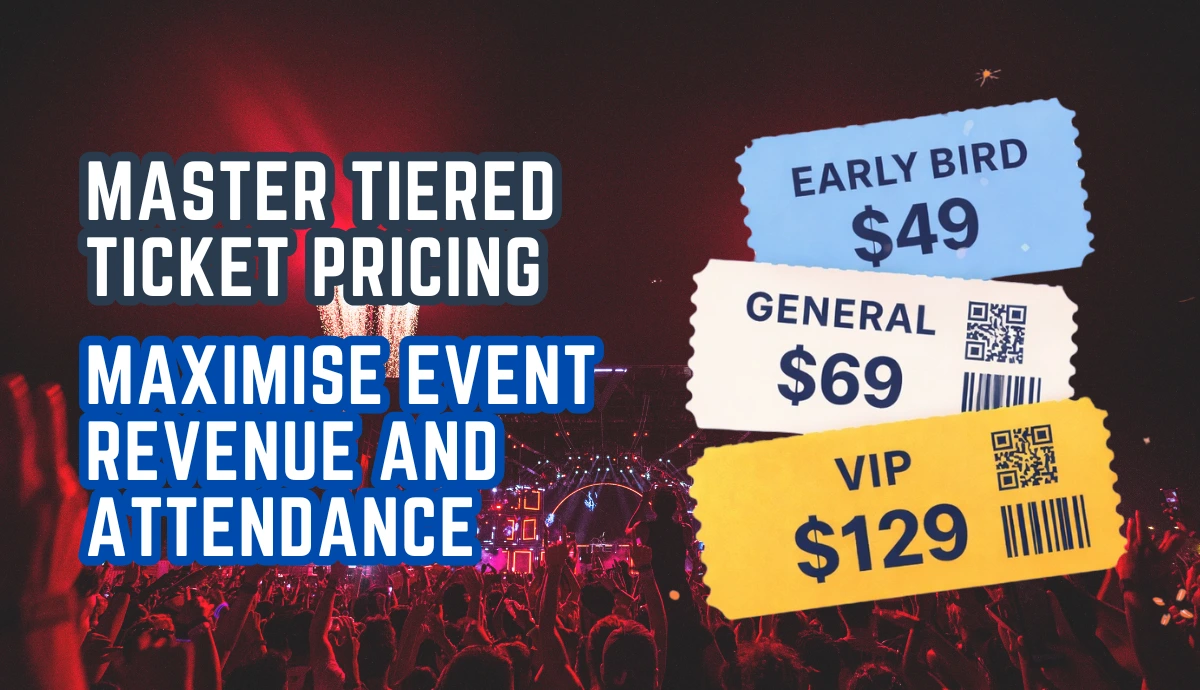
Tiered ticket pricing lets you sell the same event at different price levels.
You reward early buyers, capture higher value from premium attendees, and stay in control of capacity.
When done right, tiered ticketing increases revenue without hurting attendance or trust.
Most events don’t struggle because people don’t want to attend. They struggle because event ticket pricing is too rigid.
A single ticket price assumes all attendees value the event the same way. That’s rarely true.
Some people want the cheapest entry. Some want early access. Others are happy to pay more for better seats, perks, or flexibility.
Tiered ticket pricing solves this mismatch.
Instead of forcing one price on everyone, you offer multiple ticket tiers. Each tier matches a different level of demand, urgency, or experience.
This approach is now common across conferences, concerts, workshops, and corporate events. Even large platforms like Eventbrite promote tiered ticketing as a way to sell tickets faster and reduce last-minute price pressure.
But tiered ticket pricing only works if it’s designed well. Poorly structured tiers confuse buyers and hurt trust.
This guide breaks down how tiered ticketing actually works, when to use it, and how to structure tiers without chaos.
A. What is tiered ticket pricing?
Tiered ticket pricing is a ticketing strategy where the same event is sold at different price levels based on timing, access, or benefits.
Instead of one flat ticket price, you create multiple ticket tiers, such as:
Early access tickets at a lower price
Standard tickets at the regular price
Premium tickets with added benefits
Each tier has clear rules. When one tier sells out or expires, the next tier becomes available.
1. How is tiered ticketing different from dynamic pricing?
Now, this is important. Think of it like this: Tiered ticket pricing is predictable. Dynamic pricing, on the other hand, is constantly changing.
With tiered ticketing:
Prices are fixed in advance
Buyers know what each tier includes
Transitions are transparent
With dynamic pricing:
Prices fluctuate based on demand
Buyers don’t know when prices will change
Trust can suffer if prices jump unexpectedly
For most events, tiered ticket pricing feels fairer and easier to manage.
2. Why do event organizers use tiered ticket pricing?
Tiered ticketing helps you:
Sell tickets earlier
Match price to demand
Offer choice without complexity
Avoid heavy discounting later
It also gives organizers more control over guest flow, access, and revenue timing.
That’s why tiered ticket pricing works especially well for:
Conferences and summits
Paid workshops and trainings
Music and cultural events
Corporate and institutional events
B. Common tiered ticket pricing models (with examples)
Tiered ticket pricing works best when each tier has a clear purpose. It should feel simple to buyers and easy for you to manage. Most events use one of these models or combine two.
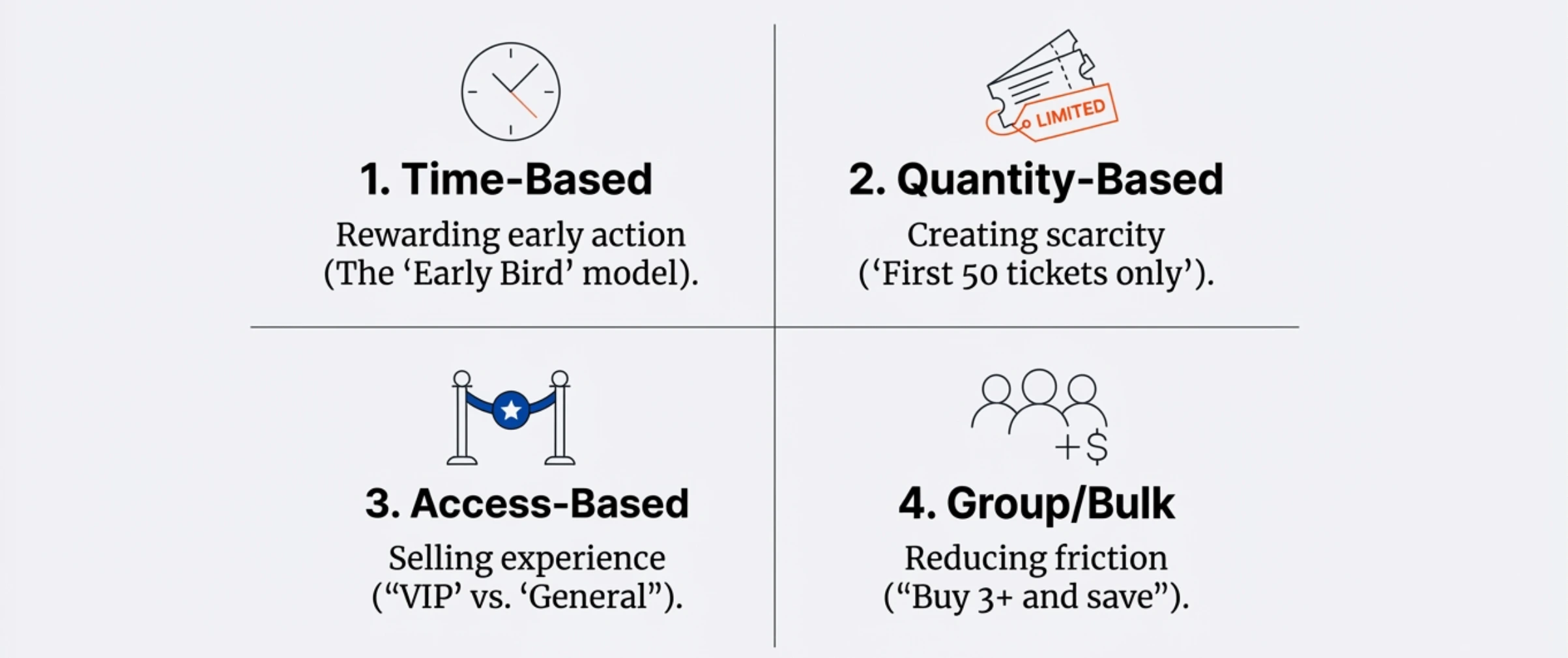
1. Early Bird → Regular → Last-Minute
This is the most common approach. You reward early buyers with a lower price, then increase prices in planned steps as the event gets closer.
Let’s say you’re planning an event and want to reward early buyers. You could start with early-bird tickets at $49, available for the first 100 people or for the first 14 days.
Once those sell out, the price moves up to $79 for general admission. And if someone decides to buy at the last minute or at the door, you can price those tickets at $99.
This works well because people like saving money, and they hate missing a deal. When prices are transparent and deadlines are real, many buyers commit sooner.
2. Access-based tiers (General, VIP, Premium)
This model is not about time. It is about the experience. All ticket types are usually available at once, and buyers choose the level that matches what they want.
For example, General Admission is a basic entry. VIP could include early entry, better seating, or a separate check-in line. Premium might include reserved seating, exclusive sessions, or a lounge.
The key is simple: higher tiers should add real value, not vague “status.”
This model works well for concerts, festivals, and conferences where some attendees will pay more for comfort, access, or time saved.
3. Quantity-based price steps
Here, prices increase after a set number of tickets sell, not on a set date. For example, the first 50 tickets are cheaper. After that tier sells out, the next tier unlocks automatically.
This works because scarcity is easy to understand. “Only 8 tickets left at this price” is a strong nudge without feeling manipulative. It also helps from a marketing perspective, you can use FOMO statements to sell your tickets.
4. Group and bulk pricing
Group pricing is based on the number of tickets sold in a single order. It is common for corporate trainings, workshops, or even concerts.
A simple structure might be: 1 ticket at full price, 3+ tickets at a better price, and 10+ tickets at the best price. This increases tickets per checkout and reduces the work it takes to fill seats.
The rule that makes every tier work: Keep tiers easy to compare, and make the “why” obvious.
Quick check before you publish:
Can a buyer understand the tiers in under 10 seconds?
Does each higher tier include a clear, specific benefit?
Are the rules visible (deadline, quantity, or access)?
C. When tiered ticket pricing works and when it backfires?
Tiered ticket pricing is powerful, but it’s not automatic. It works best in certain situations and quietly fails in others.
Knowing the difference saves you from lost trust and messy sales.
1. When does a tiered ticket pricing work well?
Tiered ticket pricing works when people expect prices to change or value choice.
Let’s say you’re running a conference that’s three months away. Some people are excited and ready to commit early. Others might want to wait until their schedule is clearer. Tiered pricing lets you serve both groups without discounting everyone.
It also works when your event attracts different types of attendees. For example, a workshop might appeal to students on a budget and professionals who care more about access or convenience. One price can’t satisfy both. Tiers can.
Tiered ticket pricing is especially effective when:
You want early cash flow,
You need attendance signals early,
Or you’re offering different levels of experience.
In these cases, tiered pricing feels fair. Buyers understand why prices differ, and no one feels tricked.
2. When does a tiered ticket pricing start to break?
Tiered pricing fails when it feels random, rushed, or unclear.
Imagine visiting an event page and seeing five ticket types with small price differences and vague names. You don’t know which one to pick, so you wait. Or worse, you leave.
Another common mistake is changing prices without explanation. If someone buys a ticket and sees a cheaper tier appear later, trust drops fast. Even if the logic makes sense to you, it won’t to them.
Tiered ticket pricing also struggles when:
The event is very small,
The audience is uniform,
Or the event is free or internal.
In those cases, tiers add friction instead of value.
Set Up Event Ticketing and Distribution in Minutes!
First 10 tickets free | Free account | No credit card required
D. How to design tiered ticket pricing that actually converts into sales?
Tiered ticket pricing only works when the tiers feel intentional. Not clever. Not complicated. Just logical.
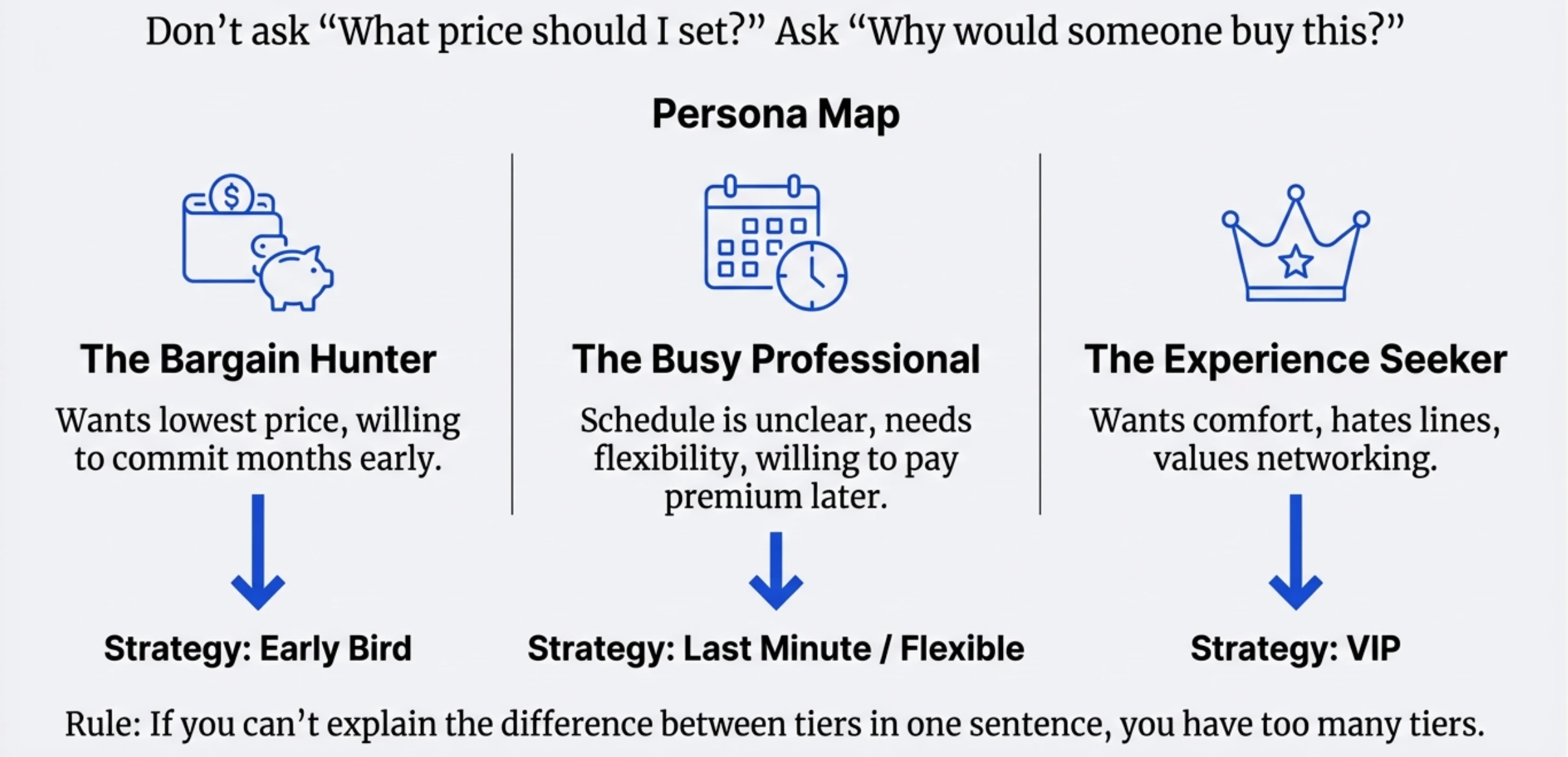
1. Start with buyer intent, not price gaps
Most pricing mistakes happen because organizers start with numbers.
They ask, “What prices should I set?” Instead of, “Why would someone buy this tier?”
Flip that thinking.
Let’s say you’re hosting a workshop. Some people want the lowest possible price and are happy to commit early. Others want flexibility and don’t mind paying more later. A smaller group wants extra access or convenience.
Those are three different intents. Your tiers should map to those intents, not arbitrary price jumps. When each tier matches a clear reason to buy, pricing feels fair instead of forced.
2. Keep the number of tiers low
More tiers don’t mean more revenue. They usually mean more confusion.
In most cases, two to three tiers perform best. Sometimes, four works for large events with clear access differences. Anything beyond that increases hesitation.
If someone has to compare too many options, they delay the decision. And delayed decisions often turn into no decisions.
A simple rule: If you can’t explain the difference between tiers in one sentence each, you have too many.
3. Name your tiers like a human, not a spreadsheet
Tier names matter more than most organizers realize.
“Tier 1,” “Tier 2,” and “Tier 3” force people to read everything carefully. That slows them down. Which might increase drop-offs.
Clear names do the thinking for the buyer. For example, “Early Bird” instantly explains why the price is lower. “VIP” signals added value without explanation. “Last-Minute” sets expectations before anyone clicks.
Good names reduce questions. Bad names create doubt.
4. Make the upgrade feel worth it
The jump between tiers should feel justified, not sneaky.
If someone moves from a lower tier to a higher one, they should gain something obvious. That could be time saved, better access, flexibility, or comfort. It should never feel like they’re paying more for almost the same thing.
5. Set clear rules and stick to them
If early-bird tickets are limited by time or quantity, say so upfront. If a tier sells out, let it stay sold out.
People don’t mind paying more later if they understand why. They do mind feeling tricked.
This is where many event organizers struggle with tiered ticket pricing and why simpler tools and workflows matter.
E. Use cases where tiered ticketing actually worked
Case 1: Conference that needed early commitment
An industry conference struggled every year with late registrations. Marketing worked, but most people waited until the last two weeks to buy.
The organizers introduced three tiers based purely on time. Early-bird tickets were priced lower and clearly positioned as a reward for committing early. Once that window closed, the price moved up and stayed there. No surprise discounts later.
The result was simple: more tickets sold in the first month, better attendance forecasting, and less panic marketing near the event date.
Case 2: Workshop with mixed audiences
A paid workshop attracted both students and working professionals. A single price wasn’t working. Lowering it hurt revenue, raising it reduced student attendance.
They introduced two audience-based tiers. Students got a lower-priced ticket with standard access. Professionals paid more but received added value, such as post-event materials and priority seating.
Attendance increased across both groups, and pricing felt fair instead of forced. No one felt subsidized or excluded.
Example 3: Event with uncertain demand
An event team wasn’t sure how strong the demand would be. Setting deadlines felt risky, but they still wanted momentum.
They used quantity-based tiers. The first batch of tickets was cheaper, and prices increased automatically as each batch sold out. No dates were mentioned, only availability.
This worked because pricing adjusted naturally with demand, without the pressure of time-bound messaging.
What do all these examples have in common? None of these events relied on clever tricks.
They all did three things well:
Changed only one variable per tier
Made the reason for each price obvious
Defined the rules before selling began
That’s what makes tiered ticket pricing work in real conditions.
F. How does tiered ticket pricing fit into a modern ticketing setup?
Tiered ticket pricing doesn’t stop at pricing. It shapes how people enter your event, how your team manages access, and how smoothly everything runs on the day.
A modern setup connects pricing, entry, and operations into one clean flow.
1. Pricing and entry must be smooth
Every ticket tier sets an expectation. Early-bird buyers expect standard access at a better price. VIP buyers expect priority. Group tickets expect flexibility.
If pricing tiers aren’t tied clearly to entry rules, confusion shows up at the gate. Staff pause. Attendees ask questions. Lines grow.
A clean setup treats each tier as a defined access level. QR-based tickets make this simple because every scan instantly confirms what that ticket allows.
Pro Tip: With
Ticket Generator
, each ticket tier (Early Bird, General, VIP) can be mapped directly to QR-based entry rules. That keeps check-ins fast and removes manual decision-making at the door.
2. Predictable pricing model
Predictable pricing avoids stress. When tiers are set up front, and transitions happen automatically, buyers trust the process. Teams don’t have to explain pricing decisions during the event.
This is easier when you’re not losing money to ticketing fees.
Pro Tip:
Ticket Generator
supports commission-free ticket sales, so organizers don’t need to constantly adjust prices to offset platform fees. You can keep ticket tiers stable and fair from launch to the last scan.
3. Clean tiers mean useful data
Tiered pricing isn’t just about revenue. It’s about learning what worked. When tiers are clearly defined, you can see:
Which price point converted best?
When did people buy more?
And which ticket types actually showed up?
If tiers overlap or change mid-way, the data becomes noisy and unreliable.
Pro Tip:
Ticket Generator
keeps tier-level sales and attendance data clean, so you can compare Early Bird vs General vs VIP performance without manual cleanup after the event.
Final Takeaway
Tiered ticket pricing works when it’s simple, predictable, and operationally aligned.
The goal isn’t to outsmart buyers. It’s to give them clear choices, reward early commitment, and keep your event running smoothly from sales to scanning.
When pricing, access, and data all work together, tiered ticketing stops feeling like a pricing tactic and starts feeling like good event design.
If you’re setting up tiered ticket pricing and want commission-free sales, clear Early Bird / General / VIP ticket types, and QR-based entry that stays calm at scale, tools like Ticket Generator make it easy to keep pricing clean without overengineering your setup.
Your event. Your pricing. Your rules.
Set Up Event Ticketing and Distribution in Minutes!
First 10 tickets free | Free account | No credit card required
Tiered ticket pricing is a pricing strategy where the same event is sold at different price levels based on timing, access, quantity, or audience type.
Instead of one flat price, organizers offer multiple ticket tiers such as early bird, general admission, or VIP.
2. How does tiered ticket pricing increase ticket sales?
Tiered ticket pricing increases sales by rewarding early buyers, creating urgency, and offering choices.
People who want a lower price buy early, while others pay more for flexibility or added benefits. This helps sell tickets faster without discounting everyone.
3. What are the most common types of tiered ticket pricing?
The most common types include early bird pricing, access-based tiers (General vs VIP), quantity-based tiers, group pricing, and audience-based pricing (such as student or member tickets). Most events use two or three of these at most.
4. How many ticket tiers should an event have?
Most events perform best with two or three ticket tiers. Fewer tiers reduce confusion and speed up buying decisions. More than three tiers often leads to hesitation and lower conversions unless access differences are very clear.
5. Is tiered ticket pricing better than dynamic pricing?
Tiered ticket pricing is usually better for events because it is predictable and transparent. Prices change based on clear rules like time or quantity, not fluctuating demand. This builds more trust compared to dynamic pricing, where prices change unpredictably.
6. When should you avoid using tiered ticket pricing?
Tiered ticket pricing should be avoided for very small events, internal-only events, or events with a uniform audience and no access differences. In these cases, tiers add complexity without real benefit.
7. What tools support tiered ticket pricing effectively?
A good ticketing tool should allow multiple ticket types, automate tier transitions, support commission-free sales, and handle tier-based access at entry.
Platforms like Ticket Generator support tiered pricing with Early Bird, General, and VIP tickets while keeping setup simple and predictable.
Ashish Chandra has spent 5+ years writing about event technology, covering topics such as ticket design, QR check-ins, attendee management, and event marketing strategy. As the Content Lead at Ticket Generator, Ashish has analyzed hundreds of real-world event workflows and ticketing setups, helping organizers across industries use QR-based tickets, event landing pages, and smarter ticketing systems to run smoother, better-attended events.
His writing is shaped by real user needs and the questions organizers ask most often: How do I sell more tickets? How do I avoid chaos at the door? How do I make my next event better than my last?
When he steps away from the screen, you'll likely find him hiking a quiet trail or tending his plants- his preferred way to reset.






.png)





.webp)

.svg)
.svg)