The best customizable event ticketing platform is the one that disappears behind your brand, not the one with the most colour pickers.
Customization runs across five layers: ticket artwork, event page, checkout, web address and email sender.
Most tools only customize the ticket. Full white-label control is usually a paid add-on or a sales call.
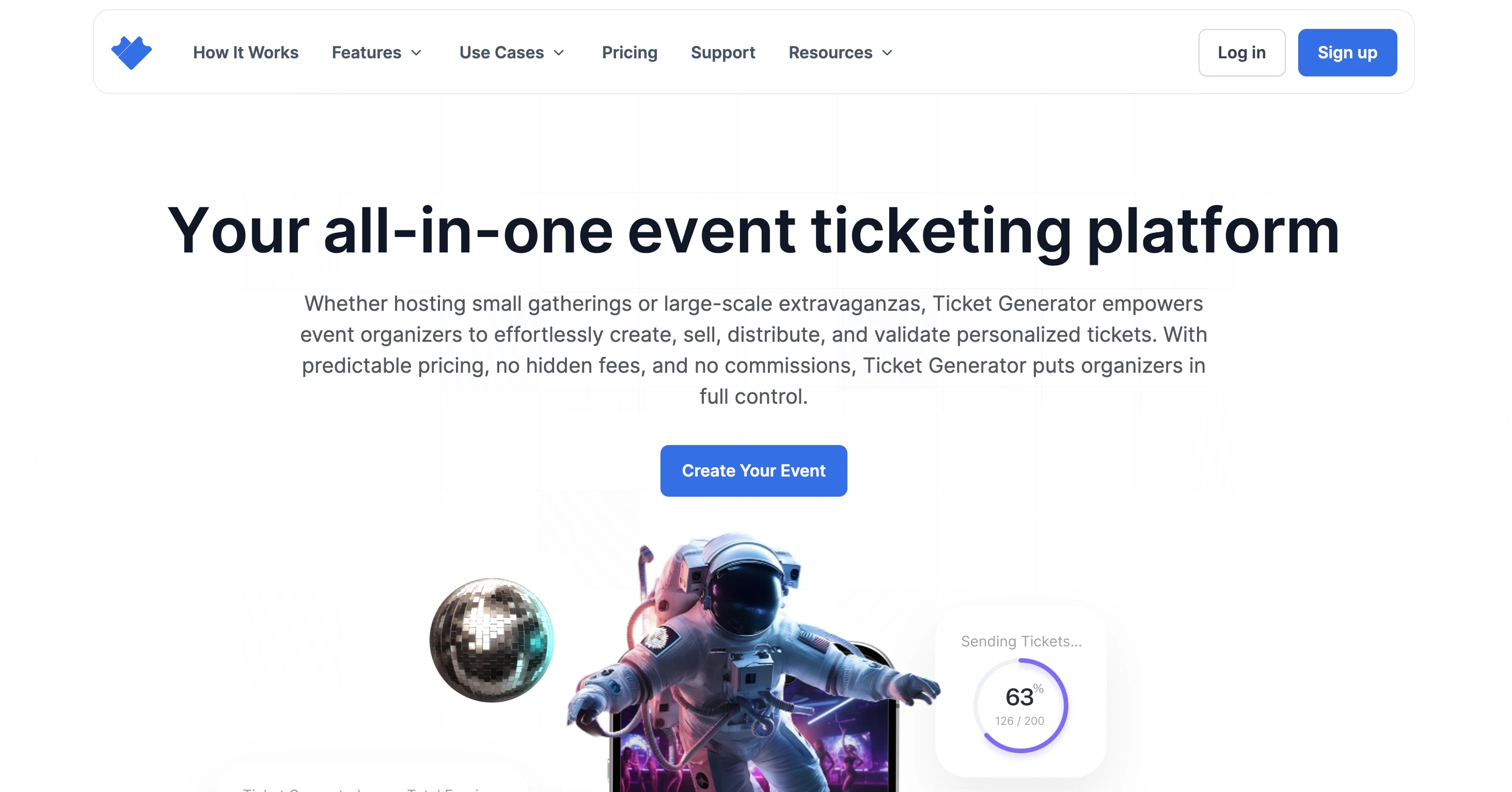
Ticket Generator includes custom domains, branded event pages and watermark-free tickets on credit-based pricing.
Check who owns the payment gateway before you compare any feature list.
Your attendees do not meet your brand on your poster. They meet it on a checkout page, on a phone, thirty seconds before they hand over money. And if that page carries somebody else’s logo, that is the brand they remember.
Did You Know?About 58 percent of online event ticketing transactions now happen on mobile devices (2025). Source: Mordor Intelligence.
So here is the short answer. The best customizable event ticketing platform is the one that lets you control the entire purchase path under your own name: your domain, your logo, your colours, your sender address and your payment account. Almost every tool on the market will let you restyle a ticket. Far fewer will let you restyle the platform itself.
I have watched organizers spend a week perfecting ticket artwork, then send buyers to a checkout URL that reads like a stranger’s website. The artwork was never the weak link.
In this guide I break down the five layers of ticketing customization, explain what white label actually includes, compare seven platforms side by side, and give you a short checklist for picking the right one for your events.
What does a customizable ticketing platform actually customize?
A genuinely customizable platform lets you change five layers, not one. Ticket artwork is only the first and the easiest.
When you shortlist tools, check each layer separately, because vendors tend to advertise the whole thing on the strength of layer one:
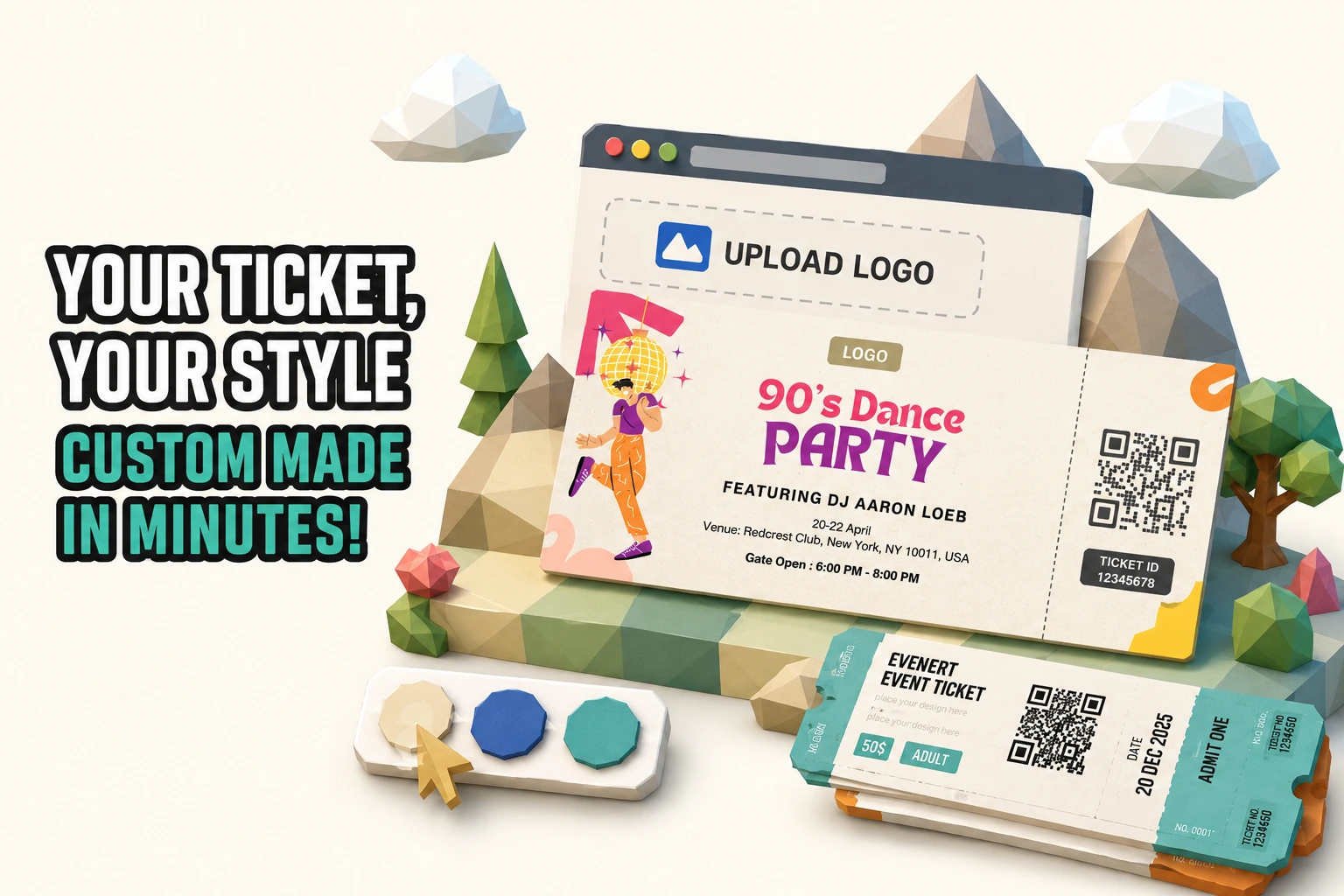
Ticket artwork. Your logo, colours, fonts, sponsor marks and variable fields such as guest name, seat and row. Watch for a platform watermark you cannot remove.
Event page. Banner images, description, organizer details and the registration fields you actually need, rather than a fixed template.
Checkout. Whether the payment step still shows vendor branding, and whether other events get promoted to your buyers on the way through.
Web address. Whether the URL bar says your domain or the vendor’s. This is the fastest tell of how much control you really have.
Emails and tickets in the inbox. Who the confirmation appears to come from, and whose name sits in the footer.
Layer one is table stakes in 2026. If you only need branded artwork and printable stock, our guide to printable customizable tickets covers that ground properly, and the event ticket design page shows the designer itself. This article is about the other four layers.
What is white-label ticketing, and do you actually need it?
White label ticketing means selling through software that shows only your brand: your logo, your colors, your domain, and your email sender, with no visible sign of the vendor underneath. Co-branded is the weaker cousin, where your logo sits on the vendor’s page at the vendor’s URL.
The two reliable tell are the address bar and the "from" line on the confirmation email. If either belongs to the vendor, you are co-branded, whatever the pricing page calls it.
This matters more than it sounds, because unfamiliar branding at the payment step reads as risk.
A branded checkout does not remove fees. It removes the second wobble, the one where the buyer is not certain they are still in the right place.
Who needs white label, and who does not
Worth paying for: agencies ticketing on behalf of clients, venues with a repeat audience, corporate teams bound by brand guidelines, and universities running events under an institutional identity.
Usually not worth it: a single public event where you want the vendor’s marketplace to help you find an audience. In that case discovery beats brand control, and platforms like Eventbrite earn their fee. Our comparison of Eventbrite alternatives walks through that trade off.
"Organizers assume white label is about vanity. It is not. When the domain, the checkout and the confirmation email all carry the organizer’s name, support tickets drop, chargeback disputes drop, and repeat buyers come back directly instead of through a marketplace."
Anshul Singh Bisht, Head of Event Technology, Ticket Generator
Which are the best customizable event ticketing platforms in 2026?
The strongest options for branding control are Ticket Generator, Ticket Tailor, Accelevents, SquadUP, Eventtive, TicketSpice and Eventcube. They differ far less on features than on what the branding controls cost and how hard they are to switch on.
Platform
Branding controls you get
Custom domain
What it costs you
Best for
Ticket Generator
Branded event page, logo and theme, watermark-free tickets, custom email sender, white-label REST API
Yes, included
Credits from about $0.60 down to $0.25 per ticket. Zero sales commission. Your own Stripe, PayPal or Razorpay account
Agencies, corporates, campuses and nonprofits that want brand control without a commission or a sales call
Ticket Tailor
Logo removal on the box office, theme and colour editor, custom ticket backgrounds on white-label only
Yes, paid
Low per-ticket fees plus a paid white-label add-on. Custom domain is free once white-label is active
Small organizers who want a clean, simple branded box office
Flat annual subscription. The White Label tier is quote-based with no public pricing
Enterprise and association teams running large multi-format programmes
SquadUP
Fully white-labelled front end, your branding across checkout, event pages and communications
Yes, subdomain
Custom quote. Flat rate, a percentage of sales, or a mix of both
Venues and festivals that want a managed, venue-first white-label build
Eventtive
Branded event pages, organizer-controlled pricing, promotions and platform fee behaviour
Not documented
Flat fee per ticket, with the first 100 tickets sold at zero platform commission
Organizers in African markets using Paystack or Flutterwave
TicketSpice
Custom CSS on ticketing pages, no forced platform logo, full page-level design control
Yes
Flat $0.99 per ticket plus card processing of about 2.9% and $0.30
Organizers who want a ticketing page that doubles as a landing page
Eventcube
Brand-free checkout, custom domains, control over customer data and payment processing
Yes
Free tier at a 5% booking fee, Pro at 3%, custom enterprise pricing
Membership-led brands and enterprise teams that want zero visible vendor branding
Note: Pricing and plan details were checked against each vendor’s own documentation in August 2026.
1. Ticket Generator: branded ticketing without the commission
Ticket Generator gives you a custom domain, a branded event page, watermark free tickets and a white label REST API without a sales call. Pricing is credit based, so you pay per ticket generated rather than a slice of every sale, and payments land in your own Stripe, PayPal or Razorpay account.
The trade-off is honest: there is no public marketplace pushing traffic to your event. This suits organizers who already have an audience.
2. Ticket Tailor: the simplest route to a clean box office
Ticket Tailor is the closest model match to Ticket Generator, since it is also low fee and routes payments through your own processor. White label is sold as an add-on that removes the Ticket Tailor logo from your box office, and activating it unlocks a custom domain at no extra cost. Custom ticket background images are also gated behind the white label.
Ticket Tailor states plainly that only the front-end buyer experience is white-labeled. It is a strong, uncomplicated choice for smaller organizers.
3. Accelevents: white label as an enterprise tier
Accelevents packages branding as a pricing tier rather than a toggle. The White Label plan covers branding removal, a custom URL, a custom email domain, a branded event app, and single sign-on, and Accelevents confirms on its own pricing page that Enterprise and White Label options are customized and quoted individually.
Billing is a flat annual subscription with no platform transaction fee, which suits high-volume programs. For a ten-person workshop, it is overkill.
4. SquadUP: a managed white-label build for venues
SquadUP is built around venues and festivals that want the whole thing operated under their own name, typically on a subdomain such as tickets.yourvenue.com. Its white label pricing is quoted per client as a flat rate, a percentage of sales, or a combination.
You get a serious branded build. You also get a procurement conversation before you can sell a single ticket.
5. Eventtive: branded ticketing built for African markets
Eventtive offers branded event pages, organizer-controlled pricing and promotions, and integrations with Paystack, Flutterwave, and Stripe. It advertises a flat fee per ticket sold and zero platform commission on your first 100 tickets.
Deep white label controls, such as custom domains, are not documented publicly, so treat it as a strong regional option rather than a full white label platform.
6. TicketSpice: page-level design control
TicketSpice is the pick if you want the ticketing page itself to behave like a landing page, with custom CSS, navigation, and layout blocks. There is no forced platform logo, and custom domains are supported. Pricing is a flat 99 cents per ticket plus card processing.
On higher-priced tickets, that flat fee is excellent value. On cheap community tickets, it stings more than a percentage would.
7. Eventcube: brand-free checkout and data ownership
Eventcube leans hard into removing every visible trace of itself, including custom domains, a brand-free checkout and control over customer data and payment processing. Pricing runs from a free tier at a 5 percent booking fee to Pro at 3 percent, with custom enterprise deals above that.
It is a percentage model, so your cost scales with ticket price. Worth modelling against a flat per ticket cost before you commit.
Want your domain, your logo and your payment account on every ticket you sell? Start free with Ticket Generator and publish a fully branded event page today.
How do you choose the right customizable ticketing platform?
Start with the one branding layer you refuse to compromise on, then check what that layer costs on each shortlisted platform. Feature grids hide the price of control.
Run these six checks before you commit:
Open a live checkout from each vendor. Look at the URL bar and the confirmation email. That answers more than any feature page.
Ask what white label costs. Is it included, an add on, a higher tier, or a quote? The answer varies wildly across this list.
Check who holds the money. If payments route through your own gateway, your name appears on the buyer’s bank statement and you are paid immediately.
Model your real volume. A percentage fee and a flat per ticket fee cross over at a specific ticket price. Find yours before you sign.
Test the mobile view. Most of your buyers are on a phone, so a branded desktop page that collapses on mobile is not branded.
Confirm data ownership. Can you export attendee data freely, and will the vendor market other events to your buyers?
How does Ticket Generator give you branding control end to end?
Ticket Generator is built for organizers who want their own brand on every touchpoint without paying a commission for the privilege. Branding controls are part of the product, not a tier you negotiate for.
Here is what that covers in practice:
Custom domain. Serve your event pages from your own subdomain, such as tickets.yourbrand.com, across both live and test URLs.
Branded event page and checkout. Your banner, logo, colours, description, organizer details and your own registration fields, with no competing events promoted to your buyers. See how a full event landing page comes together.
Watermark free tickets. Use the drag and drop designer, generate a design with AI, or open your ticket in Canva and import it straight back. No platform logo is stamped on the output.
Your sender, your inbox. Campaigns lets you run event email marketing with custom templates and custom sender details, so promotion and confirmations both read as you.
Your payment account. Money moves through your own Stripe, PayPal or Razorpay account. Zero commission on ticket sales, and your name on the buyer’s statement.
White label API. Generate and send tickets from inside your own system with the Ticket Generator API, so attendees never leave your product at all.
Heartland Emmys has run this way for four consecutive years, issuing more than 3,433 tickets across 10 plus events under its own identity. Across the platform, Ticket Generator has powered over 1,000,000 tickets and 30,000 plus events in 100 plus countries.
Pro Tip: Set your custom domain before you publish your first event page, not after. Ticket Generator applies it to both live and test URLs, so your links, QR codes and shared previews all carry your brand from day one instead of needing to be reissued.
The practical gain is simple. Buyers recognise you at every step, your team stops fielding "is this legitimate?" emails, and the audience you built stays yours.
Conclusion
Customization is not one feature. It is five layers, and most platforms only hand you the first one for free.
Be realistic about what you need. A one off public event may genuinely benefit from a marketplace, and paying for white label there is money spent on the wrong problem. But if you run recurring events, ticket on behalf of clients, or work under strict brand guidelines, the domain and the sender address are not cosmetic details. They are the difference between an audience that belongs to you and one that belongs to a vendor.
Compare on what branding control costs, not on how many colour options appear in a screenshot. Ticket Generator was built so that control is included rather than upsold.
Try Ticket Generator to sell tickets under your own domain, your own design and your own payment account, with no commission taken from any sale. Your event. Your revenue. Your rules.
FAQs: Customizable and White Label Event Ticketing
1. What is the best customizable event ticketing platform?
It depends on which branding layer matters most to you. Ticket Generator is the strongest fit for organizers who want a custom domain, branded pages and commission free pricing included as standard, while Accelevents and SquadUP suit large enterprise or venue programmes that can absorb a custom quote.
2. What is white label ticketing?
White label ticketing is selling tickets through software that displays only your brand. Your logo, colours, domain and email sender appear throughout, and the vendor stays invisible to your buyers. Co-branded setups still show the vendor’s URL or logo somewhere in the flow.
3. Does white label ticketing cost extra?
On most platforms, yes. Ticket Tailor sells it as a paid add on, Accelevents places it in a quote based top tier, and SquadUP prices it per client. Ticket Generator includes custom domains and branded pages within its standard credit based pricing.
4. Can I use my own domain for event ticket sales?
Yes, on most serious platforms. Ticket Generator lets you point your own subdomain at your event pages for both live and test URLs. Ticket Tailor, TicketSpice, Eventcube and Accelevents also support custom domains, though usually on a paid plan or add on.
5. Will my attendees know which ticketing platform I use?
Not if the platform is genuinely white label. With Ticket Generator, tickets carry no platform watermark, event pages sit on your domain, and payments run through your own gateway, so your name is what appears on the buyer’s bank statement.
6. Is a customizable ticketing platform worth it for a small event?
Often yes, because the cost is lower than people expect. Ticket Generator starts at 10 free credits with packs from $6, and registered nonprofits get 30 percent off, so a 200 person community event can run fully branded for less than most percentage based platforms would take in fees.
Ashish Chandra has spent 5+ years writing about event technology, covering topics such as ticket design, QR check-ins, attendee management, and event marketing strategy. As the Content Lead at Ticket Generator, Ashish has analyzed hundreds of real-world event workflows and ticketing setups, helping organizers across industries use QR-based tickets, event landing pages, and smarter ticketing systems to run smoother, better-attended events.
His writing is shaped by real user needs and the questions organizers ask most often: How do I sell more tickets? How do I avoid chaos at the door? How do I make my next event better than my last?
When he steps away from the screen, you'll likely find him hiking a quiet trail or tending his plants- his preferred way to reset.





.png)






.webp)

.svg)
.svg)