

Top Event Registration Platforms for Nonprofits Compared (2026)
 Written byAshish ChandraLast updatedAugust 20, 2026
Key Takeaways:
- Event registration platforms for nonprofits split into two camps: fundraising suites that bundle donations, and ticketing tools built for paid events and gate control.
- Zeffy and Givebutter cost your organization nothing when donors cover the fee.
- Humanitix charges a discounted nonprofit booking fee and gives its profits to charity.
- All three of those models are percentage-based, so the cost climbs as your ticket price climbs.
- Ticket Generator pricing charges a flat fee in prepaid credits with a 30% nonprofit discount and zero commission.
Most nonprofit ticketing advice starts with the wrong question. It asks which platform is free. The better question is where the fee lands and whether it grows with your ticket price.
Did you know that 48% of US shoppers abandon checkout when extra costs such as fees are too high? It is the single biggest reason people bail. Source: Baymard Institute (February 2024 survey of 1,012 US adults)
Here is the short answer. The best event registration platforms for nonprofits fall into four models: zero fee funded by optional donor tips (Zeffy, Givebutter), a charitable booking fee paid by the buyer (Humanitix), a donor CRM with events attached (Bloomerang), and flat prepaid credits with no commission (Ticket Generator).
Free events run fine on any of them. Paid events are where the models separate, and where most boards discover the difference too late.
I have helped event teams move on and off these platforms for years. The pattern is consistent: the option that looks cheapest for a $20 community breakfast is rarely the cheapest for a $150 gala seat.
In this guide I compare the five platforms nonprofits shortlist most, show what each costs at three real ticket prices, and explain which features matter once your event moves from a signup form to a door with a queue behind it. If you are specifically replacing Eventbrite, I have a narrower guide on Eventbrite alternatives for nonprofits.
Let's get straight to it then.
What are the best nonprofit event ticketing platforms in 2026?
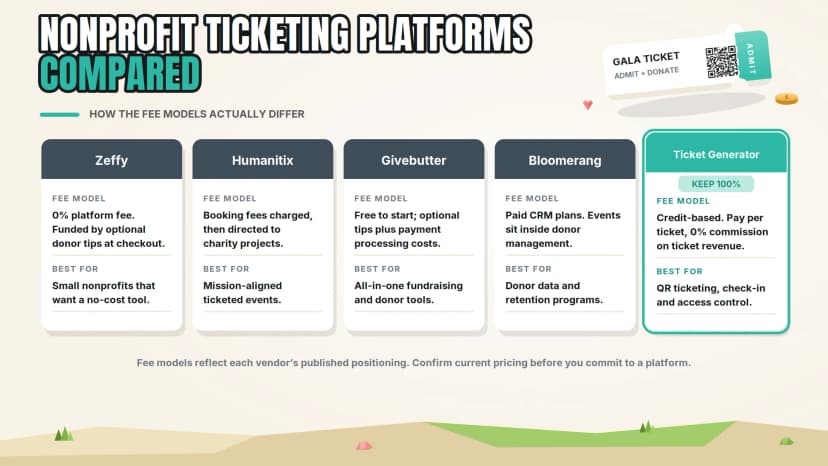
The five platforms nonprofits shortlist most are Zeffy, Humanitix, Givebutter, Bloomerang, and Ticket Generator. Zeffy and Givebutter are free to your organization when donors cover the fee, Humanitix routes its booking fee profits to charity, Bloomerang leads with donor CRM, and Ticket Generator charges flat prepaid credits with zero commission.
Four of the five are fundraising platforms that added ticketing. Only one was built as a ticketing and access control system first. That difference shows up on event day more than it shows up in a feature list.
|
Platform |
Cost to your nonprofit |
Who pays |
Where the fee goes |
Scales with ticket price? |
Best for |
|---|---|---|---|---|---|
|
Zeffy |
$0 platform and processing fees |
Donor, via an optional tip at checkout |
Zeffy, funded entirely by voluntary donor tips |
No fee at all, but tip size often does |
Small and volunteer led orgs running free or low cost events |
|
Humanitix |
3.9% + $1.29 per paid ticket at the registered nonprofit rate (processing included) |
Buyer by default, so you keep 100% of face value |
100% of booking fee profits go to education and healthcare causes |
Yes, percentage based |
Mission aligned organizers who want the fee itself to do good |
|
Givebutter |
$0 when donor tips are enabled. 3% platform fee plus processing when tips are off. Givebutter Plus from $29/month |
Donor, via an optional tip, or your org if tips are disabled |
Givebutter, funded by voluntary donor tips |
Yes, when tips are off |
Orgs wanting donation forms, auctions, CRM, and ticketing in one login |
|
Bloomerang |
CRM from $125/month billed annually. Events are a module inside the CRM |
Your organization, as a subscription |
Bloomerang, as software revenue |
No, but the subscription is fixed overhead |
Established orgs that want every ticket to land on a donor record |
|
Ticket Generator |
Flat prepaid credits with a 30% nonprofit discount. Roughly $0.28 per ticket at the 1,000 credit pack |
Your organization, a few cents per ticket. No buyer facing platform fee or tip prompt |
Nothing is skimmed off your ticket price. 100% of the sale stays with your cause |
No. A $150 seat costs the same credit as a $15 one |
Paid fundraisers, galas, and any event where branding and gate control matter |
A note on how to read that table. Zeffy and Givebutter genuinely cost your organization nothing, and for a small volunteer-led group, that is hard to beat. The trade off is that the cost moves onto your donor's checkout screen as a suggested tip. Some boards are entirely comfortable with that. Others would rather the ask be for the mission and nothing else.
Who actually pays the fee, and where does that money go?
On Zeffy and Givebutter the donor pays through an optional tip. On Humanitix the buyer pays a booking fee whose profits go to charity. On Bloomerang you pay a fixed subscription. On Ticket Generator nobody pays a platform percentage, because you prepay a flat credit instead.
This is the question the nonprofit ticketing category has organized itself around, and it is worth being precise about it.
- Zeffy and Givebutter: the fee is a voluntary tip added at checkout. Your organization pays nothing. Your supporter is asked to cover the platform on top of their ticket.
- Humanitix: a registered charity that has donated more than $13.8 million to education and healthcare programs since 2016. The booking fee is real, but its profits fund causes rather than shareholders. That is a genuinely good story and worth telling your board.
- Bloomerang: a conventional software subscription. The fee funds the CRM, and events are one module of it.
- Ticket Generator: you buy credits up front. One credit generates one ticket. There is no percentage on the sale, no buyer facing service charge, and no tip prompt in front of your donor.
So there are really two separate questions, and most comparison articles only answer the first. Question one is where the fee goes. Question two is whether the fee scales with your ticket price. Zeffy, Givebutter, and Humanitix answer the first question well. Ticket Generator is built to answer the second.
That distinction matters more as your ticket prices rise. A percentage fee on a $25 community workshop is barely noticeable. The same percentage on a $150 gala seat is a line item your treasurer will ask about. Fee transparency is also no longer optional: mandatory fees have to be shown up front. The same logic applies to no fee tickets generally.
Did you know that the FTC's Junk Fees Rule (16 C.F.R. Part 464) took effect on May 12, 2025, requiring live event ticket sellers to show the total price, including all mandatory fees, up front? It applies to nonprofits too, with no exemption based on tax status. Source: U.S. Federal Trade Commission
What does each platform cost on a $25, $75, and $150 ticket?
Percentage-based platforms cost more as your ticket price rises, while flat credit pricing does not move at all. On a $150 seat, a nonprofit rate booking fee runs about $7.14 per ticket. The equivalent Ticket Generator credit is roughly $0.28, plus whatever your own payment gateway charges.
|
Ticket price |
Zeffy |
Humanitix (nonprofit rate) |
Givebutter (tips off) |
Ticket Generator (nonprofit credit) |
|---|---|---|---|---|
|
$25 |
$0 to you. Donor sees an optional tip |
$2.27 per ticket, buyer paid, processing included |
$0.75 platform fee plus processing |
$0.28 plus your own gateway processing |
|
$75 |
$0 to you. Donor sees an optional tip |
$4.22 per ticket, buyer paid, processing included |
$2.25 platform fee plus processing |
$0.28 plus your own gateway processing |
|
$150 |
$0 to you. Donor sees an optional tip |
$7.14 per ticket, buyer paid, processing included |
$4.50 platform fee plus processing |
$0.28 plus your own gateway processing |
Two honest caveats so you can compare like for like. First, the Humanitix figures include card processing, while the Ticket Generator figures do not, because payments run through your own Stripe, PayPal, or Razorpay account at roughly 2.9% plus $0.30. Second, the Humanitix fee is passed to the buyer by default, so your organization keeps 100% of the face value, while the Ticket Generator credit is an organizer side cost of a few cents.
Run the math on your own event rather than on an average one. For 250 seats at $75, a nonprofit rate booking fee adds roughly $1,054 to your buyers' totals. The same 250 tickets on prepaid credits cost your organization about $70.
Try Ticket Generator to run your next fundraiser on flat, commission free pricing with a 30% nonprofit discount. Start with 10 free credits.
What features matter most in event registration platforms for nonprofits?
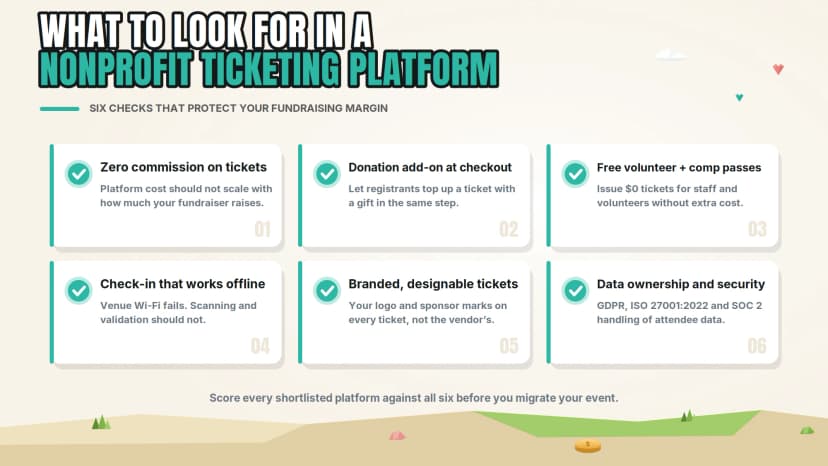
The features that decide a nonprofit event are donation collection at signup, a real nonprofit discount, QR check-in with duplicate detection, full branding and data ownership, and a setup that a volunteer can learn in an afternoon. Everything else is a nice-to-have.
Here is the checklist I give every nonprofit team I work with, in priority order.
- Donation collection inside registration. The moment someone signs up for your charity walk is the moment they care most. If your form cannot take an extra $25 right there, you are leaving money on the table.
- A real nonprofit discount. Not a coupon on an upsell. An actual reduced rate on the thing you use every day.
- QR check in and duplicate detection. A gala with 400 guests and two volunteers at the door needs scanning, not a printed list. Duplicate flagging matters the moment someone forwards their ticket to a friend.
- Branding and data ownership. Your attendee list is your donor list. It should live with you, on pages that look like your organization rather than a marketplace.
- Mobile first registration. Most supporters sign up on a phone, and a form that fights them on mobile costs you registrations before you ever see them.
- Clean export or CRM sync. Getting your attendee data into Excel, or into your donor database, should take a few clicks and not an afternoon.
There is one more thing that rarely makes a feature comparison, and it is the reason most organizers actually switch. Anshul Singh Bisht, Head of Event Technology at Ticket Generator, put it plainly:
"Nine out of ten organizers we onboard mention counterfeit prevention as the first reason they're switching; the cost and speed factors are added benefits. They've faced duplicate tickets at the gate, refund disputes, guests who claim they paid but aren't on the list, and they don't want to live that twice."
Anshul Singh Bisht, Head of Event Technology, Ticket Generator
Fundraising platforms are excellent at the money. They are frequently thinner on the door. If your events are ticketed and gated, look closely at how each platform handles QR code check in and what happens when the same code is scanned twice.
How do you turn event registration into fundraising revenue?
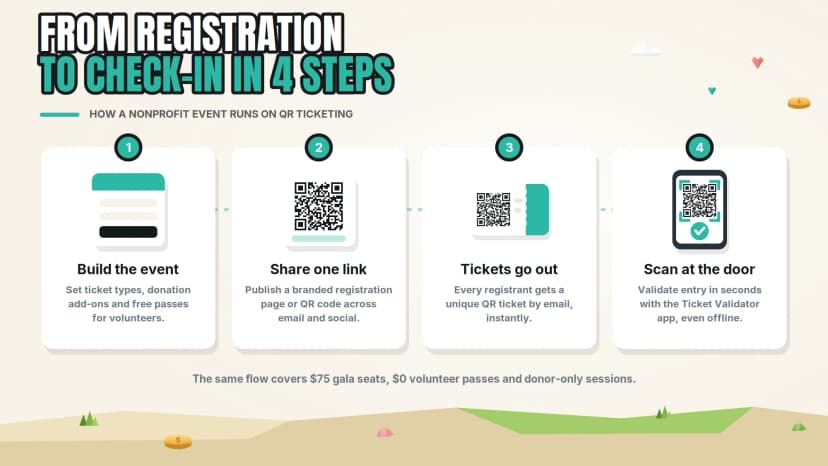
Add a donation step inside registration, offer tiered ticket levels, and write your asks in mission language rather than generic donate buttons. Those three changes do more for event revenue than switching platforms usually does.
- Ask during signup, not after. Add suggested amounts to your registration form. Most supporters choose the middle option, so the amounts you list set your average gift.
- Build ticket tiers. Admission only, supporter, and sponsor levels let people self select their contribution while feeling they got value for it.
- Use mission-specific language. “Sponsor a book for $15” outperforms “Donate now” because it tells the supporter exactly what their money becomes.
- Sell add-ons, not just seats. Parking, meal passes, raffle entries, and merchandise raise the average value of every attendee without raising your ticket price.
- Capture data you will actually use. Custom fields at registration give you the segmentation for next year's appeal. Collect what you will act on and nothing more.
- Follow up within a week. Send photos, an impact number, and a gentle ask. Event attendees have already said yes once, which makes them your warmest list.
Pro Tip: Ticket Generator's Add-ons let you attach scannable perks such as parking, meals, or raffle entries to a ticket, either bundled into the price or offered as an optional upsell at checkout. Each add-on validates separately at the gate, so you can sell more per attendee without adding a second system. Built-in Campaigns then handles the follow up email without a separate marketing tool.
If you are still running signups through a spreadsheet and a form, the jump to a proper online event registration system is usually worth more than the jump between two ticketing platforms.
How does Ticket Generator help nonprofits keep more of every ticket?
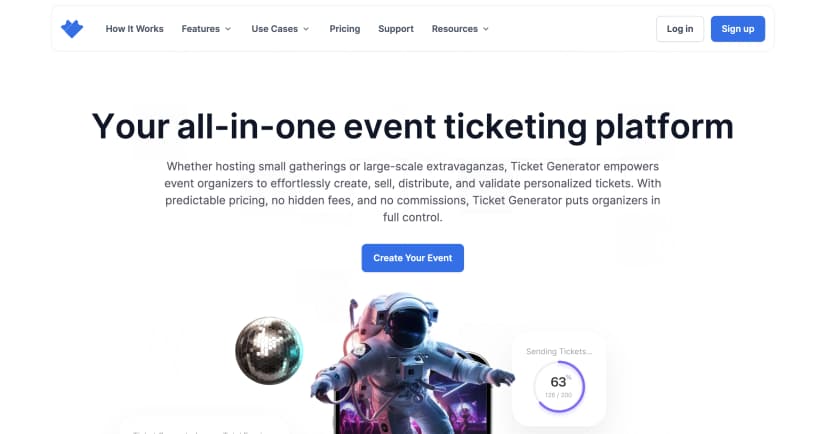
Ticket Generator is built for organizations that already have a community and simply want to sell, send, and scan tickets without handing a percentage to a platform. For a nonprofit, that is the whole job.
The model is one line: you buy credits, and one credit generates one ticket. Standard packs run 10 credits for $6, 100 for $50, 1,000 for $400, and 10,000 for $2,500. Apply the 30% nonprofit discount and a 1,000 credit pack drops to $280, which is about $0.28 per ticket. At the 10,000 level you are closer to $0.18. You also get 10 free credits at signup, so you can test the whole flow before spending anything. Full credit pricing is here.
Here is what that buys a nonprofit in practice:
- Zero commission on sales. Payments land directly in your own Stripe, PayPal, or Razorpay account, so you are never waiting on a platform payout schedule.
- No buyer facing platform fee or tip prompt. Your donor sees the price you set and nothing bolted on top.
- Branded event pages and tickets with custom domains and no platform watermark, so supporters see your cause rather than an ad for someone else's event.
- QR tickets and a dedicated Ticket Validator app that flags duplicates and blocks reuse, which keeps the gate calm even when volunteers are running it.
- ISO 27001:2022 certification and GDPR compliance, which matters when your registration form is collecting donor data.
This is not theoretical. The Heartland Emmys, a nonprofit organization, has run more than 3,433 tickets across 10 or more events with Ticket Generator over four consecutive years. Antioch University generated over 1,700 tickets across three sustainability-focused events. Across the platform, Ticket Generator has powered more than 1,000,000 tickets for 30,000+ events in 100+ countries, and its client list includes mission-driven names such as UNHCR.
One honest trade-off, because you should hear it from me rather than discover it later. Because you pay per ticket generated, even free tickets consume credits. A large free community event is not literally free on Ticket Generator the way it is on Zeffy or Humanitix. With the nonprofit discount, the cost is small, but it is not zero. If your calendar is almost entirely free events, that is a fair reason to look elsewhere. If you sell paid tickets, the math flips quickly.
For the full picture of how the platform fits mission-driven teams, the nonprofit event ticketing page lays it out, and there is a separate walkthrough on creating tickets for charity events if you also print physical passes.
Choosing the platform that fits your cause
Choosing a ticketing platform as a nonprofit comes down to one honest question: how much of every dollar reaches your mission, and who had to pay for the privilege?
Costs exist everywhere, and no single platform is right for every event. If you run mostly free community events and your board is comfortable with a donor tip at checkout, Zeffy and Givebutter are genuinely hard to beat. If you love the ticketing for good story, Humanitix earns its fee. If every ticket needs to land on a donor record, Bloomerang was built for that.
But if you sell paid tickets, care about your branding, and want a cost that does not climb with your ticket price, Ticket Generator keeps the money where it belongs. You are not choosing between free and expensive. You are choosing which platform's priorities sit on top of yours.
Try Ticket Generator to run your next fundraiser with commission free tickets, a 30% nonprofit discount, and QR check in your volunteers can handle. Your event. Your revenue. Your rules.
FAQs: Nonprofit Event Ticketing and Registration Platforms
1. What is the best nonprofit event ticketing platform?
It depends on whether your events are free or paid. Zeffy and Givebutter are the strongest choice for free and low-cost events because they cost your organization nothing when donors cover the fee. Ticket Generator is the stronger choice for paid fundraisers because its flat credit cost does not rise with ticket price, and it takes zero commission.
2. What is the best free event registration platform for nonprofits?
Zeffy is the only platform that charges your organization nothing at all, including payment processing, funded entirely by optional donor tips at checkout. Givebutter matches that when donor tips are enabled, and charges a flat 3% platform fee plus processing if you turn tips off.
3. Do nonprofit ticketing platforms offer a discount for registered charities?
Some do, and the structure varies a lot. Humanitix drops its US booking fee from 5% + $1.29 to 3.9% + $1.29 for registered charities, schools, and nonprofits. Ticket Generator applies a 30% discount to every credit pack, which brings a 1,000-ticket pack to roughly $0.28 per ticket.
4. How much do event registration platforms for nonprofits typically cost?
Costs range from nothing to a few hundred dollars a month. Tip-funded platforms like Zeffy and Givebutter cost the organization $0. Percentage-based platforms usually run 3% to 5% per paid ticket plus processing. CRM led platforms, such as Bloomerang, start around $125 per month billed annually, and credit-based platforms like Ticket Generator charge cents per ticket with no commission.
5. Can a fundraising platform handle check-in at the door?
Most offer QR scanning through a mobile app, but the depth varies. Look specifically for duplicate detection, multi-gate scanning, and re-entry support rather than just the presence of a scanner. Ticket Generator's Ticket Validator app flags duplicates instantly and supports scanning several devices at once, which matters at a gala with one entrance and two volunteers.
6. Should a nonprofit use a fundraising platform or a dedicated ticketing platform?
Use a fundraising platform if donations, auctions, and donor records are the main event and ticketing is incidental. Use a dedicated ticketing platform if you sell paid tickets, need branded pages, and have a door to control. Plenty of organizations run both, keeping their CRM for donor records and a ticketing tool for the event itself.
About the author
Content Marketer at Ticket Generator
Ashish Chandra has spent 5+ years writing about event technology, covering topics such as ticket design, QR check-ins, attendee management, and event marketing strategy. As the Content Lead at Ticket Generator, Ashish has analyzed hundreds of real-world event workflows and ticketing setups, helping organizers across industries use QR-based tickets, event landing pages, and smarter ticketing systems to run smoother, better-attended events. His writing is shaped by real user needs and the questions organizers ask most often: How do I sell more tickets? How do I avoid chaos at the door? How do I make my next event better than my last? When he steps away from the screen, you'll likely find him hiking a quiet trail or tending his plants- his preferred way to reset.
Latest posts
Check out our latest articles on the blog
 12 min read
Email Marketing for Events and Webinars: What to Send, When to Send It, and How to Automate It
A step-by-step playbook for email marketing for events and webinars. Learn what to send, when to send it, and how to automate every email for in person and virtual events.
Ashish Chandra
18 Oct 2026
 10 min read
Halloween Masquerade Ball: How to Host a Night of Masks and Mystery
From Venetian-inspired masks to QR-coded entry, here is your complete guide to planning a Halloween masquerade ball your guests will talk about for years.
Ashish Chandra
18 Oct 2026
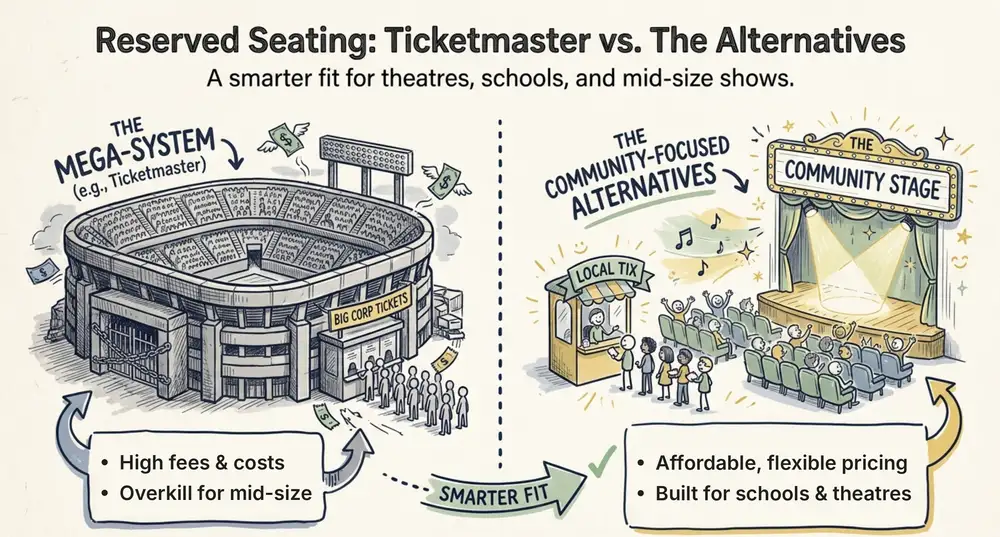 9 min read
Ticketmaster Reserved Seating: How It Works and a Better Fit for Smaller Events
Ticketmaster reserved seating works well for arenas. If you run a theatre, gala, or mid-size show, see how it works, what it costs, and how to switch.
Ashish Chandra
16 Oct 2026