Key Takeaways: Event ticket management software lets you create, distribute, validate, and track tickets from a single dashboard, eliminating spreadsheets and manual door checks. It solves the three biggest ticketing headaches: duplicate or fake tickets, slow entry lines, and lost sales caused by surprise fees. The features that matter most are bulk ticket generation, multi-channel delivery, secure QR validation, and real-time analytics. Ticket Generator manages the entire ticket lifecycle with unique QR-secured tickets and zero commission on ticket sales. The result is faster entry, fewer counterfeits, and complete control over your event revenue.
Running an event sounds simple until the tickets pile up. You have hundreds of attendees, a handful of last-minute additions, a line building at the gate, and someone at the front waving a screenshot that may or may not be real. Handle that with a spreadsheet and a printed guest list, and something will slip.
Did You Know? The online event ticketing market was worth roughly $85 billion in 2025 and is projected to reach about $105 billion by 2031. Source:
Mordor Intelligence (2025).
Event ticket management software is a single platform that creates, distributes, validates, and tracks your event tickets from one dashboard. Instead of stitching together forms, email threads, and paper stubs, you run the full cycle, from sign-up to check-in, in one connected workflow. That is the short answer.
In this guide, I'll explain what the software actually does, the features that are worth paying for, and how ticketing works from start to finish. We also cover how to stop fake entries at the gate and how to choose a tool that fits your event and your budget.
What is event ticket management software?
Event ticket management software is a tool that handles the entire ticket lifecycle: creating tickets, sending them to guests, validating them at entry, and reporting on attendance. It replaces the usual patchwork of registration forms, spreadsheets, and manual door checks with one system that talks to itself at every step.
Most platforms follow the same core loop:
Create the event: Set the name, date, venue, and capacity.
Design the ticket: Add branding plus a unique QR code and ticket ID.
Distribute: Send tickets by email, SMS, WhatsApp, or as a printable PDF.
Validate: Scan each QR code at the gate to confirm it is genuine.
Analyze: Track attendance, entries, and no-shows in real time.
Agencies, corporate teams, schools, and nonprofits all lean on this loop because it removes the manual reconciliation that eats staff time. For a deeper look at the day-to-day mechanics, see our guide to online ticket management.
What features should a ticket management system have?
The best tools cover five jobs: bulk ticket creation, guest registration, multi-channel delivery, secure QR validation, and real-time analytics. If a platform is missing one of these, you will end up patching the gap manually, which is exactly what the software is meant to prevent.
Bulk generation of unique tickets. Create thousands of tickets at once, each with its own QR code, ticket ID, and variable fields like guest name, row, and seat.
Guest registration and approval. Collect sign-ups on a branded page, approve them automatically or manually, and issue tickets on the spot.
Multi-channel distribution. Deliver tickets by email, SMS, WhatsApp, or downloadable PDF so no guest is left waiting.
Secure QR validation. Scan tickets at entry and get an instant verdict: valid, invalid, duplicate, or expired.
Real-time analytics. See how many guests have arrived, which coordinator scanned what, and how many tickets went unused.
Security and compliance. Every ticket should carry a unique QR and ID, with built-in duplicate detection and, ideally, ISO 27001 certification behind the platform.
Pro Tip: With Ticket Generator, you can edit your ticket message once and apply it across every delivery channel. Then use Scheduled Send to deliver an entire batch by email, SMS, or WhatsApp at a specific date, time, and time zone, so no one has to press "Send" on event morning.
How does event ticket management work from start to finish?
You move through five steps: create the event, design the ticket, distribute it, validate at the gate, and track attendance afterward. A good platform lets you complete all five without leaving the dashboard. Here is how the flow looks in practice with a tool like Ticket Generator.
Create your event and sign up. New accounts get 10 free credits (one credit generates one ticket), and no card is needed to start. Add your event name, time zone, venue, and capacity.
Design the ticket. Use a ready template, upload your own design, or generate one with AI. The platform superimposes a unique QR code and ID, and you can add variable fields for each guest.
Choose how to distribute. Generate and download PDFs to print, send by email or SMS in batches of up to 1,000, or push tickets programmatically through the API.
Validate at entry. Coordinators scan each QR code with the validator app or web validator. Each scan takes two to three seconds, and multiple gates can run at once.
Track attendance. Watch arrivals, re-entries, and unused tickets update live, then export the full report as Excel or PDF.
Did You Know? About 58% of online event ticketing transactions now happen on mobile devices (2025). That is why mobile-friendly digital tickets and phone-based scanning matter more than paper. Source:
Mordor Intelligence.
How do you validate tickets and stop fake entries?
You validate a ticket by scanning its unique QR code, which the system instantly checks against its records and flags as valid, invalid, duplicate, or expired. Because every ticket carries its own encoded ID, a copied or screenshotted ticket gets caught the second time it is scanned.
Strong validation rests on a few things working together:
Unique QR + ticket ID on every ticket, so no two are the same.
Duplicate detection that flags the same code the moment it is scanned twice.
Multi-gate scanning so several coordinators can check people in at once.
Re-entry support for events where guests come and go.
This is where generic QR tools fall short. Anshul Singh Bisht, Head of Event Technology at Ticket Generator, puts it plainly: "The most common mistake we see is organizers using a generic QR generator and realizing that this way every attendee will have the same code. Also, those generators can’t help you stop duplicates."
Managing tickets across email threads and printouts? Try Ticket Generator to create, send, and scan every ticket from one dashboard, with QR security built in.
How do you choose the right event ticket management software?
Choose based on the pricing model, data ownership, and how tickets are delivered and validated, not just the headline price. A tool that looks cheap but takes a cut of every sale can cost far more than flat, predictable pricing once your event scales.
Fees are not a minor detail, either. They quietly shape whether people finish buying.
Did You Know?48% of shoppers abandon checkout when extra costs like fees are too high, making it the single biggest reason for checkout drop-off. Source:
Baymard Institute (2024).
Here is how a commission-free, credit-based platform compares with a typical commission-based one:
What to compare
Ticket Generator
Typical ticketing platforms
Pricing model
Credit-based, pay per ticket generated; credits never expire
Percentage commission on every sale (often 3–10%)
Fees on sales
Zero commission; payments go directly to your own payment gateway
Platform takes a commission, often alongside buyer-facing service fees
Ticket delivery
Email, SMS, WhatsApp, and PDF, with Scheduled Send
Usually email only
Validation
QR validation app and web validator with Valid, Invalid, Duplicate, and Expired status
Basic QR scanning or manual attendee list checks
Branding
Full white-label experience with no platform logo or watermark
Platform branding on tickets and event pages
Data ownership
You own all attendee data
Platform often retains or shares attendee data within its ecosystem
For a wider view of the options on the market, our roundup of the best event management software walks through where each type of tool fits.
How to create secure event tickets?
To create tickets, you need a professional event ticket management software such as Ticket Generator. And here's how it works:
1. Generate tickets for your guests
Step 1: Sign up and create an event with the software
Note that once you've signed up, you'll get ten credits for free. And each credit helps you create one ticket. In addition, you'll not have to enter your card details while signing up.
ii. Now, go to the Create Event section on the dashboard. Next, click on the Bulk button. Here, you'll have to create an event by adding details such as event description, time zone, and venue
Once you've entered all the details, click Create.
Step 2: Design the tickets
iii. Once you've created the event, you can proceed to design your tickets. You will see two options Upload Own Design option and Default Design option
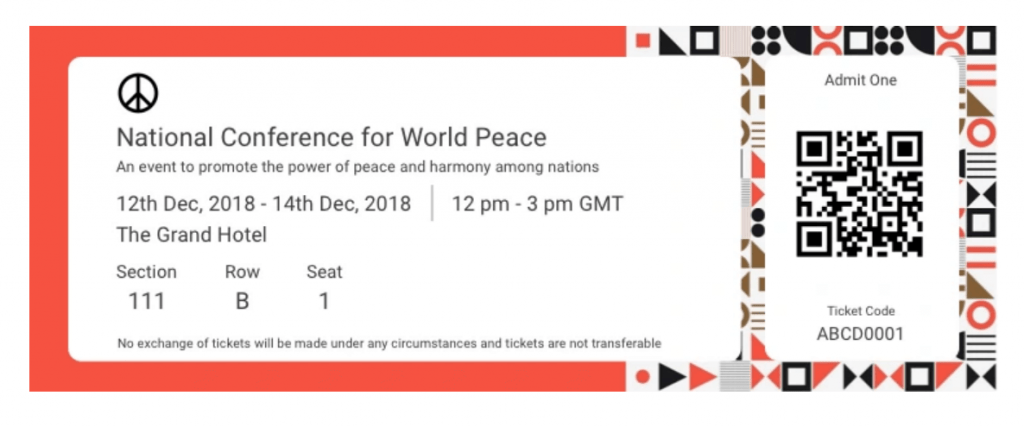
Upload Own Design: It allows you to design your ticket using your own ready-made design template. With it, you can superimpose the QR Code and unique ID on the ticket. Moreover, you can also add variable information (which would be different for each ticket) by clicking on the + button. It could be the guest's name, row number, seat number, etc.
Here's an example of a ticket created using a readymade template:
Default Design: It is Ticket Generator's standard design. And you can use it to customize your tickets. Using this, you can add a logo, change the background color, or add a background image to your ticket.
Once you've finalized the design, click on Preview to see how your ticket design looks.
Step 3: Choose the delivery method
iv. Now, click on Done and then, you'll be asked to specify the Delivery method. It means how you want to distribute your tickets to the guests. You can do it via three methods:
Generate and Download: This generates and downloads the tickets in a printable format (PDF).
Generate and Send: Here, you will further see three options to choose from:
Send tickets by email only: It allows you to email the tickets to the guests. You can add the emails in a CSV, XLS, or XLSX file and upload them. Or you can even manually type the emails in the given fieldsNote that you can only specify up to 1,000 emails.
Send tickets by SMS only: It allows you to send tickets to your guests via SMS. Here, you can specify up to 1,000 phone numbers
Send tickets by both email and SMS: With this option, you can send tickets both by SMS and email to your guests
Generate via API: This option allows you to integrate your own registration system with the Ticket Generator API. It generates tickets programmatically in real-time within your system.
v. Once you specify all the details, click on Generate. All the tickets will be generated and you'll be notified via email
That's it. That is how you can generate tickets via event ticket management software.
2. Generate single tickets for contingencies
Ticket Generator also allows you to generate and distribute single tickets to the guests. It is useful in two ways:
Case 1: Having unplanned guests at the last moment
Suppose you are organizing an event and have generated the tickets too. You've handed out the tickets to your guests. But some unplanned guests turn up at the venue at the last moment. And now you need to generate tickets for them as well.
Now rather than generating a whole batch of tickets again, you can simply create additional tickets quickly. Here's how:
ii. From the dashboard, click on Create Tickets followed by clicking on the Single button
iii. Here, select the appropriate event and click on New Ticket under Choose Action section
iv. Now under Choose Delivery Method, you'll see two options Download Ticket and Send Ticket
Download Ticket: It allows you to generate and download the guest ticket.
Send Ticket: It allows you to send the ticket to the guest via email ID or phone number.
v. Once specified, click Generate & Download (Download Ticket here) or click Generate & Send (Send Ticket here)
That's it. A new single ticket will be generated and downloaded. Note that you'll need one credit for each extra ticket you create.
Case 2: Resending the tickets
Say you have generated tickets for your event and sent them to guests via email or phone. But somehow, some guests didn't receive them. Here again, Ticket Generator can help you out. It can resend the event tickets to guests. Here's how:
ii. Go to dashboard, click on Create Tickets followed by clicking on the Single button
iii. Now select the event for which you want to resend tickets
iv. Under Choose Action option, tap on Resend Ticket
v. Now, you'll be asked to specify your mode of searching the guest's ticket. You can do it either using ticket ID or via the guest's phone number or email address which you entered while creating the ticket
vi. After submitting the details, click Search. You'll see the ticket details on your screen
vii. Click View to see ticket details
viii. Next, specify the guest's email ID or phone number followed by clicking on Resend
Note that you'll not be charged extra for resending the tickets.
How to validate tickets?
Now that you have generated tickets and sent them to your guests, let's see how you can validate them.
To do it, you'll first have to add coordinators for the event within the Ticket Generator. Once you do it, they'll be authorized to validate the tickets. Here's how to do it:
1. From the dashboard, go to the Manage Event section
2. Select the required event and click on three horizontal dots under the More option
3. Now click on Add/Edit Coordinator
Here, you can specify the email address of each coordinator. Once you do it, the coordinators will then receive an email invitation. They can then use it to login into the Ticket Validator app on their phones
5. Next, they need to select the event they need to validate tickets for. They can then click on Scan QR Code and get started with validating the tickets
How to analyze post event analytics?
As mentioned earlier, event analytics is a valuable asset for an event organizer. And Ticket Generator, an event ticket management software, can help avail of its benefit. Here's how:
1. From the Ticket Generator dashboard, go to Manage Events
2. On the page that loads, click on the event you want to track the attendance data for
3. Next, click on See Analytics under the Attendance Analytics section
4. Now, you will see attendance percentage, Event Status, and when the event ends. Moreover, you also get all the data on event attendance such as:
Attendance by time period
Tickets validated per coordinator
Used, new, expired, and invalid tickets
Duplicate and re-entry allowed counts
You can download the entire analytics in PDF or XLSX format. Alternatively, you can also see the Download CSV icon alongside each of these sections. You can click it to download the specific analytical data for whichever section you want.
That's it. That is all you need to know about event ticket management software. You are now all set to go ahead to organize the event and manage the tickets efficiently.
How Ticket Generator manages event tickets end to end?
Ticket Generator is built for organizers who want control over ticketing without paying a commission on every sale. It covers the full loop: event page, ticket design, delivery, validation, and analytics, so you are not stitching tools together.
Create and design fast. Build a branded event page, then design tickets with templates, your own upload, or AI, each with an auto-embedded unique QR code.
Deliver anywhere. Send tickets by email, SMS, or WhatsApp, schedule the batch in advance, or generate them in real time through the REST API.
Validate with confidence. Scan at multiple gates with the validator app or web validator; duplicates and expired tickets are flagged instantly.
Own your data and revenue. Payments go straight to your Stripe, PayPal, or Razorpay account, and every attendee record stays yours.
This holds up over real, repeating events. Heartland Emmys used Ticket Generator to issue 3,433+ tickets across 10+ events over four consecutive years — proof the system handles recurring programs, not just one-offs. Across the platform, organizers have generated 1,000,000+ tickets for 30,000+ events in 100+ countries.
Want to see the full flow before committing? Walk through how Ticket Generator works from event setup to check-in.
The bottom line on event ticket management software
The right software turns a messy, manual process into one clean workflow: create, send, validate, track. The gains are concrete: fewer fake tickets, shorter lines, cleaner data, and no revenue lost to surprise fees.
No single tool fits every event, and credits or subscriptions still cost something. But for organizers running recurring or sizeable events who want predictable pricing and full control, the right platform pays for itself in saved hours and protected revenue. Ticket Generator is built for exactly that, one system to run ticketing end to end, on your terms.
Try Ticket Generator to manage every event ticket in one place, generate, deliver, and scan with QR security and zero commission. Your event. Your revenue. Your rules.
FAQs: Event Ticket Management Software
1. What is event ticket management software?
Event ticket management software is a single platform that creates, distributes, validates, and tracks event tickets. It replaces spreadsheets, manual guest lists, and separate email tools with one connected workflow from sign-up to check-in. Tools like Ticket Generator also secure each ticket with a unique QR code.
2. Is there free event ticket management software?
Most platforms are not entirely free, but many let you start at no cost. Ticket Generator, for example, gives every new account 10 free credits (one credit creates one ticket) and never asks for card details to sign up. Free registrations and free events can run at little to no cost, while paid credit packs cover larger volumes.
3. How does ticket validation prevent fake tickets?
Validation works by encoding a unique ID in each ticket’s QR code, which the system checks at the gate. If someone copies or screenshots a ticket, the duplicate is flagged the moment it is scanned a second time. This makes forged or reused tickets far harder to slip through than a printed list allows.
4. Can it handle recurring or multi-day events?
Yes. Good ticketing software supports event cloning for recurring programs and multi-day events where ticket status resets each day. Heartland Emmys, for instance, ran the same setup across 10+ events over four years with Ticket Generator, reusing designs and workflows each time.
5. Does Ticket Generator charge commission on ticket sales?
No. Ticket Generator uses a credit-based model, you pay per ticket generated, not a percentage of each sale. Payments go directly to your own Stripe, PayPal, or Razorpay account, so you keep 100% of your ticket revenue and avoid the buyer-facing service fees that commission platforms add.
Yashika Tangri is an amazing marketing manager who operates from Trycon Technology's Noida office. Her name signifies success and fame, and she has certainly lived up to these expectations.
At work, Yashika is a highly efficient digital marketing organizer and a source of inspiration to her colleagues with her positive demeanor and professional work ethics. Despite being a lifelong student of science, Yashika decided to pursue a career in marketing in 2018.
After work hours, Yashika enjoys creating new playlists on Spotify, and she is an avid reader who finds solace in escaping reality through the pages of mythology books


.webp)




.png)







.webp)

.svg)
.svg)