

Eventbrite Pricing 2026: Eventbrite Ticket Fees Explained
 Written byAshish ChandraLast updatedAugust 6, 2026
Key Takeaways: Eventbrite pricing in 2026 comes down to a 3.7% + $1.79 service fee on every paid ticket, plus a 2.9% payment processing fee on the order. Free events cost nothing. On paid tickets, the flat $1.79 hits low-priced tickets hardest, often amounting to 12% to 15% of the ticket price. By default, your attendees pay the fees at checkout, which inflates the price they see. You can absorb them instead and take the hit yourself. Ticket Generator charges zero commission. You prepay credits per ticket, from $0.25 at volume, and payments land directly in your own payment gateway.
I have spent years helping organizers pick ticketing platforms, and the same question lands in my inbox every single week: What does Eventbrite actually cost me?
So let me answer it up front. Eventbrite pricing in 2026 comes down to two numbers: a service fee of 3.7% plus $1.79 on every paid ticket, and a 2.9% payment processing fee on top. Free events cost nothing, for you or your attendees.
Simple on paper. But those two numbers behave very differently depending on your ticket price, your volume, and who you ask to pay them. On a $20 ticket, they quietly take around 15% of face value. Across a 500-ticket event, they can swallow a couple of thousand dollars.
In this guide, I break down every fee Eventbrite charges, run the math on real ticket prices, explain who actually pays, cover what changed after the 2026 acquisition, and show you when the platform earns its keep and when it does not.
How much does Eventbrite charge in 2026?
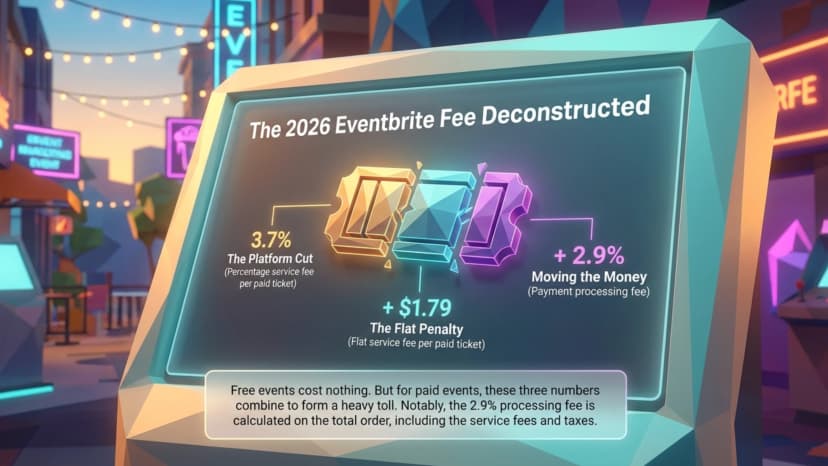
Eventbrite charges a service fee of 3.7% + $1.79 per paid ticket, plus a 2.9% payment processing fee per order, according to Eventbrite's published ticketing fees (2026). Publishing events is free, and free tickets carry no fees at all.
Together, these two charges make up what Eventbrite calls its Ticketing Fee. Here is how it breaks down for US organizers:
|
Fee component |
Rate (US, 2026) |
What it applies to |
|---|---|---|
|
Service fee |
3.7% + $1.79 per ticket |
Every paid ticket, add-on, and donation |
|
Payment processing fee |
2.9% |
The total order amount |
|
Free events |
$0 |
No fees for you or your attendees |
Rates vary by country. UK organizers, for example, pay a single combined fee of 6.95% + £0.59 per paid ticket. And here is a nuance I always point out: the processing fee is calculated on the total order, including the service fee and tax, not just the ticket price. It is a small detail that becomes real money at scale.
One more thing people often mix up: Eventbrite's optional subscriptions (more on those below) buy you marketing tools like higher email limits. They do not remove or reduce the per-ticket fees.
What is the Eventbrite service fee, and How is it different from the processing fee?
The Eventbrite service fee (3.7% + $1.79) is the platform's own cut for using its ticketing tools. The Eventbrite processing fee (2.9%) covers the cost of moving card payments. Both are charged on every paid ticket.
Some organizers lump the whole bundle together and call it the Eventbrite transaction fee. Whatever you call it, both parts come out of the same wallet, so I always evaluate them together.
Here's what actually happens while calculating the fees: Card processing around 2.9% is a cost of doing business on any platform. Stripe's standard rate is 2.9% + $0.30 per transaction (Stripe, 2026), so that part of the bill would follow you anywhere. The service fee is the part that is unique to Eventbrite. That is the number to scrutinize when you compare platforms.
What do Eventbrite Ticket Fees look like on real ticket prices?
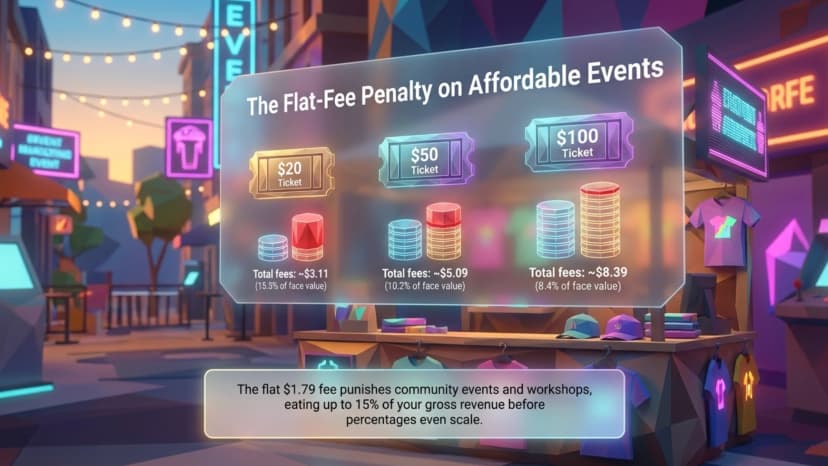
On a $20 ticket, Eventbrite ticket fees total roughly $3.11, about 15.5% of face value. On a $50 ticket, roughly $5.09, about 10.2%. The cheaper the ticket, the bigger Eventbrite's slice.
I ran the math on three common price points so you can see the pattern:
|
Ticket price |
Service fee (3.7% + $1.79) |
Processing (2.9%) |
Total fees |
Share of face value |
|---|---|---|---|---|
|
$20 |
$2.53 |
$0.58 |
~$3.11 |
~15.5% |
|
$50 |
$3.64 |
$1.45 |
~$5.09 |
~10.2% |
|
$100 |
$5.49 |
$2.90 |
~$8.39 |
~8.4% |
Figures are approximate. Because processing is charged on the order total including the service fee, real totals run slightly higher when fees are passed to buyers.
That flat $1.79 is the part that punishes affordable events. It barely registers on a $100 conference pass, but on a $15 community workshop it is 12% before the percentages even start. Now scale it: a 500-ticket event at $40 pays roughly $2,215 in total fees on $20,000 of gross sales, and about $1,635 of that is pure service fee.
Selling to your own audience, not browsing strangers? Try Ticket Generator and keep 100% of every sale, with tickets costing as little as $0.25 each.
Who actually pays Eventbrite fees: You or your attendees?
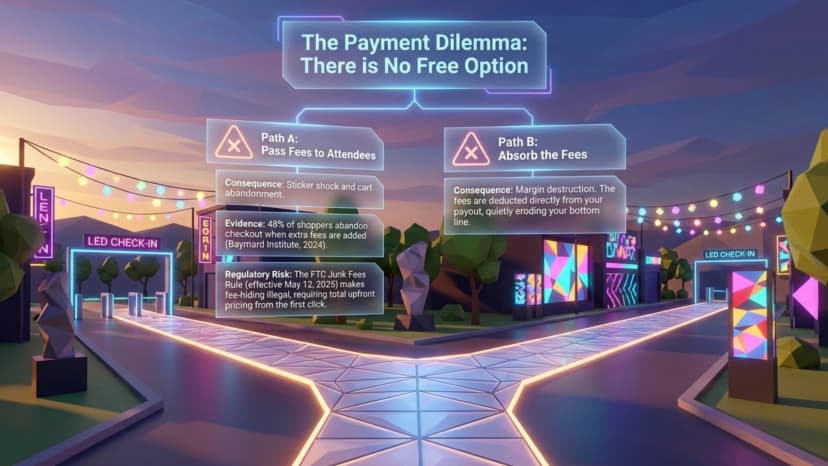
By default, your attendees pay Eventbrite fees on top of the ticket price at checkout. You can choose to absorb them instead, in which case they are deducted from your payout.
Neither option is free money. Pass the fees on, and your advertised $50 ticket rings up at roughly $55, and buyers notice. Absorb them, and your margin takes the hit instead. There is no third option where nobody pays.
Did You Know? 48% of shoppers abandon checkout when extra costs like fees feel too high. It is the single biggest reason for cart abandonment. Source: Baymard Institute (2024).
Regulation has caught up with this problem too. The FTC's Junk Fees Rule (16 C.F.R. Part 464), effective May 12, 2025, requires live-event ticket sellers to show the total price, including all mandatory fees, up front. So the days of hiding fees until the last checkout screen are over. Your buyers now see the full cost from the first click, which makes fee-heavy pricing harder to disguise.
This is exactly why I push organizers toward transparent pricing. I have written before about no-fee tickets and why one clean, final price consistently converts better than a low sticker price with surprises bolted on.
What changed with Eventbrite pricing in 2026?
The per-ticket fee structure did not change in 2026, but the company around it did. Italian tech group Bending Spoons completed its acquisition of Eventbrite in early 2026, in a deal reported at roughly $500 million.
Since the acquisition, I have watched three shifts worth knowing about:
- Same ticket fees. The 3.7% + $1.79 service fee and 2.9% processing fee carried over unchanged. Publishing events, free or paid, remains free.
- Subscription reshuffle. Eventbrite has been moving from its Pro plans toward a new Premium subscription, with perks like discounted instant payouts. Existing Pro subscribers keep their plans, but Pro is closed to new signups.
- Leaner operation. The new owner has cut staff across support and other teams, which several organizers I talk to have felt in slower response times.
My read: nothing about the acquisition made Eventbrite cheaper, and the direction of travel is toward monetizing more features, not fewer. Keep an eye on Eventbrite's pricing page before every major event you plan, because subscription structures have been moving quickly.
When is Eventbrite worth it, and When is it not?
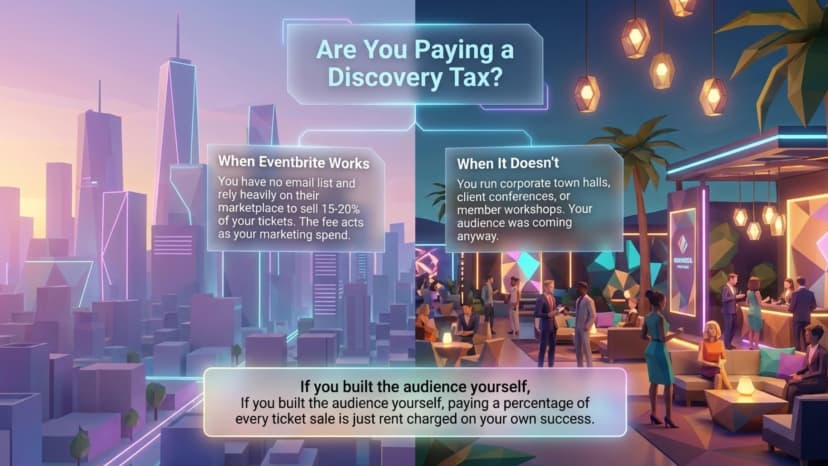
Eventbrite is worth its fees when its discovery marketplace genuinely fills seats you could not fill yourself. It stops being worth it when you already own your audience and are paying marketplace prices anyway.
Let me be fair to the platform, because I do recommend it in specific cases. Eventbrite's marketplace reaches tens of millions of ticket buyers browsing for things to do. If you are a new organizer with no email list, and a marketplace listing sells even 15 to 20% of your tickets, those fees are effectively marketing spend, and reasonable marketing spend at that.
But think about who actually gets that benefit. Corporate town halls, campus events, member meetups, training workshops, and client conferences do not get discovered on a marketplace. Attendees were coming anyway. For those events, you are paying a discovery premium on an audience you built, on every single ticket, forever.
If that describes your events, it is worth comparing what different platforms take per ticket. I keep a running comparison of ticketing platforms with the lowest ticket fees and a deeper guide to Eventbrite alternatives if you want the full landscape.
How does Ticket Generator compare with Eventbrite fees?
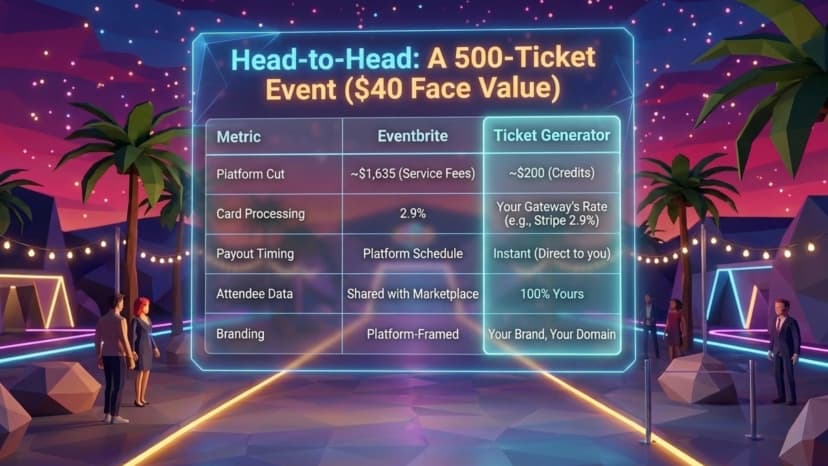
Ticket Generator charges zero commission on ticket sales. You prepay credits (one credit per ticket, dropping to $0.25 at volume), and payments go straight to your own Stripe, PayPal, or Razorpay account.
Ticket Generator is built for organizers who already have their audience and want to stop renting it back. Because there is no percentage fee, your platform cost does not grow just because you sold out. Here is the same 500-ticket, $40 event on both models:
|
Cost line |
Eventbrite |
Ticket Generator |
|---|---|---|
|
Platform fee |
~$1,635 in service fees (3.7% + $1.79 × 500 tickets) |
~$200 in credits ($0.40 × 500 tickets at the 1,000-credit pack rate) |
|
Payment processing |
2.9% via Eventbrite |
Your own gateway's rate (for example, Stripe 2.9% + $0.30) |
|
Payout timing |
Platform payout schedule |
Instant, money lands in your own account |
|
Attendee data |
Shared with the marketplace |
100% yours |
|
Branding |
Eventbrite-framed listing |
Your logo, your domain, no platform watermark |
You pay card processing either way, so the honest comparison is the platform's own cut: roughly $1,635 versus $200 on that event. And credits never expire, so whatever you do not use rolls into your next event. See the full Ticket Generator pricing breakdown for pack sizes, including a 30% nonprofit discount.
Beyond the math, you still get the operational essentials: branded event pages and registration, tickets delivered by email, SMS, and WhatsApp, and QR validation with duplicate detection through a free scanning app. Over 1,000,000 tickets have been generated on the platform across 30,000+ events in 100+ countries. The Heartland Emmys have run 10+ events on it across four consecutive years, issuing 3,433+ tickets without paying a cent of commission.
Interestingly, price usually starts the switching conversation, but it is not always what closes it. As Anshul Singh Bisht, Head of Event Technology at Ticket Generator, puts it:
"Nine out of ten organizers we onboard mention counterfeit prevention as the first reason they're switching; the cost and speed factors are added benefits. They've faced duplicate tickets at the gate, refund disputes, guests who claim they paid but aren't on the list, and they don't want to live that twice."
Pro Tip: If you run recurring events, buy a larger credit pack once and clone your event each time. Ticket Generator credits never expire, so your per-ticket cost drops as low as $0.25 and stays there across your entire event calendar. Learn more about how it works here.
My final take on Eventbrite's fees
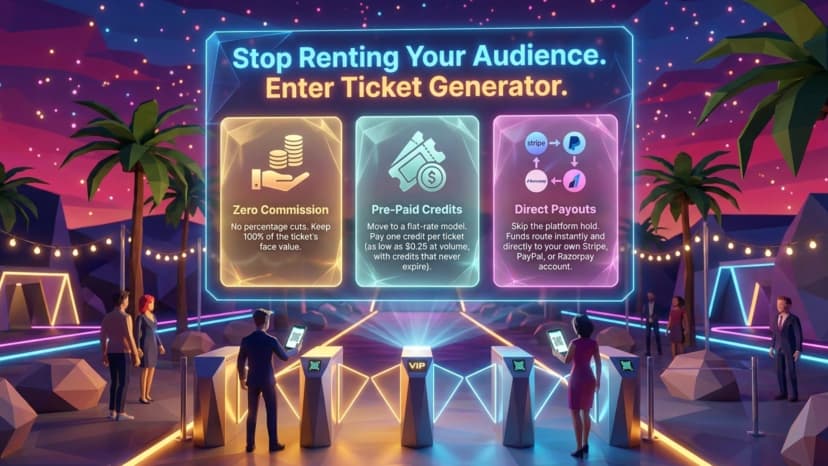
Eventbrite's fees are transparent, but they are real: 3.7% + $1.79 per ticket plus 2.9% processing, with the heaviest impact on affordable tickets. That is not a scandal. It is simply the price of a marketplace, and every platform charges something.
The question is whether you are getting marketplace value. If Eventbrite's discovery engine fills seats you could not fill, the fees can earn their keep. If your attendees were coming anyway, a percentage of every sale is rent charged on your own success.
For organizers with their own audience, a flat, prepaid cost per ticket almost always wins, and that is exactly the model Ticket Generator was built around.
Try Ticket Generator to sell tickets with zero commission and keep every dollar of face value. Your first 10 tickets are free. Your event. Your revenue. Your rules.
FAQs: Eventbrite Fees
1. How much does Eventbrite charge per ticket?
Eventbrite charges a 3.7% + $1.79 service fee per paid ticket, plus a 2.9% payment processing fee on the order (US rates, 2026). On a $50 ticket, that totals roughly $5.09, about 10.2% of face value. Free tickets carry no fees.
2. Is Eventbrite free to use?
Eventbrite is free for publishing events and for running free events. Fees only apply when you sell paid tickets, add-ons, or collect donations. Optional subscriptions add marketing features like higher email limits, but they do not remove the per-ticket fees.
3. Can I avoid Eventbrite fees on paid tickets?
No, fees apply to every paid ticket; you can only choose who pays them. You either pass them to attendees at checkout or absorb them into your payout. The only way to pay no percentage at all is a commission-free platform like Ticket Generator, where you prepay a flat credit per ticket instead.
4. Does Eventbrite refund its fees when I refund a ticket?
Generally, no. As of 2026, Eventbrite keeps its ticketing fees when you refund individual orders. For a full event cancellation, organizers can contact Eventbrite to request a fee credit, but it is not automatic, so factor that into your refund policy.
5. What is the difference between the Eventbrite service fee and the Eventbrite processing fee?
The service fee (3.7% + $1.79 per ticket) is Eventbrite's charge for its platform, while the processing fee (2.9%) covers card payment handling on the order total. Together they form the full Ticketing Fee, which some organizers simply call the Eventbrite transaction fee.
About the author
Content Marketer at Ticket Generator
Ashish Chandra has spent 5+ years writing about event technology, covering topics such as ticket design, QR check-ins, attendee management, and event marketing strategy. As the Content Lead at Ticket Generator, Ashish has analyzed hundreds of real-world event workflows and ticketing setups, helping organizers across industries use QR-based tickets, event landing pages, and smarter ticketing systems to run smoother, better-attended events. His writing is shaped by real user needs and the questions organizers ask most often: How do I sell more tickets? How do I avoid chaos at the door? How do I make my next event better than my last? When he steps away from the screen, you'll likely find him hiking a quiet trail or tending his plants- his preferred way to reset.
Latest posts
Check out our latest articles on the blog
 12 min read
Email Marketing for Events and Webinars: What to Send, When to Send It, and How to Automate It
A step-by-step playbook for email marketing for events and webinars. Learn what to send, when to send it, and how to automate every email for in person and virtual events.
Ashish Chandra
18 Oct 2026
 10 min read
Halloween Masquerade Ball: How to Host a Night of Masks and Mystery
From Venetian-inspired masks to QR-coded entry, here is your complete guide to planning a Halloween masquerade ball your guests will talk about for years.
Ashish Chandra
18 Oct 2026
 9 min read
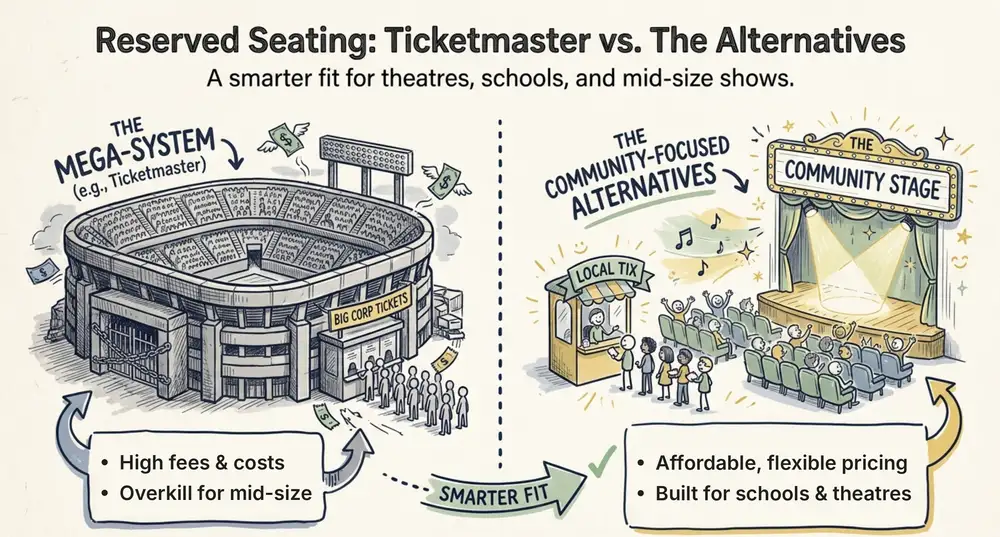
Ticketmaster Reserved Seating: How It Works and a Better Fit for Smaller Events
Ticketmaster reserved seating works well for arenas. If you run a theatre, gala, or mid-size show, see how it works, what it costs, and how to switch.
Ashish Chandra
16 Oct 2026