

Best Ticket Selling Platform in 2026: Tried, Tested, and Ranked
 Written byAshish ChandraLast updatedAugust 6, 2026
Key Takeaways: The best ticket selling platform lets you keep your revenue, own your attendee data, and settle payments directly into your own account instead of a marketplace that takes a cut of every sale. Most major platforms charge 3–10% commission plus service fees, and surprise fees remain the biggest reason buyers abandon checkout. After spending the last five years running events and testing more than 12 ticketing tools, my top pick is Ticket Generator for its commission-free credit-based pricing, instant payouts, and full branding control. That said, the "best" platform still depends on your event type and specific requirements, so this guide compares platforms based on fees, payouts, branding, and ticket validation rather than marketing claims.
I've spent the last five years running events and testing the tools that powers them. Agencies, campus fairs, food-and-wine tastings, award nights, you name it. I've loaded guest lists into most of the platforms you've heard of, and a few you haven't. Eleven of them, to be exact.
Did You Know? A 2018 U.S. Government Accountability Office (GAO) report found that primary-market ticketing companies charged fees averaging 27% of a ticket's face value, with some fees reaching as high as 58%. Source: U.S. Government Accountability Office (GAO) .
So when someone asks me for the best ticket selling platform, I don’t answer with a feature list. I answer with the thing that actually decides it: who keeps the money, who owns the data, and who controls the experience. On those three questions, my top pick is Ticket Generator: commission-free, credit-based, and built so payments land in your own account instantly.
But "best" isn’t universal. In this guide, I’ll share the criteria I use to judge any tool you might use to sell tickets online, a side-by-side comparison of the eleven platforms I tested, and honest head-to-heads so you can decide what fits your event.
Let's begin!
What makes the best ticket selling platform?
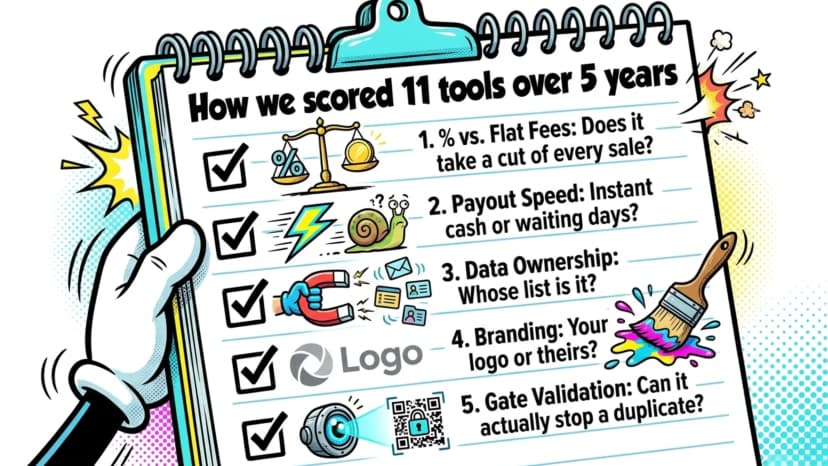
The best ticket selling platform isn’t the one with the most features. It’s usually the one that protects your revenue, your data, and your brand. Everything else is negotiable.
After enough events, I stopped scoring platforms on flashy dashboards and started scoring them on five things that hit your bottom line:
- Fees and commission. Does the platform take a percentage of every sale, or charge a flat, predictable cost?
- Payout speed. Do you get paid instantly through your own gateway, or wait days after the event?
- Data ownership. Do you own your attendee list, or does the platform?
- Branding. Is the page yours, or does it carry the platform’s logo and competing events?
- Validation and delivery. Can you deliver tickets across channels and scan them securely at the gate?
A tool can nail four of these and still be wrong for you if it fails the fifth. That’s why "best ticketing platform" is really shorthand for "best fit for how you run events."
Pro Tip: Before you commit, run one small paid event through any platform end to end, including ticket sales, delivery, and gate scanning. Ticket Generator offers a free trial and gives every new account 10 free credits with all features unlocked, so you can test the complete workflow before spending a single penny. Best of all, no credit card is required.
How do the top ticket selling platforms compare?
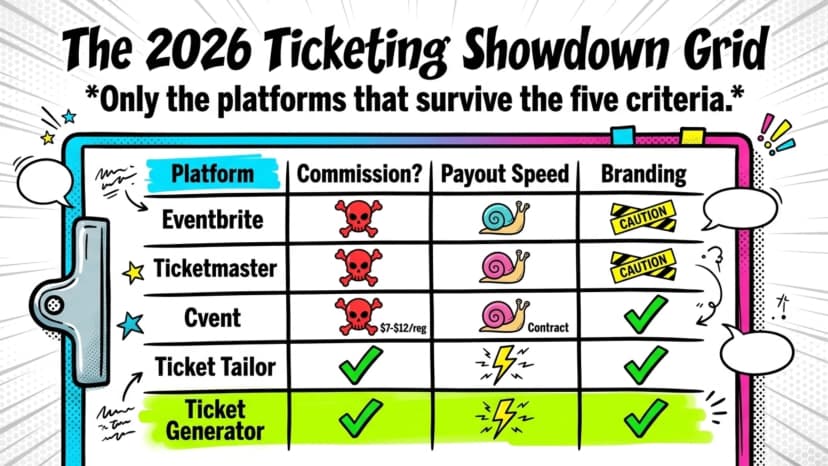
Here is the shortlist I keep coming back to, scored on the criteria above. I’ve grouped them by what they’re really built for: marketplaces, flat-cost tools, all-in-one suites, and everything else.
|
Platform |
Pricing model |
Commission on sales |
Payouts |
Branding |
|---|---|---|---|---|
|
Ticket Generator |
Prepaid credits (from ~$0.25/ticket) |
None |
Instant, via your own payment gateway |
Full white-label |
|
Eventbrite |
Percentage + processing fees |
3–8% + processing |
Delayed |
Marketplace-branded |
|
Ticketmaster |
Service + convenience fees |
5–10%+ |
Delayed |
Limited |
|
Ticket Tailor |
Credits; your own payment processor |
None |
Your payment gateway |
Full |
|
TicketSpice |
99¢/ticket + 2.9% + 30¢ |
Flat 99¢/ticket |
Your payment gateway |
Full |
|
TicketSource |
Buyer-paid booking fee |
None to organiser |
Your payment gateway |
Good |
|
Zoho Backstage |
Subscription + ~$299/event |
None |
Your payment gateway |
Good |
|
Cvent |
Quote-based (~$19,550/year median) |
$7–$12 per registrant |
Contract-based |
Full |
|
Humanitix |
~5% + $1.29/ticket (buyer-paid) |
None to organiser |
Your payment gateway |
Good |
|
Townscript / BookMyShow |
Marketplace fees |
Yes |
Delayed |
Platform-first |
|
Splash / DIY (Forms + Sheets) |
Enterprise subscription / free-ish |
— / None |
— / Manual |
Marketing-first / None |
One thing to note is that this table hides a nuance. A "no commission" tag doesn’t tell you whether the tool can deliver tickets over WhatsApp or catch a duplicate at the gate. So let me unpack the head-to-heads that actually matter.
Why do fees and payouts matter more than the sticker price?
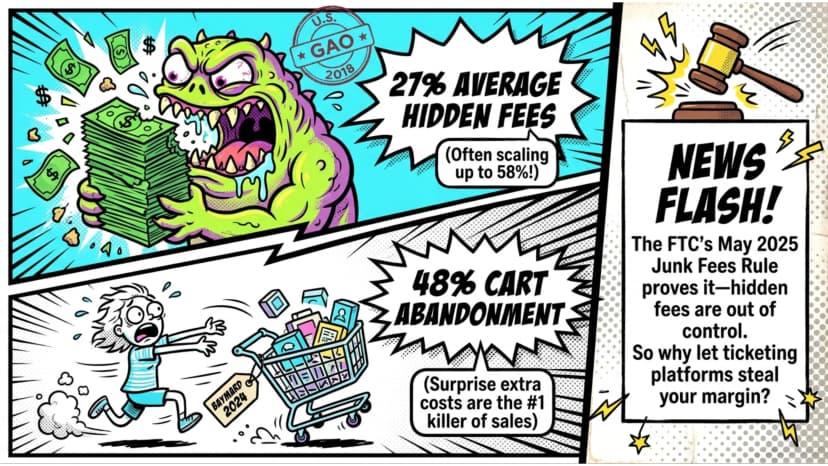
Because a low headline price means nothing if the platform skims a commission on every sale and makes you wait to get paid. Fees quietly decide your margin.
That 2018 GAO figure (27% of face value on average) is exactly why regulators stepped in. The U.S. Federal Trade Commission’s Junk Fees Rule (16 C.F.R. Part 464), effective May 12, 2025, now requires live-event ticket sellers to show the all-in total price up front, because hidden fees had become such a widespread problem.
Did You Know? 48% of shoppers abandon checkout when extra costs like fees are too high, making it the single biggest reason for cart abandonment. Source: Baymard Institute (2024).
Payout speed is the quieter problem. Marketplaces often hold your funds until after the event, so you’re basically financing your own event on their timeline. I’d rather money hit my account the moment a ticket sells. That’s the whole case for no-fee tickets and instant settlement: you set the price, you keep the price, and you get paid then and there, not next month.
Want to stop losing margin to commissions? Try zero platform commission with Ticket Generator and get paid straight to your own account.
How does Ticket Generator compare head-to-head?
Ticket Generator’s edge is consistent across rivals. There's commission-free credit pricing, your own payment gateway, full branding, and a dedicated validation app. But every competitor here has a real strength worth naming honestly.
Ticket Generator vs. Eventbrite and Ticketmaster
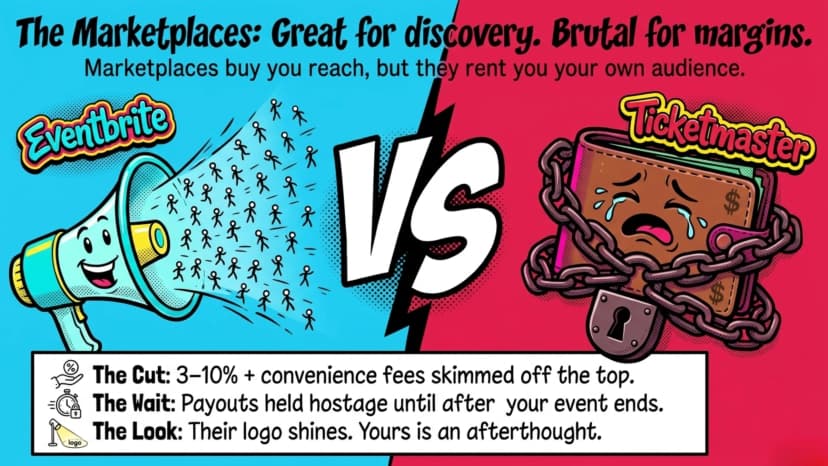
Eventbrite and Ticketmaster are discovery marketplaces, and their genuine strength is reach. Eventbrite charges 3–8% plus processing and controls your attendee data; Ticketmaster layers 5–10% service fees plus convenience fees and is built for arena-scale entertainment.
If you truly need a marketplace to find strangers, they have the audience. But you pay for it in commissions, delayed payouts, and limited branding. Ticket Generator flips all three: zero commission, instant settlement through your own Stripe, PayPal, or Razorpay, and a fully white-labeled page with no competing events.
Ticket Generator vs. Ticket Tailor and TicketSpice
These are the honest flat-cost tools, and here the contrast is capability, not price. Ticket Tailor is credit-based with no commission and uses your own processor, which is great for simple setups, and free for most free events under 5,000 tickets a year.
TicketSpice, on the other hand, charges a flat 99¢ per ticket plus 2.9% + 30¢ processing, with full branding. Both are genuinely good.
Ticket Generator matches their commission-free model and then adds the operational layer: multi-channel delivery over email, SMS, and WhatsApp with Scheduled Send, AI ticket design, Add-ons for perks like parking or merch, a white-label REST API, and a dedicated validation app with duplicate and re-entry detection.
All of this is also backed by ISO 27001:2022 certification. So, at volume, Ticket Generator's credits fall to as low as $0.25 per ticket with no per-ticket percentage on top.
Ticket Generator vs. TicketSource and Humanitix
Both move the fee onto the buyer, but Humanitix does deserve real respect. TicketSource is "free for the organizer" via a buyer-paid booking fee (zero on free events), a strong low-cost box office for community groups and charities.
Humanitix is a registered charity that donates 100% of its booking-fee profits to education and healthcare causes, a genuine reason mission-driven organizers choose it, and not something I’ll argue against.
The practical difference is who absorbs the cost and how it scales. Humanitix’s fee is roughly 5% + $1.29 per paid ticket, passed to the buyer by default. When compared to Ticket Generator’s cost, a flat prepaid credit that doesn’t rise with ticket price, and it never adds a platform fee at your attendee’s checkout.
Ticket Generator also offers a 30% discount to non-profit organizations. Non-profits can avail of this discount by reaching out to the customer relations team, plus, add AI ticket design, scheduled multi-channel delivery, Add-ons, and duplicate-detecting validation to the table and you can make your decision from there.
Ticket Generator vs. Zoho Backstage and Cvent
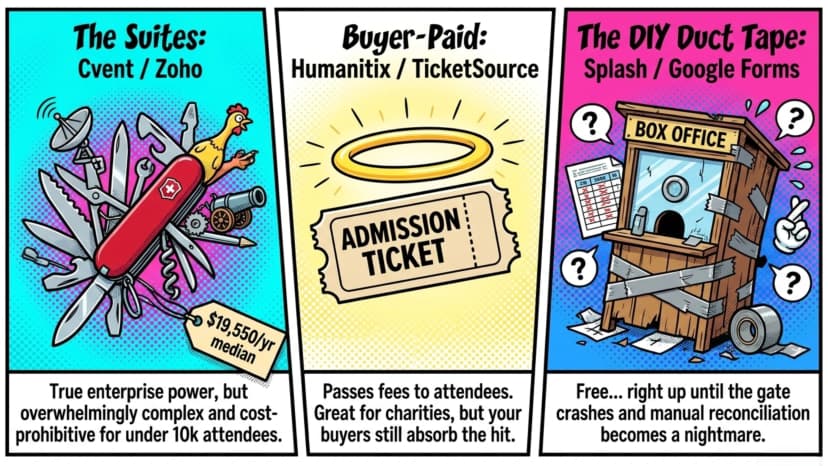
These are the suites powerful, and priced like it. Zoho Backstage is subscription-plus-pay-per-event (pricing from around $299/event) and shines for multi-session conferences inside the Zoho ecosystem, but it’s complex for beginners.
Cvent is enterprise event management with opaque, quote-based pricing, which is commonly around $19,550/year at the median, plus $7–$12 per-registrant fees and implementation costs and it is the right tool for true enterprise meetings programs.
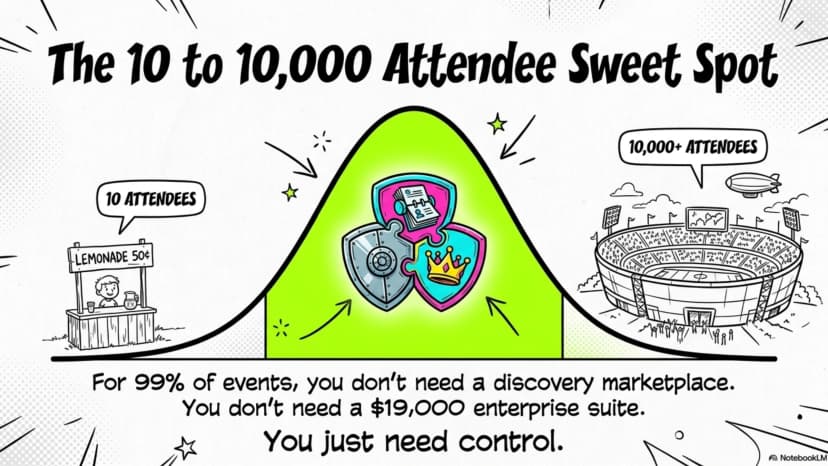
For the 10-to-10,000-attendee range where most of us actually operate, both are usually overkill and cost-prohibitive. Ticket Generator is pay-only-for-what-you-use credits: no subscription, no contract, no sales call, and you’re live in minutes.
Ticket Generator vs. Townscript, BookMyShow, Splash, and DIY
The rest fall into three buckets. Marketplaces like Townscript and BookMyShow charge marketplace fees with delayed payouts and platform-first branding.
Splash is an enterprise marketing platform built for branded pages, not operational ticketing. On top of that, it os complex and expensive for a simple event.
And DIY methods like Google Forms + Sheets + email are free until they aren’t: no QR validation, no duplicate detection, no automation, and a manual reconciliation headache at the gate. Ticket Generator replaces all of it with one clean workflow, from event page to registration to QR tickets to check-in to reports.
Why is Ticket Generator my pick for the best ticketing platform?
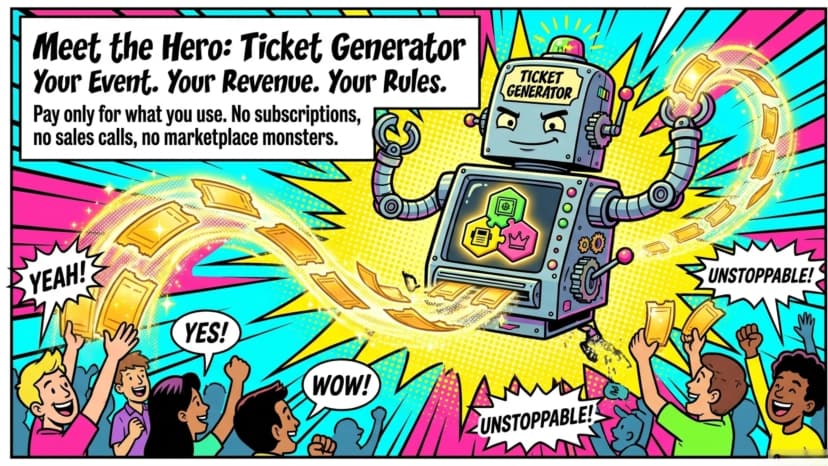
Ticket Generator is built for organizers who already have an audience and simply want to keep control of their money, data, and brand. That's why it's my pick for the best ticketing platform across most event types.
Here is what actually earns that spot after years of testing:
- Commission-free credit pricing: You pay per ticket generated, not per sale. New accounts get 10 free credits; costs drop to as low as $0.25/ticket at volume.
- Your own payment gateway: You can connect Stripe, PayPal, or Razorpay and get paid instantly. Ticket Generator never touches your revenue.
- Full branding and custom domains: No platform logo, no competing events on your page.
- Multi-channel delivery: You can send tickets by email, SMS, and WhatsApp, with Scheduled Send for timed batches.
- AI ticket design and Canva integration: You can generate on-brand tickets in seconds instead of wrestling with a designer.
- Add-ons that grow revenue: Sell scannable perks like parking, lunch, or merch, bundled into the ticket price or offered as checkout upsells, each with its own validation.
- Built-in Campaigns: You can run email marketing and subscriber lists inside the platform, so you promote your event without paying for a separate email tool.
- Real-time analytics and exportable reports: You can track attendance, conversion, and approval rates live, see flagged entry attempts, and export everything to Excel or PDF.
- One-click event cloning: Rebuild a recurring event in seconds instead of starting from scratch each time.
- A dedicated Ticket Validator app: Valid / Invalid / Duplicate / Expired results, multi-gate scanning, and re-entry support on any smartphone.
- Enterprise-grade security: ISO 27001:2022 certified, GDPR-compliant, and SOC 2 aligned, with a unique QR and Ticket ID on every ticket and built-in duplicate detection.
Add coordinator roles for your gate staff, a white-label REST API, and Zapier automation, and Ticket Generator slots into whatever stack you already run.
That delivery breadth isn't decoration. Mobile devices now account for roughly 59% of online event ticketing transactions (Mordor Intelligence, 2025), so sending a scannable ticket straight to a phone over WhatsApp or SMS is how attendees actually want to receive it.
And this isn't theory. Felipe Motta, a wine-and-spirits retailer in Panama, ran ticketed tastings at 96% maximum attendance and generated 95% of its tickets through Ticket Generator's API. Heartland Emmys has leaned on that event-cloning workflow to run 10+ award events across four consecutive years, issuing 3,433+ tickets. Across the platform, Ticket Generator has produced over 1,000,000 tickets for 30,000+ events in 100+ countries.
"Nine out of ten organizers we onboard mention counterfeit prevention as the first reason they're switching; the cost and speed factors are added benefits. They've faced duplicate tickets at the gate, refund disputes, guests who claim they paid but aren't on the list, and they don't want to live that twice."
— Anshul Singh Bisht, Head of Event Technology, Ticket Generator
That matches exactly what pushed me towards making Ticket Generator my top pick.
So, which ticket-selling platform should you choose?
After eleven tools and five years, my conclusion is simple: the best ticket-selling platform is the one that treats your event like it’s yours. Marketplaces buy you reach but rent you your own audience. Suites buy you depth but charge enterprise prices for it.
For the vast majority of events between 10 and 10,000 attendees, you don’t need either. You need commission-free pricing, instant payouts, real branding, and a scanner that catches duplicates. Ticket Generator delivers all four without a subscription or a sales call. Every platform on this list has a place — this is just the one I keep choosing.
Try Ticket Generator to sell tickets with zero commission, instant payouts, and full control of your brand. Your event. Your revenue. Your rules.
FAQs: Choosing the Best Ticket Selling Platform
1. What is the best ticket selling platform?
The best ticket selling platform is the one that lets you keep 100% of your ticket revenue, own your attendee data, and get paid through your own account. For most events between 10 and 10,000 attendees, Ticket Generator fits that with commission-free, credit-based pricing. Marketplaces like Eventbrite suit organizers who specifically need a discovery audience.
2. Which is the best ticketing platform for free events?
Most quality platforms let you run free events at no cost, including Ticket Generator, Ticket Tailor, and TicketSource. The difference is what surrounds the free tier. Ticket Generator adds multi-channel delivery, AI ticket design, and a dedicated validation app even on free events. Always check whether the platform charges you (or your attendees) the moment tickets become paid.
3. Do I have to pay commission on ticket sales?
No, not with every platform. Marketplaces like Eventbrite and Ticketmaster take a percentage of each sale, but commission-free tools like Ticket Generator, Ticket Tailor, and TicketSpice do not. Ticket Generator uses prepaid credits and routes payments straight to your own Stripe, PayPal, or Razorpay account.
4. What is the best ticket selling platform for nonprofits?
For mission-driven organizers, Humanitix is a genuine standout because it donates 100% of its booking-fee profits to charity. If your priority is keeping costs predictable and low, Ticket Generator offers a 30% nonprofit discount on its already commission-free credit pricing. Both let you run free events at no charge.
5. Is Ticket Generator better than Eventbrite?
It depends on what you need. Eventbrite is better if you rely on its marketplace to find new attendees. Ticket Generator is better if you already have an audience and want to keep your revenue, data, and branding, it charges no commission and pays you instantly through your own gateway.
About the author
Content Marketer at Ticket Generator
Ashish Chandra has spent 5+ years writing about event technology, covering topics such as ticket design, QR check-ins, attendee management, and event marketing strategy. As the Content Lead at Ticket Generator, Ashish has analyzed hundreds of real-world event workflows and ticketing setups, helping organizers across industries use QR-based tickets, event landing pages, and smarter ticketing systems to run smoother, better-attended events. His writing is shaped by real user needs and the questions organizers ask most often: How do I sell more tickets? How do I avoid chaos at the door? How do I make my next event better than my last? When he steps away from the screen, you'll likely find him hiking a quiet trail or tending his plants- his preferred way to reset.
Latest posts
Check out our latest articles on the blog
 12 min read
Email Marketing for Events and Webinars: What to Send, When to Send It, and How to Automate It
A step-by-step playbook for email marketing for events and webinars. Learn what to send, when to send it, and how to automate every email for in person and virtual events.
Ashish Chandra
18 Oct 2026
 10 min read
Halloween Masquerade Ball: How to Host a Night of Masks and Mystery
From Venetian-inspired masks to QR-coded entry, here is your complete guide to planning a Halloween masquerade ball your guests will talk about for years.
Ashish Chandra
18 Oct 2026
 9 min read
Ticketmaster Reserved Seating: How It Works and a Better Fit for Smaller Events
Ticketmaster reserved seating works well for arenas. If you run a theatre, gala, or mid-size show, see how it works, what it costs, and how to switch.
Ashish Chandra
16 Oct 2026