AI-powered personalization is reshaping how organizers design, promote, and follow up on events.
Hybrid and in-person formats are both growing.
Attendees now choose events based on experience quality, not convenience alone.
Sustainability has moved from a buzzword to a baseline expectation and influences registration decisions.
Mobile-first ticketing and instant communication such as WhatsApp and SMS are no longer optional. They are expected.
Commission-free ticketing is gaining traction as organizers protect margins against rising venue and logistics costs.
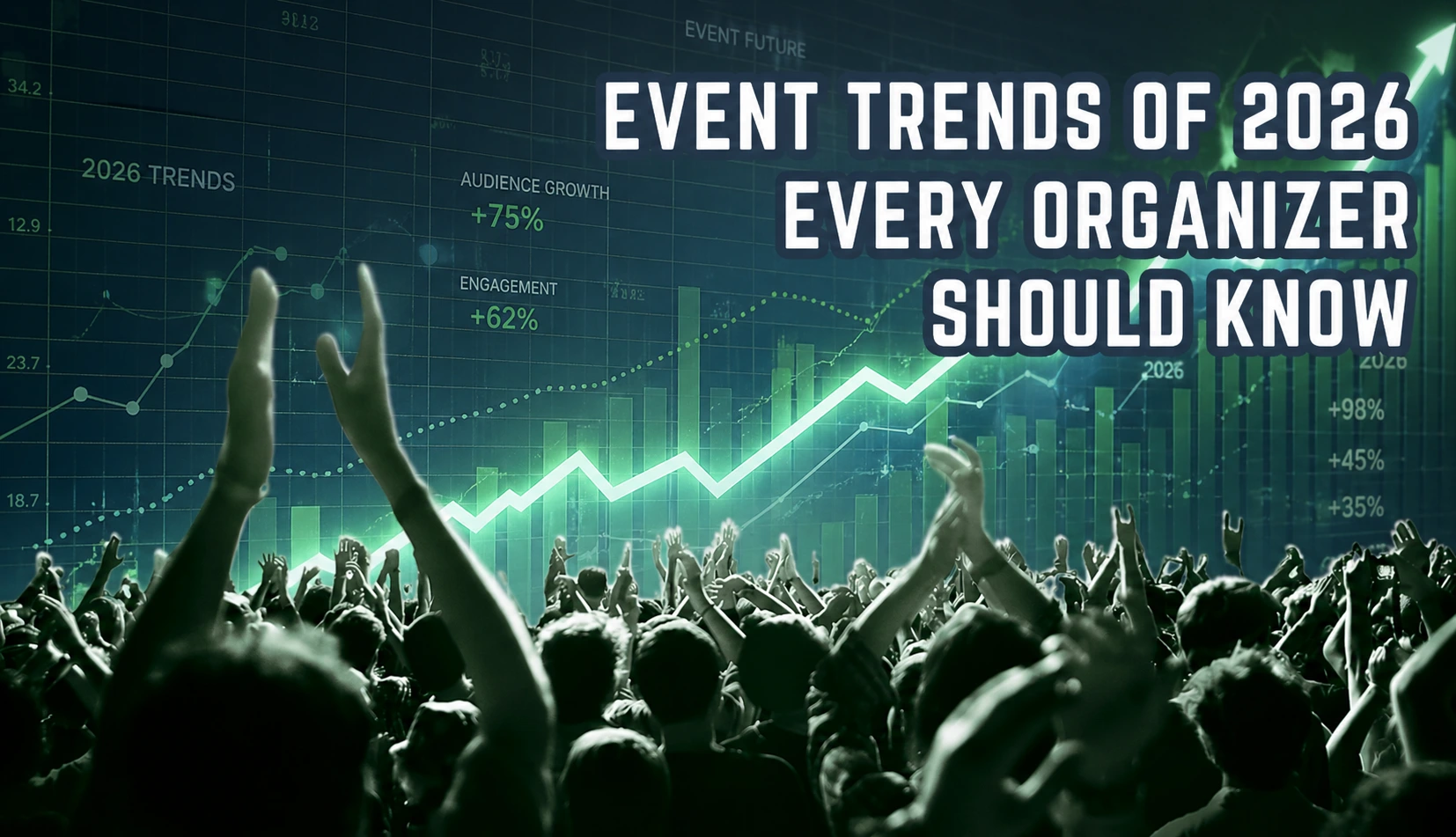
The events industry is projected to reach $2.5 trillion in global value by 2035, and momentum is strong. But the event ecosystem driving that growth looks way different from those filling calendars a few years ago.
With that being said, attendees are pickier now. Technology expectations are much higher. And the economics of running an event, which includes venue, logistics, and marketing, keep tightening.
I’ve put together this article that breaks down the seven trends reshaping the events industry in 2026 and what they mean for you. Plus, you’ll learn awesome insights on how to plan, ticket, and run your next event.
Let’s begin.
What is driving event industry growth in 2026?
The events market is growing because people want experiences, not just content.
According to Allied Market Research (2025), the global events industry was valued at $736.8 billion in 2021. This is the same research that projects it will reach $2.5 trillion by 2035, growing at a compound annual rate of 6.8%. That growth is real, but it's not evenly distributed.
Events that deliver a clear, differentiated experience are growing. Generic networking events and one-size-fits-all conferences are struggling to fill seats. Which makes sense, since everyone wants personalized, highly targeted experiences.
Why more and more people are hosting events (and what it means for you)
1. The experience economy isn’t just back, it’s now bigger than it ever was.
After the pandemic slowdown, people aren’t just returning to events; they’re prioritizing them.
Finance teams are watching costs more closely than before
Internal teams are expected to do more with the same (or slightly higher) budgets
There’s less tolerance for hidden fees and inefficient tools
What this means for organizers: Even if budgets are growing, wasted spend (like ticketing commissions) is under scrutiny. Tools that offer cost control and transparency have a clear advantage.
3. Technology has completely removed the “I don’t know how” barrier
A few years ago, hosting an event meant juggling multiple tools (design, ticketing, payments, check-ins) at once. That complexity alone stopped many people from even trying.
Now, platforms like Ticket Generator have simplified the process to the point that even a first-time organizer can:
Create a branded event page
Generate professional tickets with QR Codes
Start selling or distributing tickets
…all in under 30 minutes, without technical skills.
Why this matters:
You don’t need a team or prior experience
You can test event ideas quickly (low risk)
Even small or private events can run professionally
The real shift (most people miss this) is that these three trends together create a very specific opportunity.
Demand is high (and people want experiences). Budgets are returning (especially in corporate & community spaces). Execution is easier than ever (tools have simplified everything). Which means the biggest barrier today is no longer money, demand, or technology. It’s simply taking action and choosing the right setup.
Pro Tip: If you’re planning an event today, you don’t need a large budget to start. You don’t even need a marketplace to find an audience if you already have one. What you do need is to avoid unnecessary costs and complexity. That’s exactly where lean tools like
Ticket Generator
make the most sense, especially for organizers who already know who they’re inviting.
Set Up Event Ticketing and Distribution in Minutes!
First 10 tickets free | Free account | No credit card required
How is AI transforming event planning and execution?
AI is doing three things in event planning right now. First, AI is highly personalizing content recommendations for users. Second, AI is automating most of the administrative work that used to be manual. And, lastly, AI is providing real-time analytics that help organizers adjust on the fly.
According to Bizzabo's 2025 State of Events Report, 72% of event marketers are already using AI tools for at least one part of their event workflow, up from 38% in 2023. That's not just large enterprises. SMB organizers are using AI to write email sequences, create social content, and design event graphics.
But then again, what AI doesn't replace is the judgment calls. Which sessions to cut? How to handle a venue problem?When to extend the networking break because the energy in the room is right? Those still require a human.
Did You Know?Ticket Generator offers AI-generated design templates for your tickets. If you’re planning an event in 2026, your ideal ticket design is just a prompt away.
Are hybrid events still worth the investment in 2026?
Yes, but the economics have changed. In 2021–2022, hybrid was often a hedge: organizers ran a physical event and streamed it for remote attendees as an afterthought. In 2026, the organizers doing hybrid well treat both audiences as primary.
According to Bizzabo (2025), 87% of event leaders plan to maintain or increase their hybrid event budget in 2026. The ones seeing strong ROI share a common characteristic: they design separate experiences for in-person and online attendees, rather than just pointing a camera at a stage.
The economics: hybrid adds cost. Streaming infrastructure, technical support, and platform fees are real.
Before committing, ask: does the additional reach justify the additional spend? For thought leadership and global community events, that’s usually yes. For local events where the energy of the room is the product, the answer is often no.
What do attendees actually want from events in 2026?
Attendees in 2026 have three non-negotiables that cannot be overlooked At ALL.
Number one is personalization. The Eventbrite’s trends 2025 report found that 68% of attendees expect personalized event experiences, including agenda recommendations based on their interests. They don't want to scroll through 40 sessions to find the two that matter to them.
Pro Tip: Ticket Generator integrates with
Zapier,
so you can automate attendee communications. Send personalized confirmation emails, event reminders, and post-event follow-ups without handling them manually.
Second is seamless logistics. Long registration lines, paper tickets, and manual check-ins are now considered red flags (not inconveniences).
Attendees expect QR Code entry, instant ticket delivery via WhatsApp or email, and real-time updates if anything changes.
Last but not the least, sustainability signals do make a difference. A Nielsen global survey found that 73% of global consumers say they would change their consumption habits to reduce environmental impact.
For events: reduced plastic, local sourcing, carbon offsets, and digital-only ticketing.
What attendees don't care about in 2026 are event apps with 47 features that nobody uses. The trend is toward simplicity, an event that's easy to register for, easy to attend, and easy to remember.
Pro Tip: Running an event in 2026? Try
Ticket Generator. You can set up your event page, design branded tickets, and start taking registrations in under 30 minutes, with zero commissions on tickets. Pay only for the tickets you create and keep 100% of the revenue.
How are event organizers cutting costs without cutting quality?
Rising venue costs, higher AV rates, and platform fee inflation are squeezing event margins. The organizers managing this best in 2026 are doing these three things:
Firstly, they’re switching to commission-free ticketing. Traditional platforms take 5–8% per ticket. On a 500-person paid event at £75 per ticket (£37,500 gross), that's up to £3,000 in platform fees.
Platforms like Ticket Generator use a credit-based model: you pay for the tickets you generate, not a percentage of what you sell. Payment goes directly through your own gateway (Stripe, Razorpay, PayPal) and the platform takes zero commission.
Secondly, event organizers are building on a community first and monetizing later model. Most organizers in 2026 run free or low-cost events to build an engaged audience.
Then, they monetize through workshops, premium conferences, and sponsorships. It’s a fact that customer acquisition cost drops dramatically when your audience already trusts you.
Lastly, going digital-only on materials. Printed schedules, lanyards, and brochures add cost and waste. Digital ticketing ecosystems eliminate this and attendees increasingly prefer them.
How does Ticket Generator support these 2026 event trends?
Ticket Generator is built for the way events work in 2026. Fast to set up, fair on pricing, and flexible enough to handle a 20-person workshop or a 5,000-person conference.
2026 Event Trend
How Ticket Generator Supports It
Mobile-first attendee experience
Instant ticket delivery via WhatsApp, SMS, or email
Commission-free economics
Credit-based model; zero per-ticket commission; direct payment gateway
Seamless check-in
QR code validation via Ticket Validator app (iOS, Android, web)
Personalization
Custom ticket designs, branded event pages, organizer owns attendee data
Hybrid-ready
Generate and distribute tickets for in-person and virtual attendees
Sustainability
Digital-only ticketing. No paper, no printing needed.
Did you know that more than 1,000,000 tickets have been generated on Ticket Generator across 30,000+ events in 100+ countries? Clients include giants like Deloitte, Google, VMware, and the Emmy Awards (organizations that can't afford check-in failures or data issues). The best part? The platform is ISO 27001:2022 certified and GDPR-compliant.
Pro Tip: Ticket Generator integrates with
HubSpot
and
Zapier,
so your attendee data flows directly into your CRM. No CSV exports, no manual data entry.
Set Up Event Ticketing and Distribution in Minutes!
First 10 tickets free | Free account | No credit card required
What does the event calendar look like for the rest of 2026?
The second half of 2026 is shaping up to be dense. According to the Amex GBT 2025 Meetings & Events Forecast, internal meetings remain the most frequent meeting type, and the pipeline for H2 2026 reflects that.
The post-pandemic event rebound has settled into a new normal: more events, higher attendee expectations, and more competition for the same date slots and venues.
If you’re an event organizer, this is something you don’t want to miss out on. The key windows driving activity in H2 2026: back-to-school season (September), conference season (October–November), and end-of-year company events and galas (December).
If you're planning for any of these, the time to lock venues and set up ticketing is now.
The bottom line on event trends 2026
The trends shaping events in 2026 (AI integration, hybrid events, personalization, sustainability, commission-free economics) aren't temporary.
They reflect a permanent shift in what attendees expect and what organizers can deliver with modern tools. The good news: you don't need an enterprise budget to run a 2026-ready event. You need the right tools and the right setup.
Set Up Event Ticketing and Distribution in Minutes!
First 10 tickets free | Free account | No credit card required
The standout trends for 2026 are AI-assisted planning, personalized attendee experiences, sustainability requirements, mobile-first ticketing, and commission-free registration platforms. Organizers adopting these trends report higher registration completion rates and stronger post-event feedback scores.
2. Are hybrid events still popular in 2026?
Yes, 87% of event leaders plan to maintain or increase hybrid investment in 2026. However, the approach has matured. Successful hybrid events now design separate experiences for in-person and online attendees, rather than streaming a physical event as an afterthought.
3. How can I reduce ticketing costs for my 2026 events?
Switch to a commission-free ticketing platform. Traditional platforms charge 5–8% per ticket; on a mid-size paid event, that can mean thousands in fees. Ticket Generator uses a credit-based model where you pay per ticket generated, not a percentage of sales. Your payment gateway (Stripe, Razorpay, PayPal) processes payments directly, so you keep 100% of ticket revenue.
4. What do attendees expect from events in 2026?
Three things dominate: personalized agendas, seamless digital check-in (QR codes, instant ticket delivery via WhatsApp or email), and visible sustainability efforts. Attendees in 2026 compare their experience against the best events they've attended set the bar high from the moment they register.
5. How do I start using AI in event planning?
Start with administrative tasks: AI tools write email sequences, generate social content, create session descriptions, and analyze registration data for patterns. In 2026, 72% of event marketers already use AI for at least one workflow (Bizzabo, 2025).
The highest-value use case for most organizers is AI-assisted personalization, recommending sessions and follow-up content based on attendee profiles.
Ashish Chandra has spent 5+ years writing about event technology, covering topics such as ticket design, QR check-ins, attendee management, and event marketing strategy. As the Content Lead at Ticket Generator, Ashish has analyzed hundreds of real-world event workflows and ticketing setups, helping organizers across industries use QR-based tickets, event landing pages, and smarter ticketing systems to run smoother, better-attended events.
His writing is shaped by real user needs and the questions organizers ask most often: How do I sell more tickets? How do I avoid chaos at the door? How do I make my next event better than my last?
When he steps away from the screen, you'll likely find him hiking a quiet trail or tending his plants- his preferred way to reset.





.png)





.webp)

.svg)
.svg)