

What Percentage Does Eventbrite Take? The Real Number on Every Ticket
 Written byAshish ChandraLast updatedAugust 24, 2026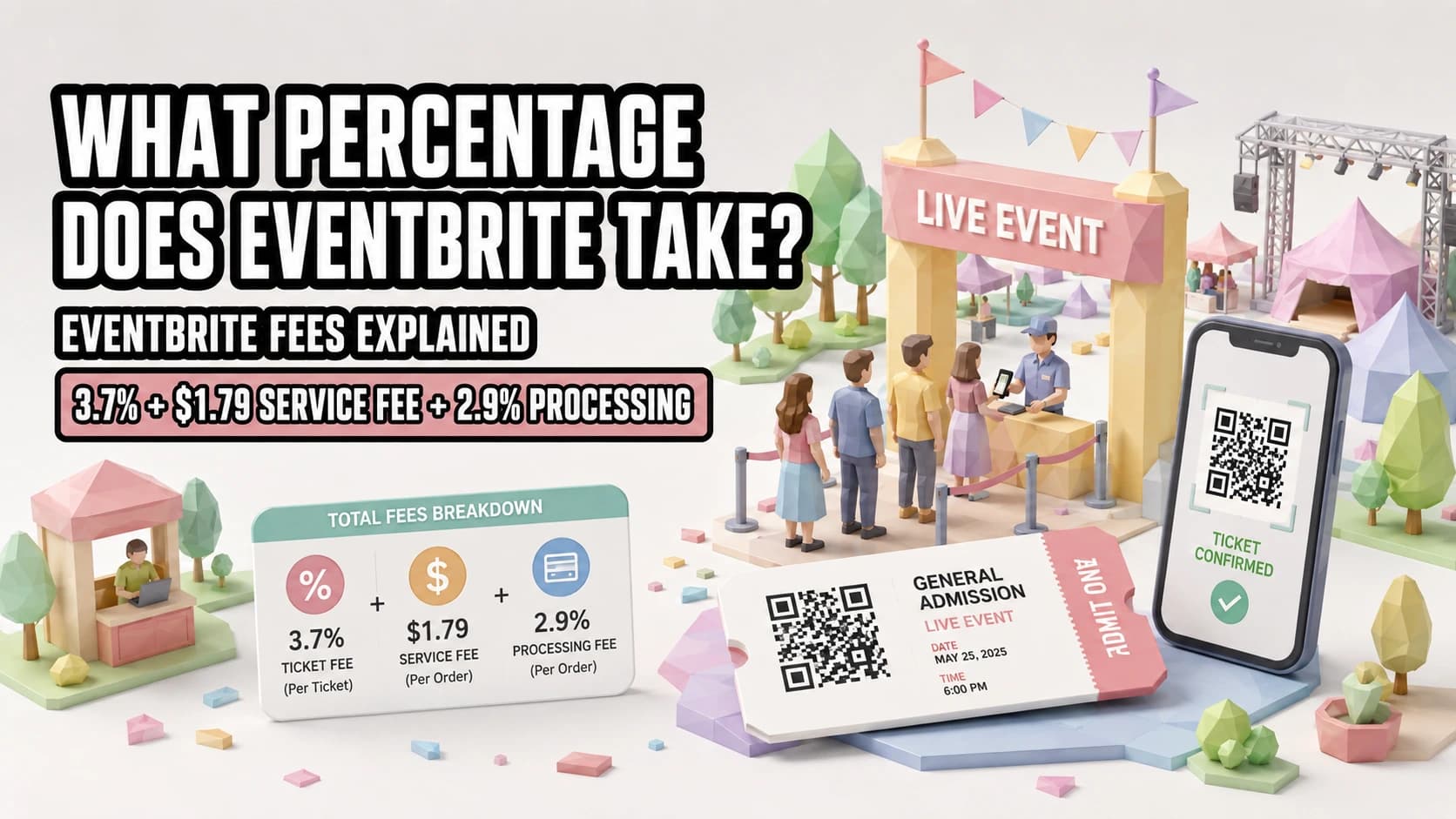
Key Takeaways:
- In the US, Eventbrite takes 3.7% plus $1.79 per paid ticket as a service fee, plus 2.9% for payment processing.
- Absorb those fees and your real cost is roughly 6.6% of the ticket price plus $1.79.
- The flat $1.79 decides your rate: 15.6% on a $20 ticket, 7.3% on a $250 one.
- Free events cost nothing on Eventbrite, and there is no cap on paid ticket fees.
- Ticket Generator charges a flat credit per ticket instead, so cost stops tracking ticket price.
Ask what percentage does Eventbrite take and you will get 3.7% as the answer. That number is real, and almost nobody actually pays it.
In the US, Eventbrite charges 3.7% of the ticket price plus $1.79 per paid ticket as a service fee, then adds 2.9% for payment processing. If you absorb those fees rather than passing them to buyers, your true cost is about 6.6% of the ticket price plus $1.79 per ticket. On a $20 ticket that is 15.6%. On a $250 ticket it is 7.3%. Same platform, same published rate, wildly different outcomes.
In this guide I break down each fee component, show the effective rate at five price points, explain who actually pays, and cover what changed when Bending Spoons bought Eventbrite in 2026. All figures were checked against Eventbrite's own Help Center in August 2026.
What Percentage Does Eventbrite Take on Each Ticket?
Eventbrite charges a Ticketing Fee on every paid ticket, made up of two separate parts: a service fee and a payment processing fee. Free tickets carry no fee at all.
Here is what each part does, according to Eventbrite's Help Center:
|
Fee |
US rate |
How it is calculated |
|---|---|---|
|
Service fee |
3.7% + $1.79 per paid ticket |
On the ticket price. Charged per ticket, so a 3-ticket order pays it three times. |
|
Payment processing fee |
2.9% per order |
On the total order, including the service fee and any tax. Charged once per order. |
|
Free events |
No fee |
No service or processing fee on free tickets. |
That second row is the detail most fee guides get wrong. Processing is calculated on the order total, not the ticket price, so when you pass fees to buyers the 2.9% lands on the service fee as well as the ticket. It is only a few cents per ticket, but it means the fee is quietly taxed too.
Rates differ by country. UK organizers pay a single combined fee of 6.95% plus £0.59 per ticket, with no separate processing line. Always check your own Organization settings before you print posters, because the published table varies by currency.
Why Is the Effective Rate Higher Than 3.7%?
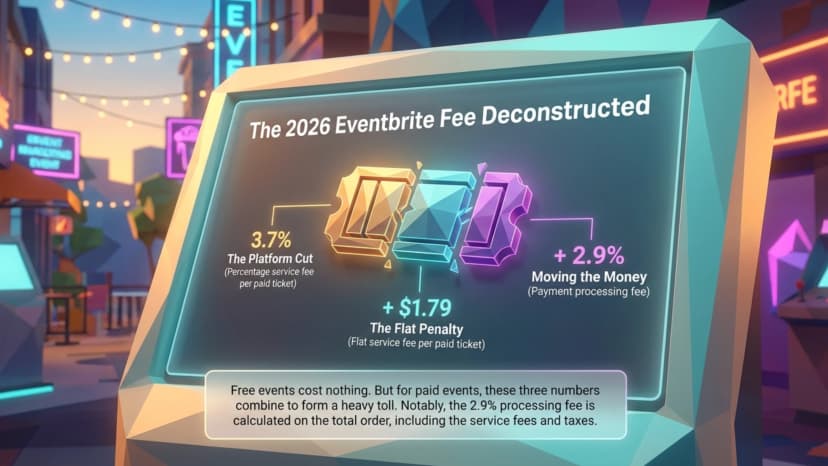
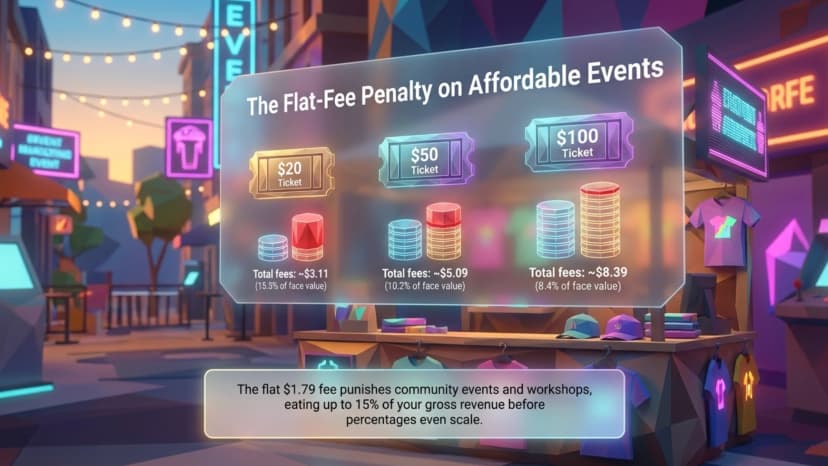
Because $1.79 is a flat fee, and flat fees do not scale. The cheaper your ticket, the larger a share that $1.79 represents, which is why the advertised 3.7% bears almost no relationship to what you actually lose.
Here is the math at five price points, assuming you absorb the fees and sell one ticket per order:
|
Ticket price |
Service fee |
Processing |
Total fees |
Effective rate |
|---|---|---|---|---|
|
$10 |
$2.16 |
$0.29 |
$2.45 |
24.5% |
|
$20 |
$2.53 |
$0.58 |
$3.11 |
15.6% |
|
$50 |
$3.64 |
$1.45 |
$5.09 |
10.2% |
|
$100 |
$5.49 |
$2.90 |
$8.39 |
8.4% |
|
$250 |
$11.04 |
$7.25 |
$18.29 |
7.3% |
US rates, one ticket per order, organizer absorbing fees. Verified against Eventbrite's Help Center, August 2026.
The shortcut is simple: your cost is roughly 6.6% of the ticket price plus $1.79. Run your own number through that and you will be within a few cents.
This matters most if you sell in the $15 to $30 range, which describes most comedy nights, workshops, community fundraisers, and club events. That is exactly where Eventbrite is at its most expensive, and exactly where most independent organizers live.
One more thing worth knowing: Eventbrite has not capped ticket fees since 2018. On a $500 VIP ticket the fee keeps climbing rather than stopping at a ceiling.
Who Actually Pays the Eventbrite Fee, You or Your Attendees?
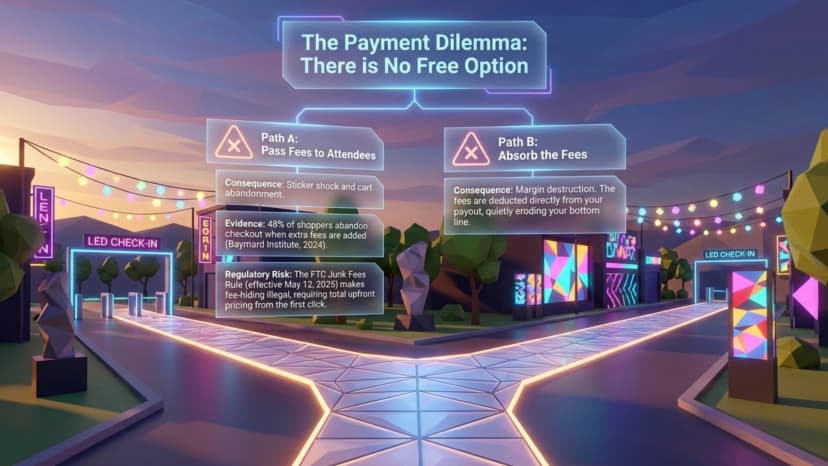
By default, your ticket buyers pay. Eventbrite adds the fees on top at checkout, so a $20 ticket rings up at roughly $23.11. You can instead tick "Absorb fees" when you create a ticket type, which folds the cost into your price and takes it out of your payout.
Neither option makes the fee disappear. It only decides whose number looks worse, and both choices carry a cost:
- Pass fees on. You keep the full ticket price, but buyers see a price jump at the final step. That is the single most common reason people abandon a checkout.
- Absorb fees. Your listed price is the price paid, which converts better, but your margin takes the hit on every sale.
Did you know that 48% of shoppers abandon checkout when extra costs like fees are too high, making it the number one reason for abandonment? Source: Baymard Institute, 2024 survey of 1,012 US adults
There is also a regulatory angle. The FTC's Junk Fees Rule (16 C.F.R. Part 464), effective May 12, 2025, requires live-event ticket sellers to show the total price including all mandatory fees up front. Hiding the fee until checkout is no longer a viable strategy, so the question is now which number you want on the poster.
If you would rather show one honest figure and keep it, that is the case for no fee tickets built on a platform that does not take a cut of each sale.
Pro Tip: Before switching platforms, calculate your blended rate rather than your headline rate. Take last year's total platform fees and divide by total ticket revenue. Organizers selling sub-$30 tickets are usually shocked. Ticket Generator charges a flat credit per ticket instead of a percentage, so that blended rate stops moving with your ticket price.
Work out what a commission-free setup would return on your last event. Try Ticket Generator and keep 100% of every ticket you sell.
What Does Eventbrite Not Charge You For?
Free events. If your tickets are free, you pay nothing, and there is no per-ticket cost for registrations. For community groups, meetups, and free workshops, that is genuinely hard to beat.
It is worth being fair about the rest of what the fee buys, because the fee is not pure overhead:
- A discovery marketplace that puts your event in front of people already browsing for something to do
- Unlimited event publishing at no upfront cost, with no contract or sales call
- Built-in checkout, refunds, and attendee management that work out of the box
If a meaningful share of your ticket sales comes from people who found you on Eventbrite rather than through your own promotion, the fee is buying you customers. That is a real service and it deserves credit.
The calculation changes when you already own your audience. If you sell to your own mailing list, your own members, or a returning community, you are paying marketplace rates for an audience you brought yourself. That is the moment most organizers start comparing Eventbrite alternatives.
Did Eventbrite's Fees Change After the 2026 Acquisition?
Not the per-ticket fees, at least not as of August 2026. The service fee is still 3.7% plus $1.79, and processing is still 2.9%. What changed is who owns the company and what sits behind a subscription.
Bending Spoons, the Italian software group behind Evernote, WeTransfer, and Vimeo, completed its acquisition of Eventbrite on March 10, 2026 in an all-cash deal worth roughly $500 million, at $4.50 per share. Eventbrite is now private and no longer trades on the NYSE. Co-founder Julia Hartz stepped down around the transition.
Two things followed that are worth factoring into a platform decision:
- Leaner staffing. New leadership announced headcount reductions in April 2026, which affects support response times.
- Support behind a plan. Direct human support continues to sit behind a paid subscription rather than the free tier.
I want to be careful here, because it would be easy to overstate this. No fee increase has been announced. But new private ownership that paid a distressed-asset price generally intends to improve margins, and ticketing fees are the obvious lever. If you are signing up for a full season of events, build in the possibility that the rate you model today is not the rate you pay in 2027.
How Does Ticket Generator Compare on Cost?
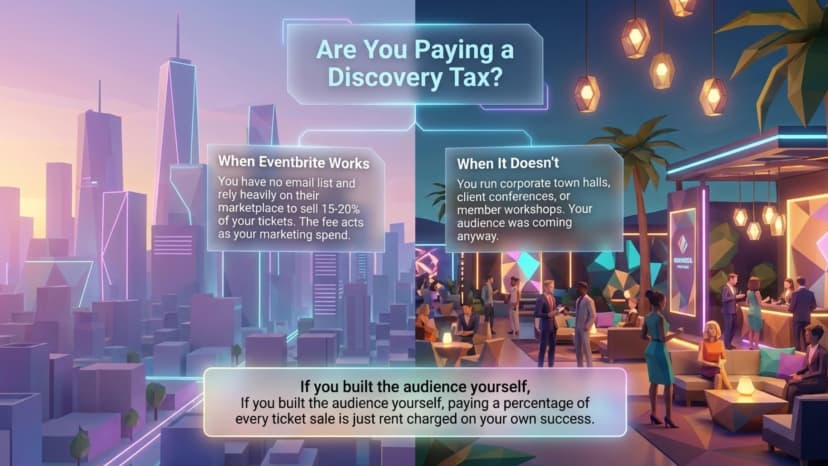
Ticket Generator is built for organizers who already have an audience and do not want to pay a percentage for reaching it. Instead of commission, you buy credits: one credit generates one ticket, and that cost does not move when your ticket price does.
Credits come in packs, which is what brings the per-ticket cost down at volume:
- 10 credits for $6, or $0.60 per ticket
- 100 credits for $50, or $0.50 per ticket
- 1,000 credits for $400, or $0.40 per ticket
- 10,000 credits for $2,500, or $0.25 per ticket
Credits never expire, new accounts get 10 free, and nonprofits get 30% off. Venue layout events use two credits per ticket.
|
Factor |
Eventbrite (US) |
Ticket Generator |
|---|---|---|
|
Platform cost per ticket |
3.7% + $1.79 |
1 credit, $0.25 to $0.60 |
|
Does cost rise with ticket price? |
Yes, uncapped |
No, flat per ticket |
|
Payment processing |
2.9%, billed by Eventbrite |
Your own gateway's rate, billed by your gateway |
|
Who holds the money |
Eventbrite, paid out after the event |
You, via your own Stripe, PayPal, or Razorpay |
|
Free events |
No fee at all |
1 credit per ticket generated |
|
Attendee data |
Shared with the marketplace |
Owned by the organizer |
Read that free events row carefully, because it is where Eventbrite genuinely wins. If you only run free events, Eventbrite costs you nothing and Ticket Generator costs you a credit per ticket. I would not pretend otherwise.
The gap opens up on paid tickets. Because payments run through your own gateway, Ticket Generator never holds your money and takes no cut of the sale. You pay Stripe or PayPal their standard rate directly, and you pay us for the ticket, not for the transaction.
That is also why the switch tends to be about more than money:
"Nine out of ten organizers we onboard mention counterfeit prevention as the first reason they're switching; the cost and speed factors are added benefits. They've faced duplicate tickets at the gate, refund disputes, guests who claim they paid but aren't on the list, and they don't want to live that twice."
Anshul Singh Bisht, Head of Event Technology, Ticket Generator
Ticket Generator has powered over 30,000 events and more than 1,000,000 tickets across 100+ countries. Felipe Motta, a food and beverage retailer in Panama, runs paid tastings on the platform and has issued 638+ tickets with 96% maximum attendance, 95% of them generated through the API.
Every ticket carries a unique QR code and ticket ID, duplicate scans are flagged instantly, and the platform is ISO 27001:2022 certified. If you want the wider market view first, we compare the field in our guide to ticketing platforms with the lowest fees.
Bringing It Together
Eventbrite's real cost is not 3.7%. It is roughly 6.6% plus $1.79 per ticket, which means your effective rate is set by how cheap your tickets are rather than by anything on the pricing page.
None of that makes Eventbrite the wrong choice. If the marketplace sells tickets you could not have sold yourself, the fee is buying something real, and free events genuinely cost nothing. The platform earns its rate for plenty of organizers.
It stops earning it when you are the one filling the room. At that point you are paying a percentage of your own marketing, on every ticket, forever. Run your blended rate once, and let the number decide rather than the habit.
Try Ticket Generator to sell tickets with zero commission, your own payment gateway, and predictable per-ticket pricing. Your event. Your revenue. Your rules.
FAQs: Eventbrite Fees and Percentages
1. What percentage does Eventbrite take from ticket sales?
In the US, Eventbrite takes 3.7% of the ticket price plus $1.79 per paid ticket as a service fee, plus 2.9% of the order for payment processing. Absorbing those fees puts your real cost at roughly 6.6% plus $1.79 per ticket. Free events carry no fee.
2. Does Eventbrite charge a fee for free events?
No. Eventbrite charges no service or payment processing fee on free tickets, and you can publish unlimited events at no upfront cost. Fees apply only when you sell paid tickets, sell add-ons, or collect donations.
3. Can I make attendees pay the Eventbrite fee instead of me?
Yes, and that is the default setting. Eventbrite adds the fees on top of your ticket price at checkout unless you tick "Absorb fees" when creating the ticket type. Bear in mind the FTC's Junk Fees Rule requires the total price, including mandatory fees, to be shown up front.
4. Is there a maximum Eventbrite fee per ticket?
No. Eventbrite removed its fee cap in 2018, so the percentage keeps applying however expensive the ticket is. On a $500 VIP ticket the fees come to roughly $34.79, with nothing capping the total.
5. Which is cheaper for paid tickets, Eventbrite or Ticket Generator?
Ticket Generator is cheaper on paid tickets in almost every scenario, because it charges a flat credit of $0.25 to $0.60 per ticket rather than a percentage, and takes no commission on the sale. Eventbrite is cheaper for free events, where it charges nothing at all. The crossover depends entirely on whether your tickets are free.
About the author
Content Marketer at Ticket Generator
Ashish Chandra has spent 5+ years writing about event technology, covering topics such as ticket design, QR check-ins, attendee management, and event marketing strategy. As the Content Lead at Ticket Generator, Ashish has analyzed hundreds of real-world event workflows and ticketing setups, helping organizers across industries use QR-based tickets, event landing pages, and smarter ticketing systems to run smoother, better-attended events. His writing is shaped by real user needs and the questions organizers ask most often: How do I sell more tickets? How do I avoid chaos at the door? How do I make my next event better than my last? When he steps away from the screen, you'll likely find him hiking a quiet trail or tending his plants- his preferred way to reset.
Latest posts
Check out our latest articles on the blog
 12 min read
Email Marketing for Events and Webinars: What to Send, When to Send It, and How to Automate It
A step-by-step playbook for email marketing for events and webinars. Learn what to send, when to send it, and how to automate every email for in person and virtual events.
Ashish Chandra
18 Oct 2026
 10 min read
Halloween Masquerade Ball: How to Host a Night of Masks and Mystery
From Venetian-inspired masks to QR-coded entry, here is your complete guide to planning a Halloween masquerade ball your guests will talk about for years.
Ashish Chandra
18 Oct 2026
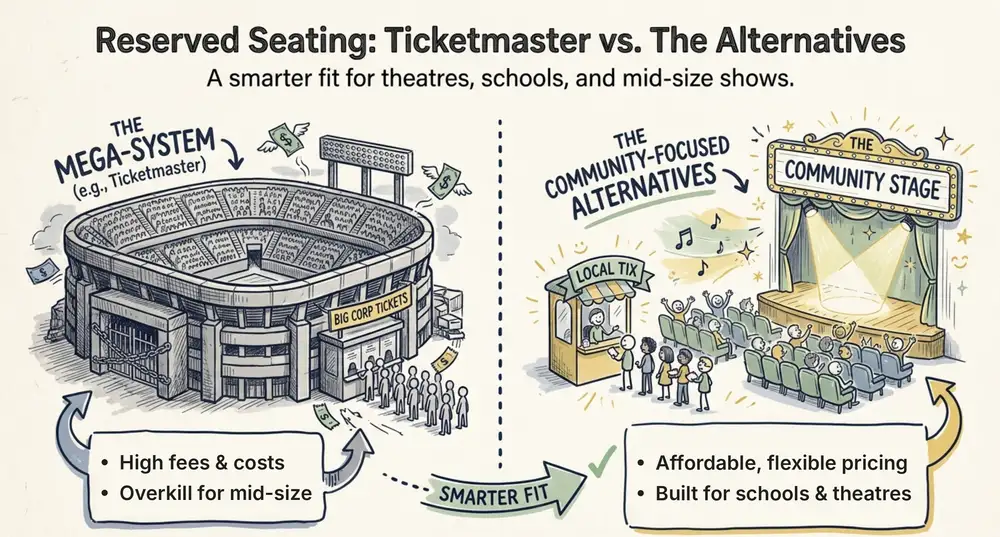 9 min read
Ticketmaster Reserved Seating: How It Works and a Better Fit for Smaller Events
Ticketmaster reserved seating works well for arenas. If you run a theatre, gala, or mid-size show, see how it works, what it costs, and how to switch.
Ashish Chandra
16 Oct 2026