

Online Fundraisers for Schools: Ideas, Setup, and What Actually Raises Money
 Written byAshish ChandraLast updatedSeptember 23, 2026
Key Takeaways:
- Online fundraisers for schools raise money through a web page instead of paper envelopes, order forms, or cash boxes.
- Ticketed events, digital raffles, and pledge-based a-thons consistently out-earn catalog sales because families can pay and share in one tap.
- Platform commissions quietly shrink the total, so check what the school keeps before you launch.
- Ticket Generator lets schools sell tickets with zero commission, using their own payment gateway.
- One clean checkout page plus QR check-in replaces spreadsheets, cash reconciliation, and door-list chaos.
It usually starts the same way for every classroom in the country. Teachers spent an average of $895 out of their own pockets on classroom supplies during the 2024-25 school year, while the median school-provided supply budget sat at just $200.
That gap is why fundraising is not a nice-to-have for most schools. It is the field trip, the robotics kit, the new set of library books.
Online fundraisers for schools are campaigns where families give, buy, or register through a web page, such as a ticket page, a donation form, or a pledge page, instead of returning cash and paper forms. The best-performing formats are ticketed events, digital raffles, and pledge-based a-thons, because each one gives a parent a single link they can pay through and forward to a grandparent in another state. That last part is the whole advantage. Paper stops at the kitchen counter. A link does not.
In this guide, I break down which online fundraisers actually raise money for schools and roughly what each one nets. We then walk through setting one up step by step, cover the fees and district rules that catch PTAs off guard, and look at what changes when the fundraiser runs on a college campus instead of an elementary school gym.
What counts as an online fundraiser for a school?
An online fundraiser is any school campaign where the money is collected digitally, through a ticket page, a registration form, a pledge page, or a donation link, rather than through cash, checks, or paper order forms.
The event itself can still be completely in-person. A spring carnival where families buy wristbands on their phones the week before is an online fundraiser. The word "online" describes how the money moves, not where people stand.
Most school campaigns fall into one of three models:
- Ticketed: families pay for entry to something, such as a gala, a talent show, a movie night, a pancake breakfast, or a spring fling.
- Pledge-based: students collect commitments per lap, page, or minute, and sponsors pay through the student's page. Read-a-thons and fun runs live here.
- Direct ask: a giving day or a specific goal ("fund the 5th-grade DC trip"), with a donation form and a public progress bar.
A single campaign often mixes two. A gala sells tickets and runs a silent auction alongside it. That is usually a good sign, not scope creep, since you are collecting from the same audience twice without asking them to show up twice.
Why are schools moving fundraisers online?
Because digital giving keeps growing while paper-based participation keeps shrinking, and because online campaigns reach people who will never walk into the building.
According to the 2026 M+R Benchmarks Study, online revenue for the average nonprofit grew 15% in 2025, and recurring monthly gifts made up 27% of all online revenue. Nonprofits also collected 37% of their entire annual online revenue in December alone, which tells any PTA planning a calendar exactly when to run the direct ask.
There is a practical reason too.
Did you know that mobile devices accounted for roughly 58% of online event ticketing transactions in 2025? Source: Mordor Intelligence
A parent standing in a pickup line will buy a $20 spring-fling ticket on their phone. That same parent will not find an envelope, locate a checkbook, and remember to send it back with a nine-year-old.
The harder truth is that online tools also expose how unevenly school fundraising works. Chalkbeat's May 2026 analysis of New York City Education Department data found that in 2024-25, the top 2.5% of schools raised nearly half of all PTA money citywide, while about a third of PTAs reported raising nothing at all. Lower-cost tools do not fix that gap, but they do stop a small school from losing a fifth of a modest total to platform fees.
Which online fundraisers raise the most for schools?
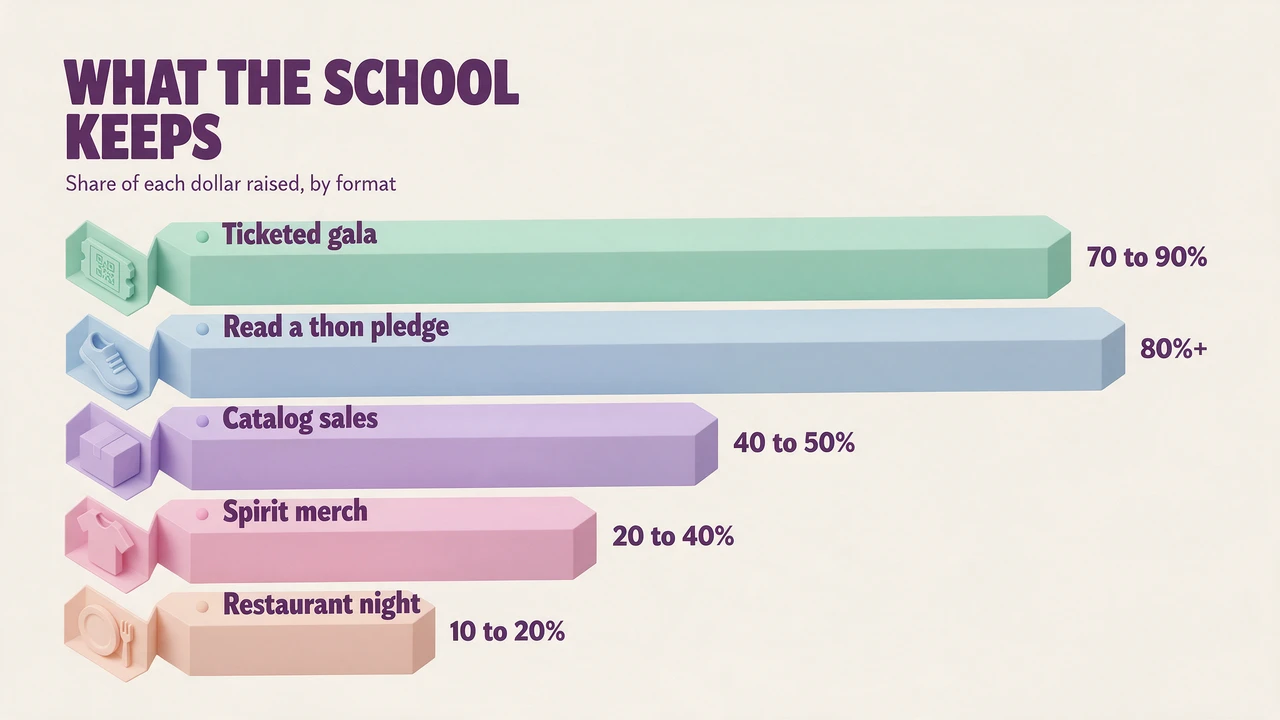
Ticketed events and digital raffles typically net the most per hour of volunteer effort, while pledge-based a-thons deliver the highest participation rates. Catalog and product sales rank lowest, because a large share of every dollar goes to the vendor.
Here is how the common formats compare:
|
Fundraiser |
Volunteer effort |
What the school typically keeps |
Best for |
|---|---|---|---|
|
Ticketed gala or auction night |
High |
70% to 90% after venue and catering |
Middle and high schools, alumni, big-ticket goals |
|
Digital raffle |
Low |
Most of the take, minus prize cost |
Any grade level, strong add-on to another event |
|
Read-a-thon or fun run (pledge) |
Medium |
80%+ if run on your own page |
Elementary schools, whole-school participation |
|
Online silent auction |
Medium-high |
Nearly all of it (donated items) |
Schools with local business relationships |
|
Ticketed talent show, movie night, trivia night |
Low-medium |
Most of ticket revenue |
Recurring, low-stakes monthly income |
|
Spirit merch store |
Low |
20% to 40% (vendor takes the rest) |
Brand building more than revenue |
|
Catalog or product sales |
Medium |
40% to 50% at best |
Schools with an established vendor program |
|
Restaurant or partner night |
Very low |
10% to 20% of the night's sales |
Filler campaigns between big events |
1. Ticketed events, virtual or hybrid
A ticketed event is the most reliable online school fundraiser because you know your revenue before the doors open. Sell 300 tickets at $25 and you have $7,500 committed, which lets you budget catering instead of guessing.
Hybrid works especially well for schools. Sell an in-person ticket and a lower-priced stream ticket to the same concert or awards night, and grandparents in another time zone become paying attendees. Multiple ticket categories, general, family four-pack, VIP table, patron, let one page serve every budget in your community. For a full run-through of the planning side, our guide on how to plan a fundraising event covers the timeline and budget work that sits behind the ticket page.
2. Digital raffles
Raffles are the highest-return-per-effort fundraiser most PTAs run, provided the numbering is clean. Sell numbered entries online, draw on a livestream, and you avoid the classic disaster of a shoebox full of torn stubs with no way to verify a winner.
"If your raffle tickets aren't clearly numbered, you're inviting confusion. Simple sequential numbering keeps the draw fair, makes tracking easier, and reassures participants that everything is transparent."
Anshul Singh Bisht, Head of Event Technology, Ticket Generator
Check your state and district rules first, since raffles are regulated gambling in some jurisdictions and may require a permit or a nonprofit gaming registration. Once you are cleared, our walkthrough on how to make raffle tickets covers the numbering and design mechanics.
3. Pledge-based a-thons
Read-a-thons, fun runs, math-a-thons, and jump-a-thons win on participation. Every student gets a page, so every family has a reason to share it, and the sponsor list quickly reaches beyond your zip code.
The trap is the platform. Many a-thon services take a percentage plus a per-transaction fee, which on a $30,000 campaign can quietly cost more than the T-shirts. Running the pledge collection through a page you control keeps that money in the school.
4. Online silent auctions
Auctions convert donated goods into cash at close to a 100% margin, which no product sale can match. Local businesses, teacher experiences ("principal for a day," "front-row seat at the concert"), and parent-donated services all bid well.
Pair the auction with a ticketed event and you get two revenue lines from one guest list. Our piece on tickets for charity events explains how to structure the entry side so the auction gets a captive, checked-in audience.
How do you run an online school fundraiser step by step?
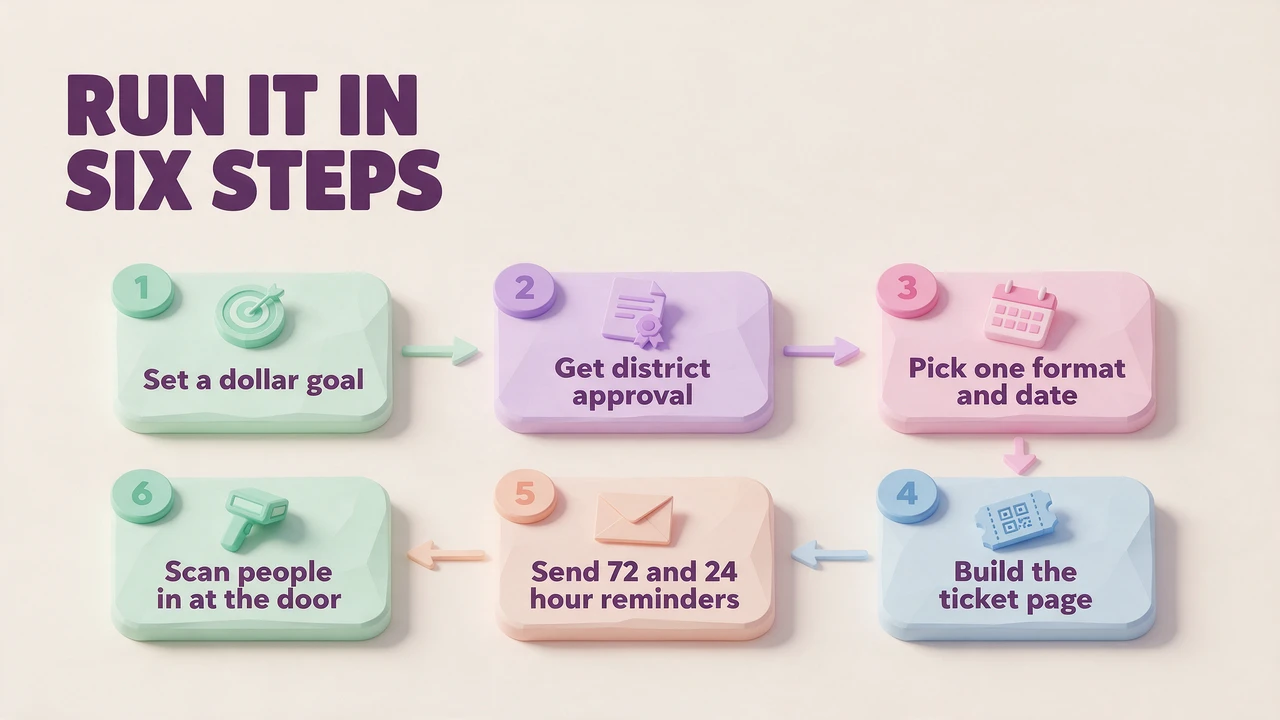
Start with the dollar goal, pick the format that matches your volunteer capacity, then build one checkout page and drive everything to it. Here is the sequence I would follow:
- Set a specific, funded goal. "Raise $12,000 for eight new Chromebook carts" outperforms "support our school." Specificity makes a progress bar persuasive.
- Get district approval early. Most districts require sign-off on who may handle funds and which payment accounts money can land in. Ask before you build anything.
- Pick one format and one date. Two overlapping campaigns split your audience and exhaust your volunteers. Choose one, run it well, then repeat next term.
- Set pricing tiers, not a single price. Offer a discounted early-bird window, a family bundle, and one patron tier. Tiers raise the average without pricing anyone out.
- Build the ticket or registration page. Collect only what you need: attendee name, email, grade or homeroom, dietary notes. Every extra field costs completed checkouts.
- Distribute the link everywhere at once. Class email lists, the school newsletter, PTA social accounts, backpack QR flyers, and the marquee. One link, many doors.
- Send a reminder at 72 hours and 24 hours. Most school-event purchases happen in the final three days. Plan for that instead of being surprised.
- Check people in digitally at the door. Scanning QR codes clears a line far faster than a printed list, and gives you an attendance number for the report.
- Report the result within a week. Publish what you raised and what it bought. That report is the best marketing asset for your next fundraiser.
Pro Tip: Recurring school events do not need to be rebuilt every year. Ticket Generator lets you clone an existing event, pricing tiers, ticket design, registration fields, and all, so your spring fling takes minutes to relaunch instead of an evening. Its Schedule Send feature can also queue an entire batch of tickets to deliver at a set date and time, which is handy when you want every family to receive their tickets the same Monday morning.
What fees and rules should schools watch for?
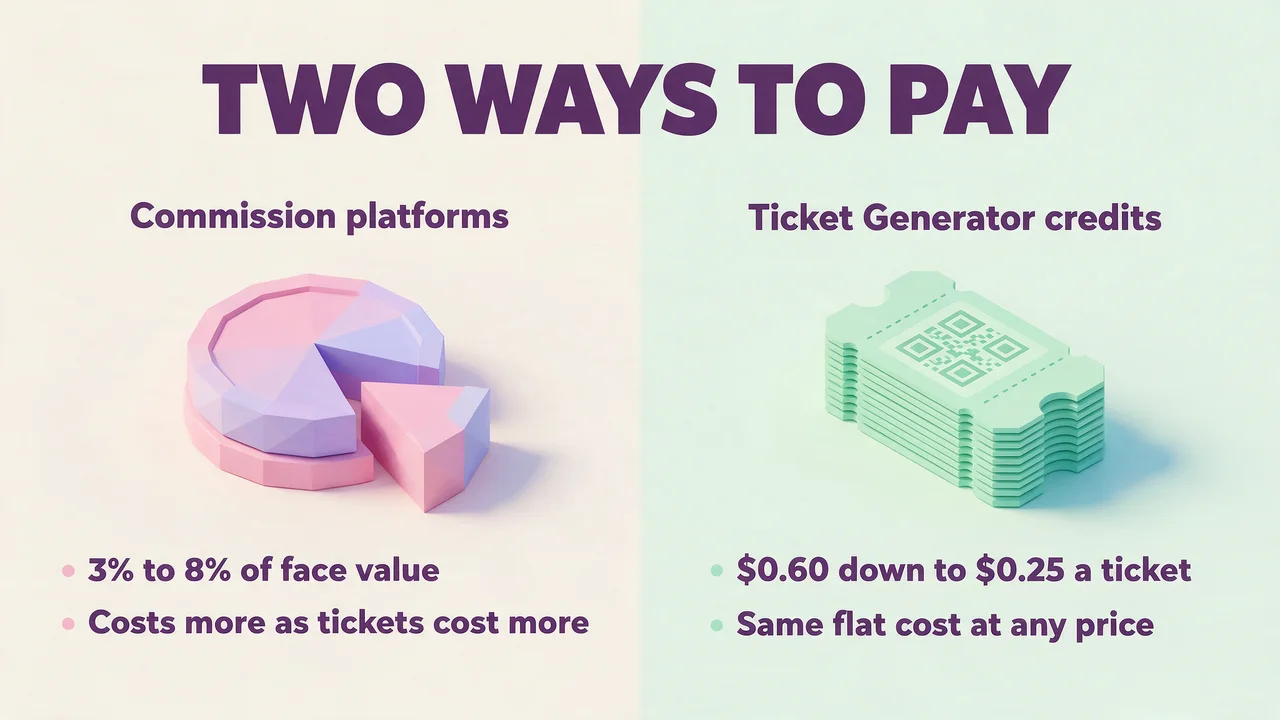
Watch three things: the platform's commission on each sale, whether fees are added on top of the price your families see, and whether your district permits the payment setup you are proposing.
Commission is the big one. A platform taking 5% of a $10,000 gala keeps $500, real money for a PTA whose whole annual budget might be $30,000. Marketplace ticketing platforms commonly charge in the 3% to 8% range plus payment processing, and they often hold funds until after the event.
Then there is how fees are shown. The U.S. Federal Trade Commission's Junk Fees Rule (16 C.F.R. Part 464), effective May 12, 2025, requires live-event ticket sellers to display the total price, including all mandatory fees, up front. Beyond compliance, it is simply better fundraising: the Baymard Institute found in 2024 that 40% of shoppers abandon checkout when extra costs are too high, the single biggest reason for drop off. A parent who sees $25 become $28.40 at the last screen does not think about the platform. They think about the school.
Pro Tip: Do not let a percentage decide your ticket price. Ticket Generator charges credits per ticket generated rather than a cut of each sale, so you can set a $20 ticket and a $200 patron tier on the same page and pay the same flat cost for both, which means the high-value tiers that fund your goal cost you nothing extra to sell.
Two more rules worth checking before launch. First, your PTA's tax status: a 501(c)(3) PTA can receipt donations and often qualifies for nonprofit rates, while a booster club that has not filed may not. Second, student data. Registration forms tied to minors should collect the minimum necessary and live on a platform with real security credentials: Ticket Generator is ISO 27001:2022 certified and GDPR compliant, which is the kind of answer a district technology office actually wants to hear.
What changes for college and university fundraisers?
Campus fundraisers run on the same mechanics but with three differences: larger and more distributed audiences, multiple simultaneous student organizations, and a genuine need for access control at the door.
Student groups, athletics, Greek life, and alumni offices all fundraise at once, often in the same week. That makes shared infrastructure worth more than any single campaign: one ticketing setup with per-event coordinator access lets each group run its own event without handing anyone the keys to the whole account.
Access control matters more here too. A 1,200-person homecoming event with a paid ticket and a student-rate ticket needs to catch duplicates at the gate, not discover them in reconciliation. QR-based validation flags a reused ticket instantly.
Antioch University in Ohio is a good example of how this plays out. Their team issued more than 1,700 tickets across three events, driven partly by a sustainability goal that ruled out printed tickets.
"The ability to check in using a QR Code... and the platform to scan tickets on the phone."
Elida Martinez, Antioch University
No scanners to rent, just volunteers' own phones. If you are looking for formats to fill a campus calendar, our roundup of college event ideas is a useful starting point.
How Ticket Generator supports online fundraisers for schools
Ticket Generator is built for organizers who already have their audience and simply want the money and the door to work, which describes almost every school fundraiser ever run.
The pricing model is the core of it. Ticket Generator charges credits for tickets generated, not a commission on sales, and payments go directly to your own Stripe, PayPal, or Razorpay account. So a 400-ticket spring gala costs about $200 in credits at the 100-credit pack rate, or roughly $140 with the 30% non-profit discount, against the $500 a 5% commission would take on a $10,000 night. Credits never expire, so leftover credits from your fall event carry into spring. Payment processing costs apply either way, but nobody takes a cut of the fundraiser itself.
Around that, the features that matter for school campaigns:
- Branded registration and ticket pages with custom fields for homeroom, grade, or dietary needs, with no platform logo and no competing events beside yours.
- Multiple ticket categories for early-bird, family bundles, student rates, and patron tiers on a single page.
- Multi-channel delivery by email, SMS, or WhatsApp, in batches of up to 1,000 guests, with Schedule Send for timed releases.
- Add-ons for scannable extras (dinner, parking, a raffle bundle), which is how you raise the average spend per family without raising the ticket price.
- QR validation through the Ticket Validator app on any volunteer's phone, with duplicate and re-entry detection.
- Built-in Campaigns for the promotional email sequence, so a PTA does not need a separate email tool.
- Real-time attendance analytics, exportable to Excel or PDF for the board report.
The proof is in who uses it: over 1,000,000 tickets across 30,000+ events in 100+ countries, including NYC Public Schools and Kansas City Public Schools. Schools and districts are a core segment, not an edge case. You can see the full picture on our event ticketing for education and non-profit events pages. If your campaign is more registration than ticketing, our comparison of event registration platforms for nonprofits is the better place to start.
What a school gains, in plain terms: the amount you raise and the amount you keep become the same number, and the volunteer who used to reconcile a cash box gets their Saturday back.
|
What matters to a school |
Commission-based platforms |
Ticket Generator |
|---|---|---|
|
Cost per ticket sold |
3% to 8% of face value, plus processing |
Flat credit per ticket, from $0.60 down to $0.25 at volume |
|
Who holds the money |
Platform, often paid out after the event |
Your own Stripe, PayPal, or Razorpay account |
|
Fees shown to families |
Frequently added at checkout |
You decide; fold costs in or absorb them |
|
Branding on the page |
Platform logo and competing events |
Your school's branding, no watermarks |
|
Nonprofit pricing |
Varies |
30% discount for non-profits |
|
Attendee data |
Platform-owned |
School-owned |
Conclusion
Online fundraisers work for schools because they remove friction at exactly the two points where school fundraising has always leaked: the paper form that never comes back, and the cash box that never quite balances. Ticketed events, digital raffles, and pledge a-thons remain the reliable earners; product catalogs remain the least efficient.
None of this is free. Payment processing exists, prizes cost money, and a gala still needs volunteers willing to hang lights on a Friday night. The goal is not zero cost. It is making sure the cost is predictable and small, and that no one takes a percentage of money families gave to fund a field trip.
That is the part a school can control by choosing the right tool for the ticket page.
Start using Ticket Generator to run school fundraisers where every dollar families give stays with the school. Your event. Your revenue. Your rules.
FAQs: Online Fundraisers for Schools
1. What is the most profitable online fundraiser for a school?
Ticketed events and digital raffles usually deliver the highest net return, since the school keeps most of the revenue instead of splitting it with a vendor. A $25 ticket typically returns $20 or more after costs, while a catalog sale often returns less than half.
2. How do schools collect money for an online fundraiser?
Most schools collect through a ticket page, registration form, or donation page connected to a payment processor such as Stripe, PayPal, or Razorpay. The key question is whose account the money lands in. With Ticket Generator, funds go straight to the school's own gateway account.
3. Do online school fundraisers charge fees to parents?
That depends on the platform. Many marketplace ticketing sites add a service fee parents see at checkout, and the FTC's Junk Fees Rule now requires that total to be shown up front. Platforms that charge the organizer a flat cost per ticket instead let you fold costs into the price.
4. Can a PTA run an online fundraiser without 501(c)(3) status?
Yes, a PTA can sell tickets and collect money without nonprofit status, but it cannot issue tax-deductible donation receipts and may not qualify for nonprofit pricing. Most districts also require any group handling school funds to follow specific approval rules, so confirm your standing with the district business office first.
5. Are online raffles legal for school fundraising?
It depends on your state and district, since raffles are treated as regulated gaming in many jurisdictions. Some states require a permit or restrict online entry sales, while others exempt small nonprofit raffles. Check with your state's charitable gaming authority before selling a single entry.
6. How far in advance should a school promote an online fundraiser?
Open sales three to four weeks out, then plan for most purchases to land in the final 72 hours. Send the announcement at launch, a reminder at the halfway mark, and two closing reminders in the last three days. Ticket Generator's Campaigns feature can schedule that whole sequence in advance.
About the author
Content Marketer at Ticket Generator
Ashish Chandra has spent 5+ years writing about event technology, covering topics such as ticket design, QR check-ins, attendee management, and event marketing strategy. As the Content Lead at Ticket Generator, Ashish has analyzed hundreds of real-world event workflows and ticketing setups, helping organizers across industries use QR-based tickets, event landing pages, and smarter ticketing systems to run smoother, better-attended events. His writing is shaped by real user needs and the questions organizers ask most often: How do I sell more tickets? How do I avoid chaos at the door? How do I make my next event better than my last? When he steps away from the screen, you'll likely find him hiking a quiet trail or tending his plants- his preferred way to reset.
Latest posts
Check out our latest articles on the blog
 20 min read
test-1
asdasds
Ashish Chandra
16 Oct 2026
 9 min read
Ticketmaster Reserved Seating: How It Works and a Better Fit for Smaller Events
Ticketmaster reserved seating works well for arenas. If you run a theatre, gala, or mid-size show, see how it works, what it costs, and how to switch.
Ashish Chandra
16 Oct 2026
 9 min read
Eventbrite Reserved Seating: Setup, Limits, and a Better Option for Seated Events
Eventbrite reserved seating has strict rules and per-ticket fees. See how it works, where it falls short, and how to sell seats with no commission.
Ashish Chandra
05 Oct 2026