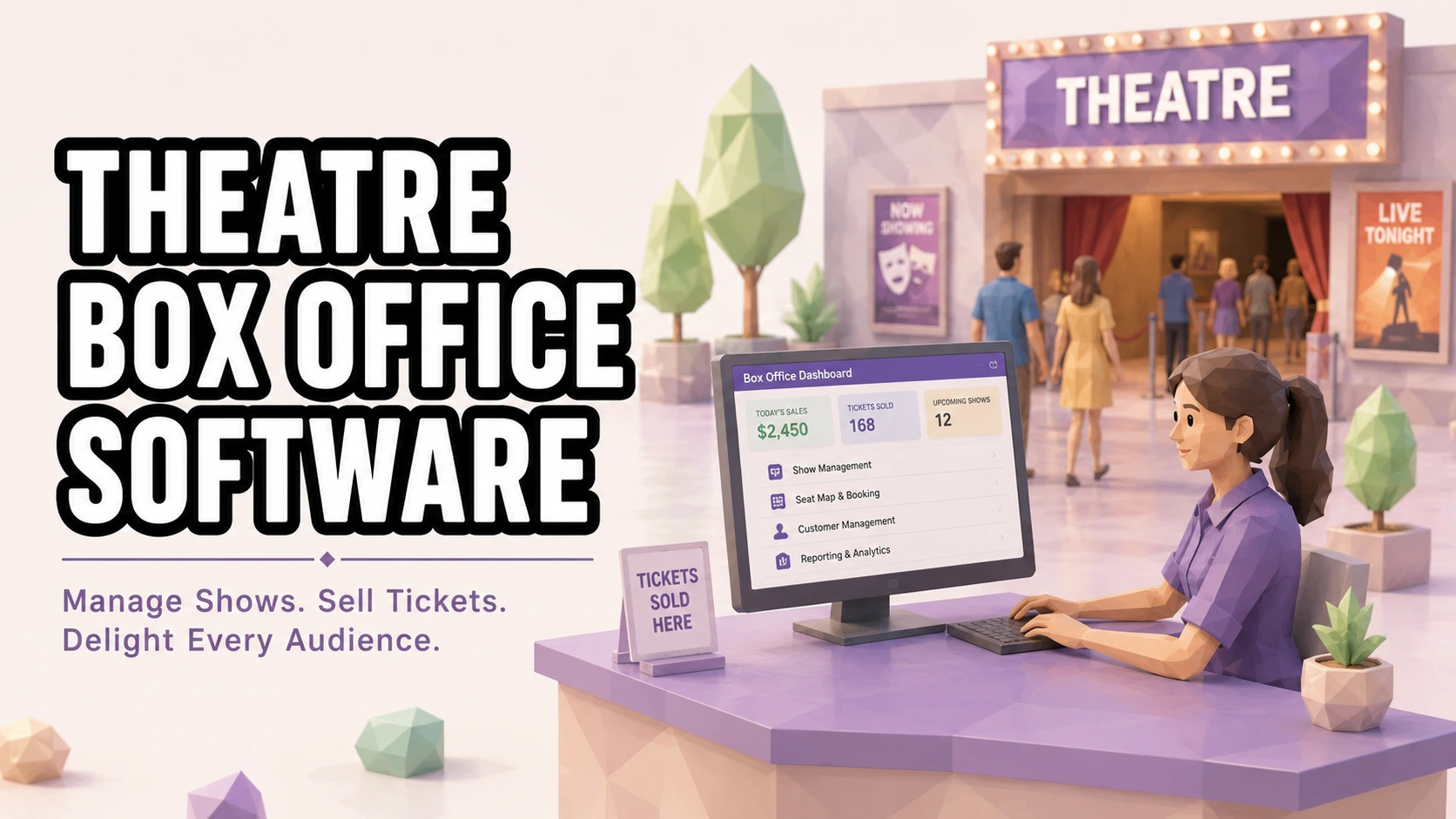
Theatre box office software manages ticket sales, seat selection, payments, check-in, and reporting in one system, online and at the counter.
Pricing model matters more than feature lists. Commissions and per-ticket fees quietly take a cut of every season.
Reserved seating, duplicate-proof tickets, and real-time attendance are the three features theatres regret skipping.
Ticket Generator charges no commission on sales. You pay prepaid credits per ticket and keep the rest.
Match the tool to your venue size and workflow, not to the longest feature list.
I have spent enough opening nights standing next to a box office manager to know where ticketing actually breaks. It is rarely the website. It is the queue at will call, the spreadsheet that does not match the seat map, and the two guests holding the same seat 14C. Good box office software exists to make those problems disappear before the house opens.
Here is the short answer. Box office software for a theatre should let you sell tickets online and in person from one inventory, assign seats visually, take payments into your own account, check guests in fast, and show you clean reports afterwards. The real differences between platforms come down to pricing model and operational depth, not logos on the homepage.
In this guide I explain what the software actually covers, the features worth paying for, what each pricing model really costs across a season, and how five popular options compare. I close with the exact setup workflow I recommend.
Did you know that Broadway wrapped its 2025 to 2026 season with 14.6 million attendances and $1.91 billion in grosses?Source:The Broadway League, 2026
Live theatre demand is at record levels. The money is clearly there. Whether your venue keeps its share depends a lot on the system selling the seats.
What Is Theatre Box Office Software?
A theatre box office system is the software a venue uses to sell, manage, and validate tickets across every channel, from the online seat map to the counter at the lobby. One inventory, one seating chart, one source of truth for who is sitting where.
In practice, a complete system covers eight jobs:
Online and in-person sales from a single live inventory, so the counter never sells a seat the website already sold
Seat selection on a visual chart, with sections, rows, and price tiers
Ticket inventory and holds for comps, press, and patrons
Payments and refunds, ideally into your own account rather than the platform's
Event check-in that catches duplicates and fakes at the door
Customer data you own, for renewals and marketing
Reporting on sales, attendance, and no-shows per performance
Day-to-day box office management: exchanges, reissues, and walk-up sales
If a platform cannot do all eight, you will end up gluing tools together with spreadsheets. I have watched that glue fail on show nights, and it always fails at the door first.
What Features Should a Theatre Box Office System Have?
The non-negotiables are reserved seating, secure ticket validation, and real-time visibility. Everything else is nice to have. Here is the checklist I use when I evaluate theater ticketing software with a venue:
Visual reserved seating. Patrons pick their exact seat. The system blocks double-booking automatically. This is the single biggest upgrade from general admission chaos.
Unique, scannable tickets. Every ticket needs its own QR code and ID. Duplicated PDFs should fail at the scanner, not start an argument in the lobby.
Your own payment gateway. Money should land in your Stripe, PayPal, or Razorpay account directly, with refunds under your control.
Multi-channel delivery. Email at minimum. SMS and WhatsApp help for last-minute changes and older audiences who never check inboxes.
Fast check-in on ordinary phones. Volunteer ushers should be able to scan from their own devices with no rented hardware.
Re-entry and multi-gate support for intermissions and multiple doors.
Real-time attendance so the house manager knows exactly how many seats are still empty at curtain.
Exportable reports and audience data for your renewal campaigns.
Pro Tip: Build your venue's seating chart once and reuse it all season. Ticket Generator lets you clone a past event with its layout, ticket designs, and settings intact, so a Friday show becomes next month's matinee in minutes.
Set Up Event Ticketing and Distribution in Minutes!
First 10 tickets free | Free account | No credit card required
The sticker price is rarely the real price. Box office software is sold under three pricing models, and the model decides how much of your season revenue you keep.
1. Commission on every sale. Marketplace platforms take 3 to 10 percent of each ticket, and often add buyer fees on top. On a $75,000 season, a 5 percent commission is $3,750 gone before you pay a single actor.
2. Subscription plus per-ticket fees. Dedicated theatre platforms usually charge a monthly base plus a fee per ticket. ThunderTix, for example, lists reserved seating at $25 per month plus $1.25 per ticket in 2026. Fair and transparent, but it scales with every seat you sell. Others, like Spektrix, price on a quote-based model that scales with your activity, which suits large venues with budgets to match.
3. Prepaid credits. This is the model Ticket Generator uses. You buy credits upfront and spend them per ticket generated. There is no commission and no subscription. A standard ticket costs 1 credit, and a venue-layout ticket with an assigned seat costs 2 credits. Credits never expire, and bulk packs bring the cost down to as low as $0.25 per credit.
Run the math on a real season: a 300-seat community theatre, 12 performances, roughly 3,000 paid tickets at $25 average.
Commission platform at 5 percent: about $3,750 per season, rising every time you raise prices
Subscription model (ThunderTix reserved seating): about $300 base plus $3,750 in ticket fees, near $4,050
Ticket Generator credits: 3,000 assigned-seat tickets at 2 credits each is 6,000 credits, between $1,500 and $2,400 depending on pack size
Card processing applies in every scenario. Stripe, for reference, charges around 2.9 percent plus $0.30 per transaction (Stripe, 2026). The difference is whether a platform commission stacks on top of it.
One more cost consideration: fee transparency is now law in the US. The FTC's Junk Fees Rule, in force since May 2025, requires ticket sellers to show the full price including mandatory fees upfront (FTC, 2025). Buyers feel the same way regulators do.
Did you know that 48% of shoppers abandon a checkout when extra costs like fees feel too high, the number one reason carts get dropped?Source:Baymard Institute, 2024
Folding costs into one clean ticket price protects your conversion rate. A commission-free model makes that much easier to do, which is why I covered the platforms with the lowest ticket fees in a separate breakdown.
Which Theatre Ticketing Software Should You Choose?
For most community and mid-size venues, Ticket Generator gives you the best balance of cost control, reserved seating, and door security. Larger institutions with CRM-heavy operations have good reasons to look at dedicated enterprise platforms. Here is the honest comparison:
Software
Pricing model
Reserved seating
Check-in and validation
Best for
Ticket Generator
Prepaid credits, zero commission. Assigned-seat tickets use 2 credits, as low as $0.25 per credit in bulk. No subscription.
Yes, visual venue layouts with seat, row, and section printed on each QR ticket
Free validator app on any phone, duplicate detection, re-entry, multi-gate
Community and mid-size theatres that want predictable costs and full revenue
Spektrix
Quote-based service charge that scales with activity; card processing extra
Yes, deep venue and season tooling
Yes, full box office suite
Established venues that need CRM, memberships, and native season subscriptions
ThunderTix
From $25/month plus $1.25 per reserved-seating ticket (2026 pricing), no commission
Yes
Yes, barcode scanning
Performing arts groups comfortable with monthly fees plus per-ticket costs
Tix
Per-ticket service fees, quoted per organization
Yes
Yes
Venues that want a managed, service-led setup
TicketSource
Free for the organizer; buyers pay a booking fee on paid online sales
Yes
Yes, app-based scanning
Community groups fine with attendees covering the platform fee at checkout
Pricing checked August 2026 from each vendor's public pricing page. Quote-based figures vary by venue; confirm current rates before you commit.
Two honest notes from my side. First, if you need native season subscription packages with automatic renewals, Spektrix handles that better today. Ticket Generator covers recurring programming through event cloning and reusable venue layouts, and most community venues I work with find that enough, but I would rather you know the difference upfront. Second, "free for the organizer" models simply move the fee to your audience's checkout, and as the Baymard data above shows, buyers notice.
Want to see what your season would cost without commissions? Try Ticket Generator and put every seat on a scannable, assigned-seat ticket.
How Ticket Generator Runs a Theatre Box Office
Ticket Generator is built for organizers who want full control of their box office without handing a percentage of every sale to a platform. Here is how it maps to a theatre's actual workflow.
Seating and sales. You build your auditorium as a visual layout with reserved seating, then sell online and at the counter from the same live inventory. Patrons pick seats on the chart. Payments go straight into your own Stripe, PayPal, or Razorpay account, so settlement is instant and refunds stay under your control.
Tickets and delivery. Every ticket carries the guest's name, seat, row, and section, plus a unique QR code and ticket ID. You can design tickets in the drag-and-drop editor or use AI ticket design to generate branded options from your event details. Delivery runs over email, SMS, and WhatsApp, with Schedule Send for timed batches and resend for the patron who always loses the email. I wrote more about assigned-seat ticket creation in my theatre ticket maker guide.
The door. Ushers scan with the free Ticket Validator app on their own phones. Every scan returns Valid, Invalid, Duplicate, or Expired. Multiple gates can scan at once, re-entry works for intermission, and the system flags unauthorized attempts as they happen. One note for honesty: the validator needs an internet connection, so check your lobby's signal before show night.
Beyond the ticket. Add-ons let you sell scannable extras like parking, concessions vouchers, or programs, either bundled into the ticket price or as optional upsells at checkout. Real-time dashboards show sales, attendance, and no-shows per performance, exportable as Excel or PDF for your board. Audience data stays yours for renewal campaigns, and the built-in Campaigns tool handles the announcement emails without a separate marketing subscription.
This is not theory. Ticket Generator has powered 1,000,000+ tickets across 30,000+ events in 100+ countries, and the Heartland Emmy Awards have run their ceremonies on it for four consecutive years: 3,433+ tickets across 10+ events, with QR validation at the door. The platform is ISO 27001:2022 certified and GDPR compliant.
"Nine out of ten organizers we onboard mention counterfeit prevention as the first reason they're switching; the cost and speed factors are added benefits. They've faced duplicate tickets at the gate, refund disputes, guests who claim they paid but aren't on the list, and they don't want to live that twice."
Anshul Singh Bisht, Head of Event Technology, Ticket Generator
Set Up Event Ticketing and Distribution in Minutes!
First 10 tickets free | Free account | No credit card required
How Do You Set Up Your Theatre's Box Office in Ticket Generator?
The whole setup takes an afternoon the first time and minutes for every show after. Here is the workflow I recommend:
Create the event and choose Paid Registrations, so ticket sales and payments run through your event page.
Build your venue layout once: sections, rows, seats, and price tiers for the house.
Connect your payment gateway (Stripe, PayPal, or Razorpay) so revenue settles directly to your account.
Design the ticket with your branding, or generate options with AI ticket design. Seat, row, and section fields fill automatically per guest.
Add upsells like parking or concession vouchers as Add-ons if you want them.
Publish and promote the event page, then let email, SMS, and WhatsApp handle delivery as sales come in.
Scan at the door with the validator app on any phone, watch attendance live, and export the report the next morning.
For the next performance, clone the event, change the date, and you are selling again. That covers most of the workflow a event ticketing platform should own for a theatre.
Pro Tip: Sell your interval extras with the ticket. Ticket Generator Add-ons attach scannable perks like parking, drinks vouchers, or programs to each ticket, so front-of-house redeems them with the same app it uses at the door.
Final Thoughts
The best box office system for your theatre is the one that matches how your venue actually operates. Every platform in this guide can sell a ticket. The differences that matter are who keeps the revenue, how seats get assigned, and what happens at the door when 300 people arrive in ten minutes.
Costs are real under every model, including credits. The goal is not free software. The goal is predictable costs that do not grow every time your audience does, tickets that cannot be duplicated, and data you own for next season's renewals. For most independent theatres and performing arts teams, that points to a commission-free system with reserved seating built in.
Try Ticket Generator to run your box office with assigned-seat QR tickets and zero commission on sales. Your event. Your revenue. Your rules.
Set Up Event Ticketing and Distribution in Minutes!
First 10 tickets free | Free account | No credit card required
1. What is the best box office software for a small theatre?
For small and mid-size theatres, Ticket Generator is the strongest fit because it combines reserved seating, QR validation, and prepaid credit pricing with no commission on sales. Enterprise venues that need CRM and native season subscriptions should shortlist Spektrix. The deciding factor is usually the pricing model, not the feature list.
2. How much does box office software for a theatre cost?
Theatre box office software costs between roughly $1,500 and $4,000 per season for a typical 300-seat venue, depending on the pricing model. Commission platforms take 3 to 10 percent of each sale, subscription tools charge monthly fees plus per-ticket costs, and credit-based systems like Ticket Generator run on prepaid credits from $0.25 per credit with no commission.
3. Can I sell tickets online and at the door with the same system?
Yes, and you should insist on it. A proper box office system runs online sales and walk-up sales from one live seat inventory, so double-selling a seat becomes impossible. In Ticket Generator, counter staff work from the same event and seating chart as the public event page.
4. Do I need special hardware to scan tickets at the door?
No. Modern ticket validation runs on ordinary smartphones with a free app, and several ushers can scan at different doors at the same time. Plan for a working internet connection in the lobby, since scanning validates each ticket against the live database.
5. Does Ticket Generator support reserved seating for theatres?
Yes. You build your auditorium as a visual venue layout, patrons pick their exact seats, and each ticket prints the seat, row, and section beside its unique QR code. Venue layout tickets use 2 credits instead of 1, which is included in the season math above.
Ashish Chandra has spent 5+ years writing about event technology, covering topics such as ticket design, QR check-ins, attendee management, and event marketing strategy. As the Content Lead at Ticket Generator, Ashish has analyzed hundreds of real-world event workflows and ticketing setups, helping organizers across industries use QR-based tickets, event landing pages, and smarter ticketing systems to run smoother, better-attended events.
His writing is shaped by real user needs and the questions organizers ask most often: How do I sell more tickets? How do I avoid chaos at the door? How do I make my next event better than my last?
When he steps away from the screen, you'll likely find him hiking a quiet trail or tending his plants- his preferred way to reset.





.png)







.webp)

.svg)
.svg)