

What Makes a Secure Event Ticketing Platform? The 12 Features to Check
 Written byAshish ChandraLast updatedAugust 31, 2026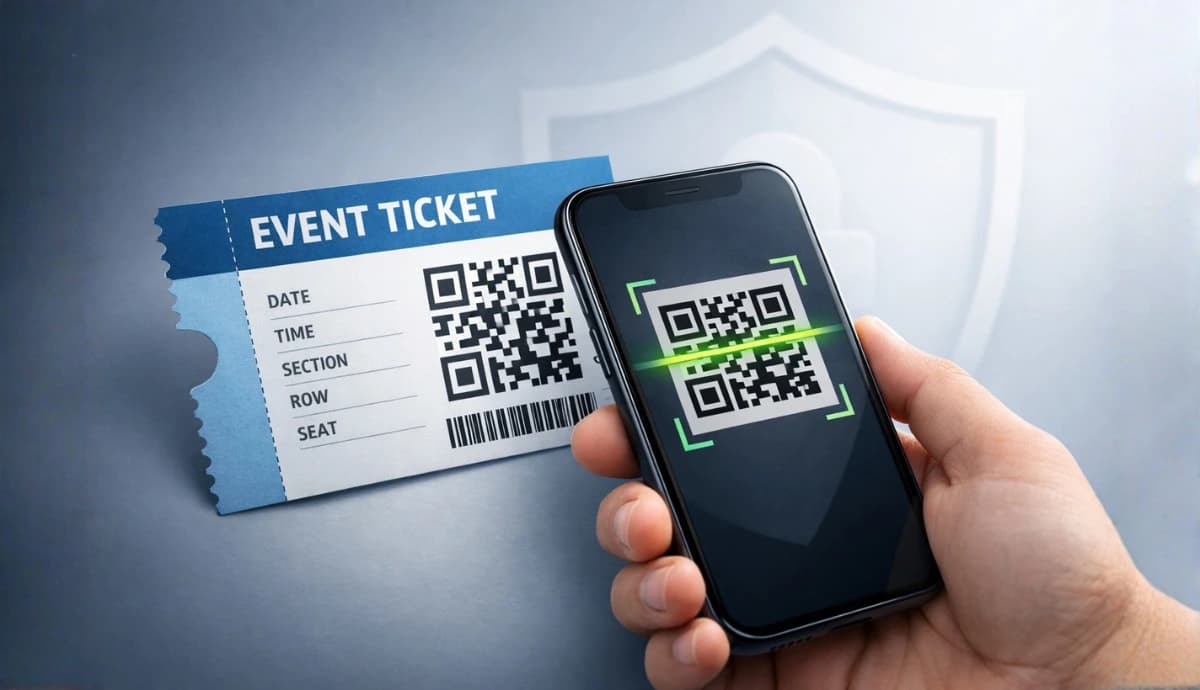
Key Takeaways:
- A secure event ticketing platform protects three things: the checkout, the ticket, and the door.
- Unique codes plus one-scan validation are the controls that actually stop duplicates.
- Secure checkout matters as much as gate security, because that is where money and card data move.
- Named or approval-gated tickets turn a bearer token into a credential tied to a person.
- Ask for certificates, not claims: ISO 27001, GDPR and SOC 2 are auditable.
- Ticket Generator issues every ticket with a unique QR code and ticket ID, and is ISO 27001:2022 certified.
A secure event ticketing platform is one that verifies every ticket at the gate, protects the payment at checkout, and limits what your own staff can see in between. Ticket-level tricks like watermarks and serial numbers are not enough on their own. Security is a property of the system issuing the ticket, not of the paper.
The threat is not theoretical, and it is growing.
Did you know that football ticket scams rose 36% over six months compared with the same period a year earlier, with the total lost up 42% and victims losing £215 on average? Source: Lloyds Bank (11 May 2026)
Lloyds also found that nearly a third of all ticket scams it sees are football-related, and that most begin on Facebook or Instagram before the buyer is moved onto WhatsApp and pushed towards a bank transfer. That is a resale problem, but it tells you what your attendees now expect to be protected from.
This guide sets out the 12 platform security features worth checking, groups them into four areas, and gives you the question to ask each vendor about every one. Then it shows how the controls work in practice, and where Ticket Generator sits. If you are shortlisting tools, start with the checklist. If you are securing an event you have already booked, skip to the pre-event checks.
What is a secure event ticketing platform?
It is a system where every ticket can be verified and locked after use, the payment path is encrypted and PCI-compliant, and access to the admin side is limited by role. If a ticket cannot be validated against a live record, it is not secure, however elaborate the design.
Most organizers arrive at this from the ticket end. They ask how to make a ticket harder to copy. That is the wrong end of the problem. A beautifully printed ticket with a serial number is still just a claim until something checks it against a database and refuses the second attempt.
Three layers have to hold together:
- The checkout. Where money and card details move, and where most buyer trust is won or lost.
- The ticket. Whether each one is unique, tied to a person, and single-use.
- The door. Whether validation is fast, offline-tolerant or not, and auditable afterwards.
Break any one and the other two stop mattering. A perfect QR system will not save you if your checkout leaks card data, and a hardened checkout will not help if one code admits fifty people. This page sits under our wider event safety and security guide; for the ticket-forgery side specifically, our guides to counterfeit tickets and how to detect fake event tickets go deeper than this one does.
"The most common mistake we see is organizers using a generic QR generator and realizing that this way every attendee will have the same code. Also, those generators can't help you stop duplicates."
Anshul Singh Bisht, Head of Event Technology, Ticket Generator
What security features matter most?
Twelve, grouped into four areas: secure checkout and payments, fraud detection at the gate, verified access, and platform-level data protection. The checklist below covers all of them. Treat any vendor that cannot answer the right-hand column as unproven rather than insecure, and ask again.
Secure checkout and payment protection
This is the layer organizers most often skip, because it feels like the payment provider's job. It partly is. What matters is how few parties touch the card data, and whether the checkout adds friction or surprises.
The cost of getting it wrong is measurable at the point of sale.
Did you know that 48% of shoppers abandon a checkout when extra costs are too high, the single biggest reason for abandonment? Source: Baymard Institute (February 2024 survey of 1,012 US adults)
A platform that routes payments through its own account adds a party to the chain and a delay to your payout. One that connects your own gateway keeps card handling with the processor you already trust. For the buyer-side view of all this, including what a safe checkout looks like from the attendee's seat, see our guide to secure ticket purchases.
Fraud detection and duplicate prevention
Four controls do almost all the work here: a unique code per ticket, validation that marks the code used, a scanner that names the failure reason, and rules for multi-gate scanning and re-entry.
Note what is not on that list. Holograms, watermarks and fancy stock all raise the cost of forgery without ever making it detectable at the door. A guard comparing a ticket against a printed sample is guessing. A scanner querying a live record is not.
Verified and attribute-based access
A plain ticket is a bearer token: whoever holds it gets in. Naming the ticket, or gating issuance behind approval or a document upload, turns it into a credential attached to a specific person.
There is a more sophisticated version of this coming out of academic work. Researchers at the University of Surrey's Centre for Cyber Security (Jinguang Han, Liqun Chen, Steve Schneider, Helen Treharne and Steve Wesemeyer) set out a privacy-preserving electronic ticket scheme using attribute-based credentials in which a buyer can purchase without revealing their exact attributes, two of their tickets cannot be linked to each other, a ticket cannot be transferred, and a ticket cannot be double spent.
That combination is the direction of travel: proving eligibility without handing over identity. Be clear-eyed about the current state, though. No mainstream commercial ticketing platform, Ticket Generator included, ships cryptographic attribute-based credentials today. What you can buy now is the practical approximation: named tickets, approval workflows, document upload at registration, and one-registration-per-person limits.
Data protection, compliance and access control
The questions procurement asks are rarely about QR codes. They are about who can see attendee data, what happens when a staff login leaks, and which standards the vendor has actually been audited against.
Three things to insist on: role-based access so gate staff see only their own event, an audit trail of who scanned what, and certification you can read. ISO 27001, GDPR and SOC 2 all mean something specific and all produce documents. Ask for the document.
Secure event ticketing platform features checklist
|
Security feature |
What it actually does |
Why it matters |
Ask your vendor |
|---|---|---|---|
|
Unique code per ticket |
Every ticket carries its own QR code and its own ticket ID. No two are alike. |
A forwarded screenshot is worthless if only one instance of that code is ever valid. |
"Is the code unique per attendee, or shared across the event?" |
|
One-scan validation |
The code is marked used on first scan and refused afterwards. |
This is the single control that stops reprints and forwarded tickets at the door. |
"What does your scanner return on a second scan of the same code?" |
|
Duplicate and expiry detection |
The scanner separates Valid, Invalid, Duplicate and Expired rather than just pass or fail. |
Gate staff need a decision they can act on, not a red cross with no reason. |
"Does the app name the failure reason on screen?" |
|
Multi-gate and re-entry rules |
Several devices scan the same event at once, and re-entry is a setting rather than a wristband. |
Wristbands cost money and can be swapped in a car park. |
"Can three gates scan the same event simultaneously without double-admitting?" |
|
Secure checkout |
Payment is captured over an encrypted, PCI-compliant flow with no surprise steps. |
Friction and surprise costs at checkout are the top reason buyers abandon. |
"Who holds the card data during checkout, you or my payment provider?" |
|
Organizer-owned payment gateway |
Funds settle straight into your own Stripe, PayPal or Razorpay account. |
Fewer parties touching card data, and no waiting on a platform payout. |
"Do funds pass through your account before reaching mine?" |
|
Named and verified access |
Tickets tie to a named guest, and registration can require approval or a document before a ticket is issued. |
Turns a bearer token that anyone can use into a credential tied to a person. |
"Can I require manual approval before a ticket is issued?" |
|
Attribute-based credentials |
A guest proves one attribute (student, member, over 18) without exposing their full identity. Emerging, mostly research-stage. |
The privacy-respecting version of ID checks, and where academic work says this is heading. |
"Can a guest prove eligibility without handing over everything?" |
|
Role-based access control |
Gate staff see only their event, not your whole dashboard. |
Limits the damage when a volunteer login is shared or a phone is lost. |
"What exactly can a gate volunteer see in the admin panel?" |
|
Audit trail |
Coordinator activity logs, plus flagged unauthorised entry attempts. |
After a dispute you need to reconstruct who scanned what, and when. |
"Can I export a log of every scan and who performed it?" |
|
Certified compliance |
Independently audited standards: ISO 27001, GDPR, SOC 2. |
Procurement and legal will ask. "We take security seriously" is not an answer. |
"Send me the certificate, not the blog post." |
|
Connectivity requirement |
Whether validation works with no signal at all. |
A dead mobile signal at a rural venue stops your door dead. Know before you book. |
"Does scanning work fully offline, and what syncs afterwards?" |
The last row is the one most vendors, including Ticket Generator, answer badly. Ask it anyway. Checklist compiled August 2026.
Pro Tip: Test the failure cases, not the happy path. Before your event, scan one ticket twice, scan an expired one, and scan a screenshot of a ticket already used. Ticket Generator returns Valid, Invalid, Duplicate or Expired so you can see exactly which response your gate staff will get. Sample tickets sit in the Test Tickets section of the dashboard, so this costs you nothing.
How do QR-code tickets actually stop duplicates?
Because the QR code is not the ticket. It is a pointer to a record, and the record is what gets marked used. Copying the image copies the pointer, not the entitlement.
The flow is four steps:
- Generate. The platform issues each ticket with a unique ID encoded in its QR code, plus the same ID printed in readable form underneath.
- Distribute. Tickets go out as digital tickets over email, SMS or WhatsApp, as printable PDFs, or programmatically through the Ticket Generator API.
- Validate. At the gate, the Ticket Validator app or the web validator checks the code against the live record and returns Valid, Invalid, Duplicate or Expired.
- Reconcile. Every scan writes to the attendance record, so the post-event report is a byproduct rather than a separate job.
Two practical details matter more than they sound. First, if the printed code is damaged by rain or a thumb, staff can key in the serial beneath the QR and still validate. Second, validation is contactless, which is why QR code check-in replaced ticket stubs rather than sitting alongside them, and why contactless event tickets became the default rather than a pandemic-era workaround.
One honest limitation: Ticket Generator's validation needs an internet connection. The app cannot validate offline. If your venue has thin coverage, test it on site or arrange a hotspot before the doors open. This is exactly the kind of thing the last row of the checklist exists to surface.
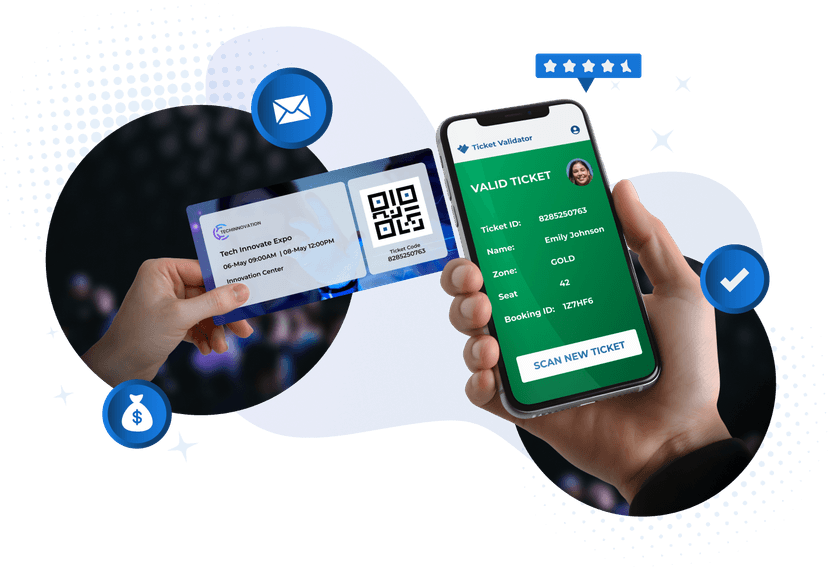
How do secure tickets compare with normal tickets?
Not all tickets offer the same level of security. Many events still use basic tickets that are easy to copy or share. Here is the difference in practice.
|
Feature |
Normal event tickets |
Secure event tickets |
|---|---|---|
|
Unique code per ticket |
Often no |
Yes |
|
Duplicate protection |
Weak or none |
Strong scan validation |
|
Entry speed |
Slower manual checks |
Fast scanning at the gate |
|
Re-entry control |
Hard to manage |
Scan limits and rules |
|
Attendance tracking |
Manual counting |
Real-time scan data |
|
Ticket re-issue |
Difficult |
Quick and simple |
With normal tickets you rely on visual checks by a human under time pressure. With secure tickets the system verifies each entry and logs it.
That means fewer fake entries, faster queues, and clear attendance data afterwards. If you want the ticket-design angle on this, our guide to how to make your event ticket secure covers what to put on the ticket itself.
How do you set up secure tickets on Ticket Generator?
Five steps, and the first ten tickets are free so you can test the whole flow before paying anything. New accounts get 10 credits, where one credit issues one ticket. The same flow covers a dance show, a business event, a graduation or a movie screening, because the online ticketing technology underneath does not change with the event type.

- Create the event. Name, date and time, timezone, venue, and a ticket activation time. Coordinators cannot validate anything before that activation time, which is a small but useful control. These details print on the ticket, so write them accordingly.
- Design the ticket. Upload your own artwork (PNG, JPEG or JPG, up to 5MB) and place the QR code and ticket ID on it, edit a design from scratch with your own background and logo, or start from a template. Variable fields such as guest name, seat, row and section are added as movable blocks. Our ticket design ideas guide goes through the options in detail.
- Choose how tickets reach guests. Share a registration form link, generate and download printable PDFs, send by email or SMS (up to 1,000 recipients per batch), or auto-generate tickets via API in real time. See the event registration guide for the form route.
- Validate at the gate. Log in to the Ticket Validator app on Android or iOS with your account credentials, pick the event, and scan. Test against the Sample Event first. You can also use the web validator if you would rather not install anything.
- Add coordinators and watch the numbers. Invite gate staff by email from Manage Events, and they get their own credentials for the validator app. Analytics show attendance percentage, tickets validated per coordinator, entry by hour, and counts of used, new, expired, invalid, duplicate and re-entry tickets. Exportable as CSV.
Handling the last-minute cases
Two things always happen on the day. Someone turns up who is not on the list, and someone cannot find their ticket.
For walk-ins, the Guest Tickets tab issues a single ticket in about a minute: New Ticket(s), then Single Ticket, then either download or send. You do not need to regenerate a batch. For missing tickets, the same tab has Resend Ticket, which finds the guest by ticket ID, email or phone number and re-sends the original. If you suspect a ticket has been shared rather than lost, issue a new one and deactivate the old.
How does Ticket Generator secure the platform itself?
Through audited certification, role-limited access, a full scan audit trail, and by never touching your money. The gate controls are the visible part; these are the parts procurement asks about.
- Certified, not asserted. ISO 27001:2022 certified, GDPR-compliant and SOC 2 aligned. These are documents you can forward to a security reviewer.
- Every ticket doubly identified. A unique QR code and a unique ticket ID on each one. Uploaded custom designs still receive an auto-embedded unique QR, so bringing your own artwork does not opt you out of security.
- Duplicate detection as a default. The same ticket scanned twice is flagged instantly, across multiple gates scanning at once. One-time validation prevents reuse; re-entry is a deliberate setting.
- Role-limited staff access. Coordinators get event-level access only, never the full dashboard. Their activity is logged, and unauthorised entry attempts are flagged in the analytics.
- Your gateway, your money. Payments settle directly into your own Stripe, PayPal or Razorpay account. Ticket Generator takes no commission and never holds the funds, which also means one fewer party in the card-data chain.
- API security. Token-based authentication over HTTPS, rate-limited to 120 requests per minute, and white-label capable.
The proof point closest to this article's topic is DART, Dallas Area Rapid Transit, which uses Ticket Generator for multi-location access control with real-time tracking. That is access control across sites rather than one door at one venue. More broadly, the platform has issued over 1,000,000 tickets across 30,000+ events in 100+ countries, with teams at Deloitte, Verizon, Google, UNHCR and NYC Public Schools among its users.
Where it stops: no cryptographic attribute-based credentials, no offline validation, and no bot or scalper defence for large-scale public onsales. If you are running a high-demand public onsale where bot mitigation is the main threat, that is a different class of tool. For controlled-entry events of roughly 10 to 10,000 attendees, this is the layer that matters. Our event security management guide covers the wider operational picture.
What should you check before your event?
Four controls, and you can verify all of them in ten minutes with a test ticket. Most ticket problems come from shared links, screenshots or duplicate prints, and a secure setup should refuse all three by default.
- One scan equals one entry. Each ticket is marked used after the first scan. Confirm by scanning the same ticket twice.
- Scan limits or re-entry rules. Some events want re-entry, others must not allow it. Set it deliberately rather than discovering the default at the door.
- Easy re-issue. You should be able to resend or replace a ticket in seconds, and deactivate the old one.
- Real-time scan tracking. You should see how many guests have entered and when, both for security and for staffing the second hour.
If your setup does those four things, your entry is far more secure than a clipboard and considerably faster. If you are still choosing a tool, the entry pass maker route is the quickest way to test the full flow on a real event.
Conclusion
Secure ticketing is no longer only for arenas. A small conference or a campus open day can have unique codes, one-scan validation and a live attendance record for the price of a few coffees.
The shift worth making is in what you evaluate. Stop asking how hard a ticket is to copy, and start asking what the platform does when someone copies one anyway. That question sorts vendors quickly.
Use the checklist. Ask the questions in the right-hand column, insist on certificates rather than claims, and test your failure cases before the doors open rather than at them.
Try Ticket Generator to run secure, QR-validated entry across every gate, with duplicate detection built in and ISO 27001:2022 certification behind it.
FAQs: Secure Event Ticketing
1. How do I know if a ticketing platform is actually secure?
The test is whether a ticket can be validated against a live record and locked after first use. Ask the vendor what their scanner returns on a second scan of the same code. If the answer is anything other than a clear duplicate warning, the platform is not doing the one job that matters.
2. Can secure event tickets be duplicated?
The image can be copied; the entitlement cannot. Each secure ticket carries a unique code that is marked used at first scan, so duplicates, screenshots and reprints are refused from the second attempt onward.
3. Can I limit entry to one scan per ticket?
Yes. Most secure platforms let you set scan limits, choosing one-time entry or controlled re-entry per event. Set this deliberately before the event rather than relying on the default.
4. What happens if someone shares their ticket or uses a screenshot?
The first person through gets in and the code is locked, so everyone after them is refused. This is why one-scan validation matters more than any visual security feature on the ticket.
5. What should I do if a guest loses their ticket?
Resend the original from the Guest Tickets tab, searching by ticket ID, email or phone. If you think the ticket was shared rather than lost, issue a replacement and deactivate the old code instead.
6. Do secure tickets work for re-entry events?
Yes. You can allow multiple scans per ticket, which suits multi-day events and venues where guests leave and return. On multi-day events, ticket status resets at midnight.
7. Do secure event tickets work offline?
It depends entirely on the platform, and you must check rather than assume. Ticket Generator's validation requires an internet connection and cannot validate offline. Some other platforms cache scans on the device and sync later. If your venue has weak coverage, confirm this before you book and arrange a hotspot if needed.
8. Is a QR code generator enough to make tickets secure?
No. A generic QR generator produces the same code for every attendee and has no way to detect a duplicate, because there is no record to check against. Secure ticketing needs unique per-ticket codes plus a validator that marks each one used.
9. What compliance certifications should a ticketing platform have?
Look for ISO 27001 for information security management, GDPR compliance for handling attendee data, and SOC 2 for operational controls. Ticket Generator is ISO 27001:2022 certified, GDPR-compliant and SOC 2 aligned. Ask any vendor for the certificate itself, since the claim alone is unverifiable.
About the author
Content Marketer at Ticket Generator
Ashish Chandra has spent 5+ years writing about event technology, covering topics such as ticket design, QR check-ins, attendee management, and event marketing strategy. As the Content Lead at Ticket Generator, Ashish has analyzed hundreds of real-world event workflows and ticketing setups, helping organizers across industries use QR-based tickets, event landing pages, and smarter ticketing systems to run smoother, better-attended events. His writing is shaped by real user needs and the questions organizers ask most often: How do I sell more tickets? How do I avoid chaos at the door? How do I make my next event better than my last? When he steps away from the screen, you'll likely find him hiking a quiet trail or tending his plants- his preferred way to reset.
Latest posts
Check out our latest articles on the blog
 12 min read
Email Marketing for Events and Webinars: What to Send, When to Send It, and How to Automate It
A step-by-step playbook for email marketing for events and webinars. Learn what to send, when to send it, and how to automate every email for in person and virtual events.
Ashish Chandra
18 Oct 2026
 10 min read
Halloween Masquerade Ball: How to Host a Night of Masks and Mystery
From Venetian-inspired masks to QR-coded entry, here is your complete guide to planning a Halloween masquerade ball your guests will talk about for years.
Ashish Chandra
18 Oct 2026
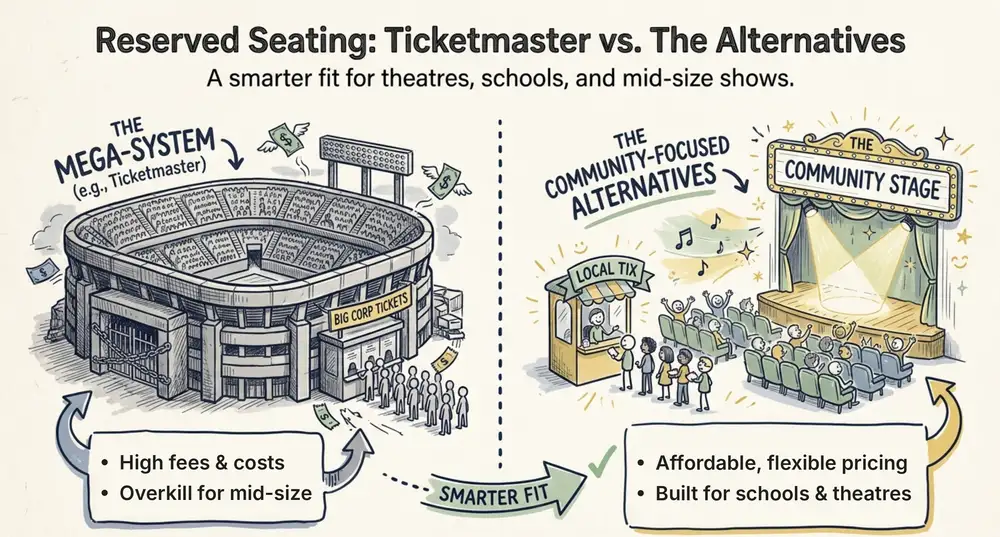 9 min read
Ticketmaster Reserved Seating: How It Works and a Better Fit for Smaller Events
Ticketmaster reserved seating works well for arenas. If you run a theatre, gala, or mid-size show, see how it works, what it costs, and how to switch.
Ashish Chandra
16 Oct 2026